
Meet the New AHA Staff Member: Kevin Jagoe
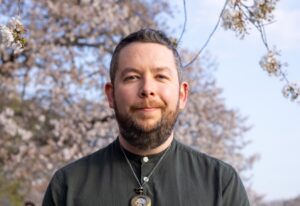
Get to know the AHA Education Center’s new director, Kevin Jagoe!
What is your educational and work background?
I’ve been a student most of my life. I attended college at Hamline University in Saint Paul, MN and while I was there I majored in Anthropology, Criminal Justice and Forensic Science with minors in Biology and Psychology. Many times I am asked what I learned through this broad array of Liberal Arts coursework. Beyond the common, though true, answers of critical thinking, academic skills, and personal development — I would say I began to learn about human beings and what makes us tick: from the cellular to the societal. I was able to appreciate the ways we function and dysfunction biologically, socially, and psychologically as well as the ways we work well together and hurt each other in groups, families, and our broader society.
Next, I completed a Certificate in Humanist Studies and Leadership through The Humanist Institute (which would later merge with the AHA to become the Center for Education). Then I returned to Hamline University for a Master of Arts in Nonprofit Management. I followed that up with a Master of Divinity from Meadville Lombard Theological School in Chicago. I am currently in what I believe will be my final degree program at United Lutheran Seminary in Philadelphia where I am in the final stage of my Doctor of Ministry. The working title for my final research is Navigating the Practiced Life: Drawing a Constellation of Practices for Non-theists.
My career has focused on building community, helping nonprofits achieve their missions, and reflecting with people on shared identity. I’ve worked at a Hillel, my alma mater, multiple Unitarian Universalist congregations, and with Humanist organizations as well. I’m both an ordained Unitarian Universalist minister and Humanist Chaplain. I’ve also been fortunate to teach graduate courses about Humanism, contribute to books on the subject, and work with people in discernment about how to work professionally in identity-based movements.
How did you first learn about humanism?
I discovered Humanism in college. I learned about Humanism from the college chaplain and through coursework in religion. I learned about the AHA not long after that and joined as a member in 2009.
Did you grow up in a traditional religious faith? How did it impact you?
I grew up nominally Lutheran, though my family was really inconsistent about how involved we were in the church. I was baptized and confirmed as a Lutheran though. In fact, my Confirmation class is what confirmed I was an atheist and was the end of my formal participation in Christianity. I believe the Confirmation process worked in the sense of answering whether I was Lutheran/Christian, though the answer was not appreciated by several people in my family and church.
My family had people from many religious traditions: Lutheran, Catholic, Jewish, Jehovah’s Witness, which led me to be curious about religion in many ways even as I rejected much of the core teachings. This curiosity has shaped much of my life and career as an adult.
What interested you most about working for the American Humanist Association?
I’ve been in the orbit of the AHA for almost 20 years. I feel that this organization has a unique place in American society, particularly in our current political era. When Kristin Wintermute announced her retirement, I saw a way to bring together many pieces of my career and interests into one place with one organization. It was an opportunity I couldn’t let slip by without applying.
What book has influenced you the most?
“The Eye of the World” by Robert Jordan, the opening lines of which are… “The Wheel of Time turns, and Ages come and pass, leaving memories that become legend. Legend fades to myth, and even myth is long forgotten when the Age that gave it birth comes again.”
Through the many, many pages of this book and The Wheel of Time series it begins, I began to understand in junior high how all the religions of the world are human stories told and retold and changed over time and due to circumstances to meet human needs.
If you could have dinner with any three people in the world (living or dead), who would they be and why?
My favorite author Robert Jordan, my favorite poet Mary Oliver, and Octavius Brooks Frothingham – a 19th century Unitarian minister and non-theist who helped found the Free Religious Association. In many ways, these three people represent three major influences on who I am today and the ways fantasy, art, and religion are always interwoven.