
An Intimate Look at the Life of Thomas Jefferson in This Anniversary Year
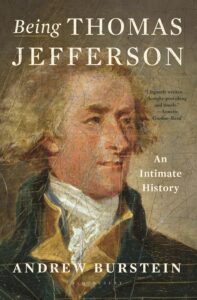
“Being Thomas Jefferson: An Intimate History”
Book by Andrew Burstein
New York: Bloomsbury Publishing, 2026
480 pages, $33.00
Over a long life encompassed by countless books while a student, professor or a researcher, it is only “once in a blue moon,” this reviewer encountered a magnificent book. One such is Andrew Burstein’s latest, “Being Thomas Jefferson: An Intimate History.” I can only sing praises of this monograph. I had difficulty putting it down. This poignant book is a must read for those wishing to learn more about the author of several significant achievements that still ring the cause of freedom in the United States of America. Particularly in this 250th anniversary year of Jefferson’s Declaration of Independence, “well-armed with pulsating phrases,” one should spend time getting reacquainted with this man of particular talent and devotion to the cause of liberty. It is also the 200th anniversary of Jefferson’s death. Between these two anniversaries lie a testament to greatness, and devotion to his country. There are numerous history book offerings in this anniversary year, but surely this book stands apart from many others.
From time to time there appear books which I would have used in college/university teaching. This is surely one of them, especially for undergraduate American history classes focusing on the Revolutionary and early national periods. This book speaks loudly to all those years, with wisdom and appreciation for those who gave their lives and fortune to see the birth of a new nation freed from the bonds of another. This is a book which an undergraduate or graduate should read and, more particularly, digest. It is certainly also an exemplary book for the general reader. In many ways it is a call to action.
Burstein has written an honest portrayal of Jefferson’s personality, not showering him with adulation nor demeaning his missteps and flaws. He describes the beauty and dignity of Jefferson as American president, coming at a time when such traits are even more glaringly absent in the present incumbent. Whether intended or not, such comparisons are implied in several passages in the book. For example, Burstein quotes 19th century historian Henry S. Randall who wrote this about Jefferson’s personality: “There was a sympathy between his heart and the great popular hearts of which nothing ever did, ever can, shake.” What a contrast.
Andrew Burstein recently retired from a long career at the Louisiana State University, Baton Rouge, where he was the Charles P. Manship Professor of History. He is the author of twelve previous books, including 6 on Jefferson. His books have received praise in many distinguished periodicals. As a noted Jefferson scholar, he serves on the advisory board of the Papers of Thomas Jefferson. He has consulted on several documentary films, especially in Ken Burns’ PBS feature on Jefferson. He is also a frequent opinion writer for national news outlets. Burstein received his Ph.D. in U.S. history from the University of Virginia.
The book contains a long introduction and 13 chapters divided into four major parts, each detailing specific periods in Jefferson’s life, plus two appendix sections followed by approximately 80 pages of end notes and a very respectable index. Among the most significant elements of Bernstein’s book are (1) the thoroughgoing evaluation of Jefferson’s personality, essentially a detailed focus on the humanity of the man; (2) a loving portrayal of Jefferson’s devoted wife, Martha Wayles Jefferson, who he called Patty; (3) a detailed focus on Jefferson’s most significant works: Notes on Virginia, the Statute of Virginia for Religious Freedom, the Declaration of Independence, The Jefferson Bible, and his First Inaugural Address; (4) his close relationships with his friends, especially Dabney Carr, James Madison, James Monroe and his distinguished mentor George Wythe; (5) Jefferson’s attitudes toward enslaved people, especially those at his adored mountain-top home, Monticello, near Charlottesville, Virginia, his special refuge and glory spot which embellished his attitudes toward growing the new republic while likewise growing plants and raising animals; (6) Jefferson’s adoration of his children and grandchildren, especially his two daughters who survived into adulthood; (7) Jefferson’s views on non-supernatural religion formed from his classical humanist education; (8) his founding of the Enlightenment-focused University of Virginia; and (9) last but not least, Jefferson’s relationships with his enslaved concubine Sally Hemings and the Hemings family.
Burstein is a master storyteller and describer of people and their character, in addition to their physical appearance, personality, their opinions and values. Such is the meticulous description Burstein makes of Jefferson the man: his height, his voice, his eyes, hands and general demeanor both in private and in public. The author, in his introduction says, “This book is about the extraordinary drama that punctuated the life of a famous man who had an unusual need to control his environment.” Burstein successfully characterizes Jefferson as a complicated man, although essentially an introvert, but notes especially Jefferson’s great love for his books which comprised the largest library in colonial America. Also, Jefferson’s enormous attachment to letter writing gives the researcher a vast trove of information about the man and his correspondents. Burstein’s task in writing this book was to write an intimate history, which he calls “a formidable summons, because any approach to historical biography is autopsy, not a two-sided conversation.”
“Being Thomas Jefferson” describes Jefferson’s drive for public celebrity that he “scrupulously hid.” The book examines both the public versus the private man, and his expectations from the citizens of the republic, as he saw it and them. Burstein makes it clear that most modern Americans insufficiently grasp just how much Jefferson did to shape a new American vocabulary and give birth to an American cultural identity. Jefferson was a bold thinker, gifted writer, a humane philosopher and a champion of liberty who “embodies the American ideal.” But he was also a stubborn and reactive man, often unwilling to reconsider any prejudice even when contradictory evidence was given to him. This was particularly glaring on the issue of slavery.
As to new information and characterizations of Jefferson, Burstein entered untrodden areas of inquiry and revisited relationships that have been largely undervalued in the past. The author argues against his book as being a trap of presentism, and as such therefore tries to understand Jefferson’s thinking in the context of over 200 years ago. Assessing past efforts at analyzing Jefferson’s mind, Burstein brilliantly teases out various truths about Jefferson’s inner life. Burstein writes Jefferson “was not modern” and that he “does what he can to leave history guessing.” He was “a secretive individual, for the most part.” What better characterization of a brilliant mind who had an overarching passion for the preservation of the new country’s history but a fear that citizen memory loss could be detrimental to nationhood. Jefferson wanted more than anything else to wish for future generations to see him as “an enlightened compassionate friend of humanity.” Again, throughout this fine book is Burstein’s strong effort to exit the debate over Jefferson’s attitudes to slavery and to advance historical knowledge without “prescriptive politics.” Burstein wants not to promote or debase, but to explain the man Jefferson with the tools of the historical archive of evidence, all of it.
Burstein writes multiple pages on Sally Hemings, Jefferson’s enslaved concubine and her family. Most of his survey resonates with Annette Gordon-Reed’s crucial books on the Hemings family, with special emphasis on Sally. Burstein points out the emotional side of Jefferson and Sally’s relationship as unknown, except for sketchy passages her son wrote years later, and what was carried down through generations of Hemings descendants to this day. Burstein has focused his research on the collections of Jefferson’s papers and numerous monographs on his life, especially the writings of the renowned 20th-century Jefferson historians Dumas Malone and Merrill Peterson, in addition to the latest research by Annette Gordon-Reed and Peter Onuf.
The most impressive parts of this book are those echoing strong human emotions, e.g. the gripping discussion of a square scrap of paper on which Jefferson and his wife shared their love with the lines from Laurence Sterne’s novel of the 1760s, “Tristram Shandy.” “Time wastes too fast: every letter I trace tells me with what rapidity life follows my pen, the days and hours of it are flying over our heads like clouds of windy day never to return.” There was such a great love between Jefferson and Martha and Burstein captures that so beautifully, especially those passages concerning Patty’s death.
There were several items Burstein emphasized in this book that were new and eye-opening. One concerned Jefferson’s first inaugural address which he delivered on March 4, 1801. Burstein writes that his address was the most important speech of Jefferson’s life. This address “has yet to be improved upon as a moral declaration, attesting to America’s unsullied, incorruptible self-image.” It presents Jefferson “as a man at peace, tolerant of difference, rhapsodically engaging with the natural world. A fertile land unleashes fertile imaginations. Young and vigorous, the United States will only get bigger and better.” Here, Burstein perhaps implies differences of this man and the times from the present occupant of the White House and administration. Jefferson did not at all appreciate heavy-handed autocrats anywhere.
Equally so, Burstein’s recounting of the deaths of Jefferson’s two eldest daughters, in addition to the death of his dearest friend Dabney Carr and Jefferson’s own death at his beloved Monticello at the very long life of 83, almost ancient in those days, demonstrate great sensitivity. But for all his love and praise for those who were allies of his, Jefferson, on the other hand, had an extreme dislike for Alexander Hamilton, the irascible Secretary of the Treasury, ardent Federalist and quasi-monarchist. He also was wary of his first Vice President Aaron Burr’s trustfulness and deviousness. He strongly detested the Supreme Court Chief Justice John Marshall. Nevertheless, Jefferson was, to use Winston Churchill’s phrase in reference to Russia in 1939, “a riddle, wrapped in a mystery, inside an enigma.” But this only makes Jefferson more human, more fascinating and more a candidate for extensive psychological examination in Burstein’s book. There are “certainly many more unresolvable questions than there are like answers” in this famous man’s life, but Burstein has done a splendid job in at least seeking answers.
This compelling book offers very much to readers in understanding the intimate mind and history of one of the foremost Founders of the United States of America. In a time, at the 250th anniversary of Jefferson’s Declaration of Independence, a time when aspects of our country’s political makeup bear a distorted, misinformed agenda of spreading false teachings and perverted notions of various aspects of our country’s original values and place in a new world order, it is quite the time for as much exposure as possible. This book tells truth and explains the values of one of our country’s greatest Founders and their hopes, ideals and aspirations for the future.