
Dinosaurs, Chalk Cliffs, and Me: My Life As a Garden
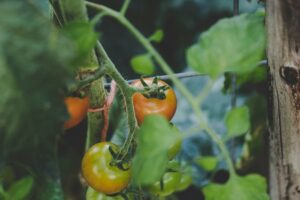 Photo by Stella de Smit on Unsplash
 My raised bed at Hogge Park measures six feet by 18. Bigger than a coffin. Not by much.
A metal fence runs along one side of it — put up, in roughly equal measure, to keep out deer and non-gardeners. Close enough to touch if the fence weren’t there is a Greek Orthodox church, its dome catching the morning light while I stand at the bed pulling the rare weed that manages to take hold. They do resurrection over there — incense, icons, a body that doesn’t stay dead. I do mine over here, with a trowel and a bag of composted leaves, and mine takes all season and ends every fall in a heap of black rotted matter that doesn’t look like resurrection at all. It looks like the floor of a well-shaded forest — dark, loamy, unremarkable — the kind of ground you’d walk across without a second thought, never guessing what it’s about to become.
Hogge Park sits in suburban Washington, barely a mile from the spot where Abraham Lincoln once rode out to review the Union troops massed around the capital — young men by the thousands, many of whom would be dead within the year, and violently. The ground hasn’t moved. Only what’s standing on it has changed, over and over, for 160 years.
* * *
Here is what the garden knows that took me 83 years to catch up to: Nothing in that bed is ever really new material. The nitrogen in this year’s tomato was in last year’s squash fruit, and before that in someone’s grass clippings, and before that in a lawn, and before that in whatever the lawn’s own dead matter used to be. The bed doesn’t manufacture anything. It only rearranges what’s already there, over and over, into whatever happens to be growing this particular season.
I am no different, and neither are you. The carbon in your hand was forged in a star that exploded before the Earth existed. The calcium in your bones may have been part of a dinosaur, a redwood, a glacier, a Roman soldier’s own bones, dissolved and scattered and gathered up again. Nothing here was made for you. It was borrowed — the way this year’s pepper borrows last year’s dried corn stalks.
The White Cliffs of Dover are not, strictly speaking, cliffs of stone. They are cliffs of the dead — a hundred meters of chalk built almost entirely from coccolithophores, single-celled organisms too small to see, each one leaving behind a microscopic shell when it died, over tens of millions of years, until the shells alone were enough to hold up England’s coastline against the sea. Stand at the edge of that cliff and you are not standing on rock. You are standing on countless small former lives, compressed and whitened and mistaken, from a distance, for geology. Coal is the same arrangement, differently disguised — compressed forest instead of compressed shell, ferns and horsetails from 300 million years ago waiting out the same kind of stretch of the Earth’s history for their turn. Burn it, and you are watching a very slow cremation finally finish its work.
And someday, if the arrangement holds long enough undisturbed, some of what is presently me may do the same thing in reverse: settle, compress, mineralize and become someone’s future cliff face, or someone’s future coal seam, dug up by whatever comes after us and burned for whatever they’ll need burning for. I will not be here to mind. The calcium had only ever been on loan to me in the first place, the way it was to the coccolithophores, the way it was to the ferns. Their turn is long since over. Mine will be too, eventually, and then it will be someone else’s turn to stand on top of what’s left of me and call it ground.
The tomato is not passive in this either. It takes that nitrogen on loan and builds itself with it — leaf by leaf, vine by vine, into a shape nothing else in the bed will become. I do the same with what has been lent to me. Every year in this bed I decide what goes where, stake the vines, thin what’s crowding, pull what doesn’t belong — and a life is the same work, done to yourself instead of to a garden. You are not the atoms any more than the tomato is the nitrogen it was given. The shape is what matters — what got built out of them, the arrangement, the thing that stood up out of the ground and answered to a name.
* * *
I ran a 51-second quarter mile at 22. Almost none of the atoms that ran that race are still in me. New ones have taken every place the old ones vacated — some in days, some in years, only tooth enamel holding out close to unchanged from the start. And yet something continued anyway — the pattern, maybe, or just whatever holds together while the atoms rotate through and nobody’s watching.
We spend a life building that thing, mostly without noticing we’re doing it. And the building, like the garden, is never finished by choice. It is finished by frost.
* * *
The bed doesn’t hold one crop all year. It holds a sequence.
Late winter, while the ground is still hard in the mornings, I put in the brassicas and the frost-hardy greens and roots — the ones that don’t mind a cold snap, that can sit in the ground through a freeze and keep going. They come up slowly at first, then all at once, the way things do.
Tomatoes, peppers and squash don’t go in until the frost has actually passed, not just seemed to. A late frost can take all three of them out overnight, the way certain things only have to happen once, early, to end everything that would have come after. I’ve learned to wait longer than I want to.
By midsummer the bed is thick — vines climbing, fruit setting, the smell of tomato leaf on my hands whether I mean to touch them or not. This is the bed at its fullest, everything in it working at once.
I put in liberal amounts of peat moss and compost, especially that first year, until the soil turned rich and friable — loose enough that any weed that manages to take hold comes up with an easy tug, roots and all, hardly a fight in it. Once the garden fills out, my own plants cover the bed so thoroughly that whatever weeds do sprout are already weak, shaded out, no match for what I planted on purpose. By late summer the bed becomes that same forest floor I mentioned earlier — dark, loamy, unremarkable — except this time there’s nothing hidden about it: scrape the surface anywhere and you’ll find worms and other small creatures already at work, aerating what I’ll need again next year, doing it for free, all winter, without being asked.
Then, right about now, in mid-July, I put in another wave of brassicas — the same frost-hardy varieties as the ones I started with in late winter, planted again while the summer crop is still going strong around them. These new ones will outlast everything currently in the ground. They’ll still be producing in December, in weather that would have killed the tomatoes weeks earlier, holding on well past the point where anyone would have expected a garden to still be giving something back.
Not every planting gets that kind of ending. Most of what fills this bed will be gone by the first hard freeze, spent, pulled, composted — finished not because it failed but because its season simply ran out. A body works the same way, on a much longer clock but the same principle: Some things in it hold on stubbornly, past the point anyone expected, and some things quit early, and there is rarely much justice in which is which.
The senses go first, usually. Things that used to be sharp go soft at the edges — hearing, taste, the quickness of recovery after effort, the small daily pleasures that used to arrive without any work to get them. For a while you compensate. You adapt around what’s failing, the way a gardener works around a bad season, an early freeze, a plant that isn’t coming back. Some years you can still coax a harvest out of a bed that’s clearly past its best years. Then some years you can’t, no matter what you do.
Janet and I had known each other since 1971 — two Hoosiers loose in Washington, both of us out of the same small college in Indianapolis, years apart but claiming it as common ground anyway. In December 2010, in her nineties by then, she caught my arm as the congregation filed into National Cathedral for the Christmas service and asked me, quite plainly, to help her find the pills to end her own life.
My own feeling is that what she wanted wasn’t more time. She wanted to still be standing in whatever time was left — not sedated through it, not deferred into another treatment, another year extended rather than lived. That’s not wanting to die. It’s wanting the last harvest to still be a harvest you’re standing in.
* * *
Eventually the bed goes to compost. Not tragically — that’s simply the next stage of the same process that grew the tomato in the first place. What was built gets taken apart. Where the material goes next, I’ve already said enough about — back into circulation, eventually into something else’s turn to hold. What actually ends is narrower and stranger than the material’s fate: it’s the arrangement itself, the particular pattern that stood up out of the ground for 83 years and answered to a name, opinionated about tomatoes and Lincoln and limestone. Nobody scatters a pattern. It just stops being built — the way a garden stops being a garden the day nobody comes back to tend it. The ground stays. The material stays too. Only the tending stops — and that’s the part that was ever really you.
That is not nothing. For 83 years and counting, a great deal of very old material has agreed, temporarily, to hold this particular shape. When the tending stops, the shape goes first, and the material goes back to being available for whatever gets built next — beside a church that has its own answer to the same problem, on the other side of a fence, close enough to touch.