
Shielded by God
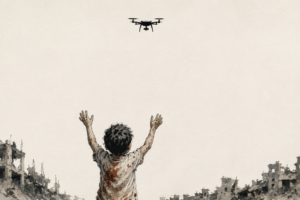 Image via Frode Kjærvik
 A three-year-old boy is carried out of a school in northern Gaza, covered in blood, his legs cut off. His parents were killed in an earlier strike, so it is his uncle who reaches him. The boy is signalling – both hands raised – for someone to pick him up and save him. The uncle remembers the hands.
Somewhere above that boy, at some point in these two years, there was a thing in the sky. Its operators describe it with a strange tenderness. A quadcopter, an Israeli officer told Channel 14, “does not hesitate, does not stop, and almost never makes mistakes.” A soldier in another documentary put it less reverently: You sit in the basement of a house, safe, helmet off, half-dressed, and you kill Palestinians, and it feels like a game. An eye that sees everything, that judges without doubt, that executes and is never itself seen or judged in return – we used to have a word for a being like that. The boy raised his hands to it.
I want to follow that gesture upward, because the report I am reading – the Independent International Commission of Inquiry’s paper on the deliberate targeting of Palestinian children, published in June 2026 – documents more than 20,000 such deaths and cannot make a single one of them answerable. It names brigades. It names divisions. It hands its findings to a prosecutor and a Security Council that will, in all likelihood, do nothing. A complete account of a genocide, and it changes nothing. The question I cannot put down is not how this was done. The machinery of the doing is laid out in the report’s pages with terrible precision. The question is why it is permitted to continue by everyone with the power to stop it. And the answer, I have come to think, is theological before it is anything else.
A claim to goodness that 20,000 dead children cannot dent is not a moral position. It is a closed system. No fact reaches it, because it has been built so that no fact can. That is the shape of the thing I want to describe, and it is, at the bottom, the shape of a god.
The Purest Good
On May 9, 2025, on the floor of the Knesset, Michal Waldiger spoke about the army. She had served, she reminded the chamber, on its Ethics Committee. “IDF soldiers are the purest good,” she said, “and they do everything to protect human life… they fight every enemy… including children… Sometimes there is no choice… it’s a war.” And then the load-bearing sentence: the Ethics Committee had “determined repeatedly that IDF soldiers are above this argument and cannot be blamed.”
Read it slowly. The soldiers fight children. The soldiers are the purest good. The soldiers cannot be blamed. These are not three claims in tension; they are one claim stated three times. If a force is purely good, then whatever it does is good, including the killing of children, and therefore the killing of children cannot be examined – because to examine it would mean entertaining the impossible thought that the pure might sin. The righteousness does not sit beside the impunity. It manufactures it. You cannot investigate the holy.
The soldiers understood this perfectly. Several who served in Gaza told interviewers they did not concern themselves with international law, because they believed they would be shielded from prosecution. One described the doctrine he had been trained in – fire only if the target has the means, the intent and the ability to cause harm – and said plainly that in Gaza no one followed it. Decisions were made not by the rules of engagement but by the mood of the commander on the ground. “Obviously,” another remarked, “fingers are light on the trigger.”
The report confirms the shield from the other side. After Hind Rajab and six members of her family were shot in their car, and the two paramedics sent to reach the five-year-old were burned alive in their ambulance, the army announced that the matter had been referred to its General Staff Fact-Finding Assessment Mechanism. That was February 2024. More than two years later, the Commission is aware of no investigation having been conducted. This is the pattern, repeated across incident after incident: an announcement of inquiry, then silence, indefinitely. The mechanism is not a route to accountability. It is the ritual that receives the demand for accountability and dissolves it. The bodies of killed children are withheld from their families – at one point the bodies of 40 children – held as bargaining chips, denied burial. The dead, too, are placed beyond reach.
This is a closed loop, and the loop is sealed by a single premise: that the ones doing the killing are good in a way nothing the killing reveals can falsify.
The Land of the One True God
Where does a premise like that come from? Not from military doctrine, which knows about proportionality and distinction and writes them into its own manuals. It comes from somewhere older, and the politicians say so out loud.
“Erase Gaza,” wrote Nissim Vaturi, deputy speaker of the Knesset, on the second day. “Do not leave a child there.” Eighteen months later he refined it: “Every child born there is already a terrorist, from the moment of his birth.” Amit Halevi described 300 newborns in a maternity ward as “all born terrorists.” Moshe Feiglin, formerly of Likud: “Every child, every baby in Gaza is an enemy… We need to conquer Gaza and colonise it and not leave a single Gazan child there. There is no other victory.”
Listen to what is being said. This is not the language of a war against a fighting force. Hamas has a military wing; Feiglin explicitly brushes it aside – the enemy is not the military wing, the enemy is every child. Guilt is assigned not for any act but at the moment of birth, which is to say it is assigned to a kind of person, by virtue of where and to whom they were born. This is original sin run backwards. The Christian doctrine washes inherited guilt off at the font; here it is stamped on at the cradle and never comes off. And the cure prescribed – leave no child, no resurrection – is the grammar of consecrated annihilation. It belongs to the oldest stratum of the monotheistic imagination: a holy land promised by the one true god, and the inhabitants devoted to destruction precisely because their presence, their gods, their very continuity pollute the covenant. Vaturi is not improvising. He is quoting a structure.
Here I have to be exact, because the next sentence decides whether this essay is an indictment or a poison. The structure he is quoting lives inside a tradition that spent 2,000 years disarming it – allegorizing those conquest texts, hedging them with rabbinic restriction, building fence after fence around them so that no one could ever lift them down and use them as an operational order. The supremacist reading is not an inheritance. It is a choice, made against the grain of the tradition it claims, by particular and nameable currents: Kahanist, messianic, ethno-nationalist. The men quoted above did not receive this theology. They reached past two millennia of restraint and took the war-god down off the shelf. That reaching is itself the crime I am describing. The closed system is not closed because the texts compelled it. It is closed because someone chose the unfalsifiable reading and discarded the falsifiable one, and the choosing is the betrayal.
And now the honest objection, the one a hostile reader is already forming. The killing in this report is overwhelmingly secular and managerial. It is done by the Kfir Brigade and the 401st and the Menashe Brigade, by numbered divisions, under open-fire orders, according to a policy the soldiers call “messing with the ground” – bend to pick up a stone and you may be shot. In 2025 the Defence Ministry stood up an Artificial Intelligence and Autonomy Administration to run the drones. This is an engineers’ war, the objection goes, and I have pinned it on God by quoting the fringe.
The objection is right about the machinery and wrong about what the machinery proves. It does not matter, for the dead, whether the man who pulls the trigger holds Feiglin’s theology in his heart or has never once thought about God. Whether the righteousness is devout conviction or convenient cover, it produces the identical shield, the identical impunity, the identical referral to the mechanism that finds nothing. God, in this essay, is not a private belief lodged in a heart. God is the name for whatever makes conduct unanswerable. And the rhetoric of the chosen, sincere or instrumental, is what hands the unanswerability to the engineers.
In God We Trust
But the shield does not hold by Israeli righteousness alone. It holds because the righteousness is underwritten across an ocean, and the underwriting has a god of its own.
Printed on the currency of the United States – the currency that buys the jet fuel, the bombs, the diplomatic veto – are four words: In God We Trust. We are trained to read them as irony when they sit beside a war. They are not irony. They are an accurate confession. The market is the god the coin professes, and the worship of wealth is the operative religion of the redeemer nation, with its own liturgy fully intact: the prosperity gospel that promises grace as net worth, the megachurch that preaches the favour of God as the favour of the market, the conviction that to prosper is to be chosen. This is an American civil religion, and its high priests are not rabbis. They are Joel Osteen and the long Protestant line that taught a nation to read its own wealth as proof of its election.
See, then, what the two gods have in common, because it is the whole argument. The god with a deed to the land and the god with a deed to wealth are the same structure: a deity that confers absolute entitlement and answers to no fact. The Levantine name for that god is the covenant over the soil. The American name is the market. The shared name is stamped on the instrument that pays for the bombs. Two chosen-nation theologies, each certain it holds a deed no evidence can revoke, underwriting each other across the water – the city on a hill arming the holy land, the new Israel arming the old, and between them a coin that professes faith in the god of both.
This is what fuses belief to commerce, and it is the move that keeps the American role from being a separate, lesser accusation about arms dealers. The contractor need not believe that Gaza’s children are born guilty. He books the order. Elbit builds the “Birds of Prey.” General Atomics sells the “Predator.” A company called Xtend supplies an attack drone with no name at all. None of these firms holds Feiglin’s theology; they hold contracts. But the theology is what converts their sale from complicity into permission. The faith is what sanctifies the transaction, which is exactly why the faith is printed on the money. The covenant absolves the interest. The operator in the basement and the operator in the boardroom are pre-absolved by the same deed – the soldier before the trigger, the manufacturer before the sale, the ally before the veto.
It is also why the report’s recommendations run upward into the Security Council and stop. The body that could enforce them contains a permanent member that reads itself into the same covenant and worships, on its currency, the same answerless god. The bottleneck is not a procedural accident. It is a theological fact. The court of final appeal belongs to the power that holds the deed.
Absolution
Which brings me back to the boy with his hands raised, and to another boy.
On November 16, 2025, in the Al-Fara’a refugee camp in Tubas, West Bank, a 14-year-old is shot and lies bleeding on the ground for at least 45 minutes. Around 10 soldiers stand over him. He throws his cap towards them, trying to get their attention; a soldier kicks it back. One films him. Another places a stone beside his body, so the killing can be dressed afterwards as a response to stone-throwing. They fire at his mother when she tries to approach. They keep the ambulance from reaching him. When he is dead they take his body and withhold it from his family. The army told a newspaper the soldiers had identified a terrorist who threw a concrete block and posed an immediate threat. The video shows otherwise.
The boy was not unforgiven. The soldiers were. They were forgiven before he had finished dying – forgiven enough to film it, to stage it, to take the body, in the certain knowledge that no one with authority over them would ever name it sin. This is not impunity, exactly. Impunity is a gap where accountability should be, an absence. What the report records is a presence: a positive act of clearing, performed in advance, by an authority that stands above the deed. It is not impunity. It is pre-absolution.
So ask the question the word demands: Who absolves? Absolution requires a confessor, someone with standing to forgive. Here the confessors are visible and they sign their names. The parliamentary confessor, who rules the soldiers “above this argument and cannot be blamed.” The military confessor, the Fact-Finding Mechanism, which receives the gravest incidents and returns nothing, year upon year, so that the act of referral becomes the act of pardon. The transatlantic confessor, who supplies the weapons and casts the veto and prints the trust in God on the instrument of payment. And behind all of them the oldest confessor, the deed-holding god in whose land the false-born have no standing, whose election is the original grant of innocence to one people and original guilt to another. Vaturi’s terrorist-from-birth and the operator’s pre-absolution are the same theology read from opposite ends: guilt assigned to the child at the cradle, innocence assigned to the killer before the trigger – and, through the doubled meaning of that flat technical word, innocence assigned to the firm before the sale and the ally before the veto. The whole circuit pre-absolved, from the boardroom to the basement to the body in the street.
I said at the start that I wanted to stand outside this, and now I have to make good on it, because the temptation is to step inside and argue that these men have the wrong god – that a better reading of their own tradition forbids what they do. That is true, and it is not my argument, because to make it my argument would be to concede that the covenant adjudicates, that the question of these dead children is a question of whose god is real. It is not. The thing I am pointing at is not a false god to be corrected by a true one. It is the deed-holding god as such: the idea that there exists a deity with title to particular land or particular wealth, and a people or a nation appointed to hold it, against whom the rest have no claim that need be heard. That idea is the engine. It ran the conquest of the Americas under one cross. It ran the wars of religion across a ruined Europe. It has worn the name of the market and the name of the covenant and it has always produced the same thing it is producing now over Gaza: a field of children who do not count, killed by people who cannot be blamed.
Karl Popper taught that the mark of a claim that has cut itself off from reality is that nothing can be allowed to count against it. The quadcopter that “almost never makes mistakes.” The soldier who is “the purest good.” The state that is “above this argument.” The covenant that absolves before the body is cold. The market that answers to no fact. These are the same gesture, dressed as virtue: a position built so that nothing can falsify it and no one can answer it. A god does not investigate himself.
And here – without false comfort, without the forced hope a sealed system would itself produce – it is worth asking what stands against such a thing. Not an army; armies can be absorbed into the war. Not outrage; outrage is the fuel the shield runs on. The one thing a self-absolving system cannot metabolize is the demand to be answerable – a person or an institution that places itself where a fact can reach it, that names its standard of proof and submits to being checked, that can be shown wrong and says so. This is what the report is, for all its impotence: a document built to be tested, the exact inverse of the mechanism that receives everything and finds nothing. It is what the doctors are who kept the chart marked Wounded Child No Surviving Family, refusing to let a child die nameless. It is what the paramedics were who drove toward Hind’s car knowing the tank was there. None of them could lift the siege. The answerable are always smaller than the machinery, and they were smaller here. But the unfalsifiable cannot pardon in advance someone who insists on being judged, and that insistence is the one act the shield has no rite for. It is the only thing the god who does not investigate himself has never learned to absorb.
The boy in Tubas raised a cap, and a soldier kicked it back. The boy in the school raised both his hands. The thing in the sky has no record of the gesture, because it sees everything and answers to nothing. We do have a record. It is 20,000 names long, and it is built to be read, and that is the whole of what we have against a sky the dead keep raising their hands to – not enough to save the boy, but enough, finally, that someone may be made to answer for him.
Afterword
On July 15, 2026 — after this essay was completed — something shifted. For the first time, a majority of House Democrats voted to block $3.3 billion in military aid to Israel. The amendment failed, 104 to 314. The shield held.
But watch the structure, not the score. The amendment, authored by a Republican, deliberately bundled military aid with humanitarian funding — a document engineered so that no vote could express the position most Democrats actually hold. The form of the instrument did the political work. That is the shield’s architecture showing itself under stress.
More significant still: the second-ranking House Democrat, voting yes, declared that no country failing to comply with American law and values should receive an unconditional blank check — and named the Netanyahu government as failing that standard. This is not policy change. It is something prior to policy change: the introduction of conditionality into a relationship defined by its absence. Pre-absolution works only while no conceivable conduct can count as disqualifying. The moment a standard is articulated — even in a losing vote — the arrangement becomes falsifiable in principle. Popper would recognize the moment. The theology has been asked, for the first time in decades, to submit to evidence.