
Species Extinction is a Humanist Issue
 Photo by Jean Vella on Unsplash
 It started with either condors or tigers.
I was interested in animals from an early age, and the indelible and existential issue of extinction came to my attention in the early 1980s when I was a high school junior. I did an independent research project and gave a presentation on endangered species with a top-level explanation of the factors that could lead to endangerment and the ways species could be saved from the finality of extinction.
However, like the science of genetics before the early twentieth century grand synthesis of Darwin’s theory of evolution by natural selection with Mendel’s lost study of inheritance and the new science of population genetics, I knew the basic details, what could be seen, but not the mechanisms and drivers of the process. Then I studied biology, genetics, and ecology in college and conservation biology in graduate school. I learned from well-known experts in evolutionary biology, several of them the lights of the 1990s “new atheist” movement, though these old, white men have since become apostates to skepticism, atheism, and humanism.
Extinction is not a new or bad thing in evolutionary terms. Virtually all species that have ever existed on earth are now extinct. There have been five great extinction events, when entire groups of species vanished in a blink of geological time. It is not unusual for a few species to go extinct every million years. What is new and bad is the greatly increased rate of extinctions over the past 200 years, what some are calling the sixth great extinction.
What does it mean when a species is endangered? I’m not talking about straight, white, Christian males here. An endangered species is one that is at high risk of extinction. It’s a numbers game—the population size below which a species will be unable to survive the next threat, such as a natural disaster or disease. It’s not the same for each species, as it depends on breeding behavior, habitat requirements, genetic diversity, and other factors, but there is a number for each. When the last individual is gone, the species is officially extinct. But a species can be genetically extinct earlier, if the remaining individuals are all male, all female, past reproductive age, or too far apart to find each other. The last passenger pigeon, a female, died in a zoo in 1914, but the species became genetically extinct in 1907 when the last male died. The species was behaviorally extinct even earlier, when huge flocks still darkened the skies, because the pigeons needed a high density of individuals roosting together to trigger normal breeding behavior.
Endangerment and Extinction
The factors that cause endangerment and eventually extinction are many. They include natural factors such as habitat changes, disasters, and disease outbreaks, and human activities such as hunting, habitat destruction, and introduced species. Introduced species can carry novel diseases, outcompete native species for food or shelter, directly prey upon native species, or modify the environment to make it unsuitable. Climate change exacerbates these factors by shifting ranges of species, habitats, and disease vectors and increasing the number and severity of disasters. Some species have survived an historical population bottleneck (very low numbers that later rebounded) or founder effect (population fragment moved into new habitat without all the gene variants in the larger gene pool), resulting in low current genetic variation, making them more susceptible to stressors such as disease. Finally, all extinction threats are magnified on islands, either true islands in the ocean or habitats biologically akin to islands such as individual lakes and mountaintops, or isolated fragments of once-contiguous habitat.
As a scientist by education, I needed data to back up my statements, though the research was loosely structured and inexact. I started by searching for lists of species that went extinct in the past 100 years. I then removed those without a specific recognized year of extinction and no known or suspected cause; all fish and invertebrates; and those classified as a subspecies, though the very definition of species is becoming less rigid. Out of my final dataset of 100 extinctions, 81 percent were on islands. The stated causes were multiple for each species, summarized below both in total and just on islands:
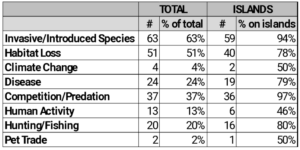
Island species are particularly vulnerable to introduced (non-native) and invasive (non-native but established) species because smaller islands tend to lose large predators over time, and remote islands tend to lack larger, non-flying animals and plants without wind- or water-borne seeds. Their naïve immune systems and lack of natural predators make them highly vulnerable to new predators and diseases. Bird species on islands often become flightless and any larger animals that persist tend to become smaller, thus more vulnerable to new large predators.
There are a few but clear ways to improve the chances an endangered species will survive: remove the threats, increase the numbers, and improve genetic diversity. Removing threats requires changing laws and business practices, eliminating introduced/invasive species, protecting habitat, mitigating climate change, and providing socioeconomic alternatives to human communities to reduce hunting and habitat destruction. Increasing numbers and diversity depends upon protection in the wild and on zoos and aquaria, which maintain breeding plans for captive populations. The ideal endpoint is to reintroduce captive-bred individuals into their native habitat, but this is sadly impossible for many species as their habitats are also extinct.
The Intrinsic Value of All Species
As with almost all environmental problems, humans are the primary cause, and humans will be the solution. Extinction is a human issue, for certain, but is it a humanist issue? Isn’t it just a condorist or a tigerist issue?
I say, emphatically, that it is a humanist issue. Human health benefits from species diversity for discovering new drugs. Genetic diversity in wild food species is critical for future humans given our genetically impoverished monocultures of farmed species. Climate change effects are mitigated by the carbon-absorbing properties of growing forests and active algal and plant communities in the ocean. Species diversity enhances recreational pursuits such as hiking, birding, hunting, and nature tourism, which are vital to mental health.That covers the material benefits to human health, subsistence, and recreation. There is also the concept, impossible to quantify or monetize, known as intrinsic value. A species has value, to itself and the planet, independent of human beings, simply because it exists.
If humanists support the right of human race, gender identity, and culture groups to exist, should we not also support the right for species to exist? We should recognize and acknowledge the intrinsic right to exist of every extant species. Beyond that, there is what some humanists interpret as spiritual, others as deserving of awe or gratitude. I am grateful that there are still condors and tigers on this planet, our only planet, now four decades later in my life, my only life, since I first noticed they were at risk. I know that the extinction of any species — bird, fish, frog, or butterfly — hurts my heart. Only a human being could say that. Humanists should care.