
The Guiding Light of Story
 Photo by Etienne Girardet on Unsplash
 Humanists love reason. We trust science to tell us what is true about the world. This works beautifully to understand the objective world around us, but science can’t answer moral questions or weigh competing values. Stories offer us pathways to understand those moral questions and the art of telling stories shapes the world’s values.
Stories capture pieces of who we are; they need to be woven together into narratives to take on their full power. I imagine most humanists would agree with this statement: “People have inherent worth, the world has inherent beauty, and we have the power in ourselves to heal the hurt and pain.” How do we share that message? First, we need to believe it ourselves—we need sincerity. We need to know our own worth. We need to know the beauty in the world. We need to believe in our own agency and capacity for good. We build those beliefs through storytelling, starting by telling stories of loving one another. We tell our friends how much we love them, and they return the favor. When people care for us, they tell us that we are loved, even and especially when we hurt. Stories of caring–and being cared for–reinforce the idea that care matters. And in turn, this shows people matter and people have the power to heal.
Nature gives us a library of beautiful, powerful stories. For example, ducklings show us the magic of new life. The duckling struggling to keep up with its mother tells a story of growth through struggle and effort. We see ourselves in the duckling; the magic of its being reflects to us the magic of our own. Its growth reminds us of how we grow. The duckling also reminds us that the work of living into our gifts is not done alone. The duckling learns to swim gracefully and effortlessly by swimming behind its mother, letting her partially block the current. We learn to swim on our own paths by following those who have come before; when our time comes, we in turn help the new ducklings to learn.
In some way, we are the duckling, new to this world, making our way through the streams of life. We know what it is to struggle to swim but to have no choice but to keep going. We know what it is to be dependent on someone’s care and teaching. We tell a story of the duckling that makes us one with the duckling. Spending time on the side of the river in imaginative observation invites us to know the wonder of nature and to build our self-understanding and our sense of interconnectedness.
When we tell stories of ducklings, we affirm that the duckling matters, and that our affirmation of the duckling’s worth and our affirmation of our own worth are bound together. I am the duckling; the duckling is me. I see the wonder in the duckling, so I see the wonder in myself. We find powerful, life-giving stories in culture and tradition. The tale of “The Ugly Duckling” tells a story of a baby swan deemed ugly and rejected time and time again. It reminds us that social acceptance doesn’t define our beauty, and that by refusing to accept those who are different from us, we deprive ourselves. The meadow is made beautiful by the diversity of wildflowers, and our society is made beautiful by the diversity of its people.
To do justice work – to create a world that respects the inherent worth and dignity of each person and affirms the bonds that hold us together – we must tell the stories of the work and build life-giving narratives that counter the unsurvivable narratives of empire. For example, empire tells us that society is best when white Christian men hold power at every level. Lifesaving counternarratives tell us that we are better for our diversity by telling stories of cooperation and celebrating the achievements of women and people of color. Moreover, stories motivate us to do the work in a way that abstract principles cannot. Stories of acute injustices, like children being separated from their parents or trans children being forced to drive for hours each way to access healthcare, remind us why we show up in the streets or submit public comments on regulations.

Vigil in Minneapolis for Renée Good, By Chad Davis, CC BY 4.0
The story of neighbors coming together in Minneapolis this past January to care for vulnerable people reminds us that we are powerful and we can do good together. The story of people across the nation and across Minneapolis coming together to protest the murders of Renée Nicole Good and Alex Pretti reminds us that there are many of us, united in purpose, and that there is power in that. The story that those vigils told changed the national conversation around ICE. They told a story of a hurt people peacefully grieving that contrasted with the narrative that protestors were dangerous and agents were preserving peace.
In my home city of Richmond, Virginia, there was a prominent statue on Monument Avenue of Robert E. Lee on horseback. The statue told a story of pride in the Confederacy. It reinforced a narrative that the Confederacy was a group of noble Southerners fighting for their rights rather than a group desperate to protect their wealth by defending their right to own and enslave others. In 2020 and 2021, people came together to reject this. They protested and covered the statue in bright graffiti that affirmed that black lives matter, despite tear gas and violence from police. The graffiti-covered monument said, “We reject this.” The story of the graffiti is an affirmation that the mostly Black organizers on the ground can be more powerful than centuries of racial oppression and violence. Both the statue of Lee and the pedestal have now been removed, leaving only grass.
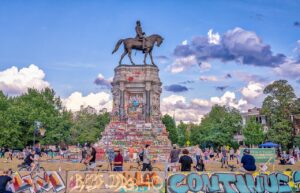
Robert E. Lee Monument, June 2020. By Mobilus In Mobili – RVA 2020 MDPC, CC BY-SA 2.0
The story of the pedestal is one of hope, courage and people finding their power. Telling the story of how protestors faced violence with art tells us that the same is possible elsewhere. When the government erects authoritarian symbols, we remember that art and community have the power to transform them. Stories of this kind give us hope that is rooted in the reality of our experiences. Particularly as the government tries to enforce narratives of Christian nationalism, humanists have a responsibility to tell stories of empowerment and resistance. It is too easy to be hopeless in times like these, and stories build the roads upon which we can travel to create change.
If powerful stories of social change build roads, then the individual pavers are made of smaller stories of care and love. The Saturday after Trump’s second inauguration, I attended an organizing training at my local Unitarian Universalist church. Following the training, there was a group sing. The music brought my emotions out, and I started crying from feeling hopeless and powerless. One of the choir members asked me if I needed a hug and let me cry in her arms. She gave me reassuring words, but it was the action of caring for me, someone she had never met, that made me know that we can do better than fascism and Christian nationalism. There is power in welcome. We have the power to create communities that bring people in and share hope, and to create places of safety in a hurting world.
Stories are guiding lights that, when formed into constellations, serve as powerful guides and keepers of memory. They preserve the lessons of the past; they keep us connected to culture and tradition. Stories can bring both comfort and challenge. Whether they remind us of our power, remind us of who we are or call us into action, they help us find our way, clearing the current of the creek as the mother duck does for her ducklings.