
Totally Sated with Teranga in a West African Village
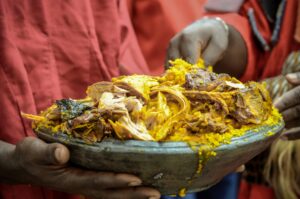 Photo by nathaniel abadji on Unsplash
I spent many years studying the behavior of the endangered western red colobus monkeys in The Gambia, the smallest country on the African mainland. Like many anthropological researchers, who shared their days with our very distant primate relatives, my days were early and full of memorable, amazing sights, sounds and smells. I was constantly, pleasantly ambushed by remarkable creatures from the before-sunrise moment I entered the forest until I left way past sundown. Day in and day out, my daily scribblings, thoughts, fantasies and realities were engulfed with eye-popping scenes and fascinating colobus observations. There was never a boring moment while I was living my forest life.
And, after the colobus had settled down in their sleeping trees for the night, I left the forest and returned to the village where I lived with an extended family – members of the Jola tribe – who welcomed me into their compound, shared their meals, celebrations and stories with me and almost certainly found me quite mad for spending so much time with a bunch of monkeys in the “not safe bush.” There was never a boring moment while I was living my village life. I was constantly, pleasantly ambushed by everyday acts of generosity.
In the evenings I often joined the women and children for dinner. We all squatted on the ground or sat on low, small wooden, hand-carved stools and ate rice and stew from one large, communal, chipped, Chinese, enamel bowl. Grandma, her two adult daughters, her seven grandchildren and me, all of us dipping our hands into the rice and stew. We all ate hurriedly while forming round balls of sauce and rice with our right hands and popping them into our mouths. Over and over again until the bowl was wiped clean and we were sated.
These communal meals frequently punctuated by invitations to anyone and everyone—friends and foes—who passed by to “come eat,” “join us,” “sit down and take some chop.” In this compound and in many compounds throughout the village and beyond, meals were always the center of openhanded benevolence. I often found myself wondering, as I popped small balls of deliciousness into my mouth, how many people, would constantly volunteer to share their precious chop? How many people would go out of their way to invite all outsiders, visitors, neighbors, distant relatives and even strangers into the very heart and hearth of their home?
Here food was clearly not just for fuel and nourishment. It was so much more. It was a gastronomic channel for sharing, generosity and welcoming. As the socio-cultural anthropologist, Harry West, PhD, has shown for various cultures throughout history, the very acts of feeding and eating are deeply social acts where affinities are expressed, strengthened and initiated and suspicion and differences can be overcome.
Looking back on my time in this village and many other villages in West Africa, I am reminded of the words of Pierre Thiam, a celebrated Senegalese chef, cookbook author and TED Talk speaker. He explained that the Wolof word teranga humanizes the guest, the other, the one who is not you, the one who should always be treated with respect and “invited to sit around your bowl”. Furthermore, the concept of teranga values the wealth of a person not by how much he has, but by how much he shares, by how much he gives. Throughout the Senegambia region, teranga is a deeply entrenched value that says “there is always room for the other around your table.”
Certainly, after every shared meal, I was not simply gastronomically sated. I was also, mentally enlightened and completely humbled. There were always examples of teranga. And, I left every meal wishing these examples of teranga were a universal trait.
The renowned food scholar, cookbook author, founder of Gastronomica: the Journal of Food and Culture, and expert on the various ways in which the sharing of meals transcends cultural differences, Darra Goldstein, wisely wrote “food can be used to promote tolerance in an increasingly fractious world.”
And so, I wonder, in today’s world, rife with political divisiveness and conflict, growing xenophobia, economic me-me-me ism and socially, culturally and religiously fractured populations, might a warm bowlful of teranga shared amongst friends and strangers, allies and foes, help promote—at least on some very, very small scale—a morsel of much-needed empathy, meaningful connection, cooperation, communication and necessary tolerance in this rapidly progressing tumultuous world.