What Great Partners These Two Make: Secular Humanists and Democratic Socialists
Suddenly, almost out of the blue in November 2025, a strong movement was energized from the wings of the Democratic Party and of some Independents who call themselves “progressives” or “liberals.” A man with a progressive mission emerged who was not only an avowed democratic socialist but also a Muslim campaigning on an affordability-focused platform for mayor of New York City. A real political bridge had been crossed. What was thought never to be possible happened. Following on the heels of this astonishing and compelling victory by Zohran Mamdani were two Congressional seats won in New York, one in Pennsylvania, one in Colorado, and one in Michigan backed by the Democratic Socialists of America (DSA). Two of these upset long-serving incumbents. A DSA candidate is poised to be the next mayor of Washington, DC; another is in a runoff for mayor of Los Angeles. Several others, not officially members of DSA but strongly progressive, won the Democratic nomination for US Senate in Michigan and governor in Minnesota, and one for a House seat in Michigan. The winning slogan of the very progressive Muslim Democratic candidate in Michigan was “Money out of politics. Money in your pocket. Medicare for all.” And the beat goes on.
We are coming upon the home stretch of the 2026 Midterm elections on November 3. Probably a good number of Republicans are frightened by what looks like a huge loss to their Congressional power and control. For most Democrats, and possibly many Independents, this is a longed-for time when a Blue tsunami will flood over this country and return our Congress to a decent, ethical and responsible government fueled by gross discontent with a largely corrupt and “just say no” House and Senate. Freedom and democracy will come back to democratic congressional government where, although still led by the most corrupt, vile, and disgraceful administration in this nation’s history, the executive branch will nonetheless be paralyzed and virtually unable to enact any legislation now blocked by Congress. Americans will have an opportunity to say “Enough of the crap!” We are now at a point of progressive and Democratic Socialist momentum.
Suddenly, again, came a dramatic and astonishing win by a member of the DSA running in Red Florida’s primary election for the Democratic nomination for US Senate: State Representative Angie Nixon, a Black Democrat, pulled off a shocking upset of an establishment Democrat with millions more in his war chest than a miniscule campaign fund of Nixon’s. It was clearly a “shake, rattle and roll” victory for Angie Nixon. All of this shows what Sen. Bernie Sanders has been saying for months: progressive candidates, like democratic socialists, despite being heavily out spent, defeat “same old, same old” policies of establishment Democrats and then definitely the whole MAGA-based national administration.
The democratic socialists’ mission looks a bit like that held by secular humanists. How about that? This writer had a sudden epiphany this summer as he witnessed the ongoing primary campaigns across the country, especially those in July and August. Much of what I read about the aims and programs advocated by the democratic socialists sounded very similar to a number of those advocated by Secular Humanists. I was caught a bit off guard not knowing precisely where things fit between the two groups and therefore decided to find out through research and writing.
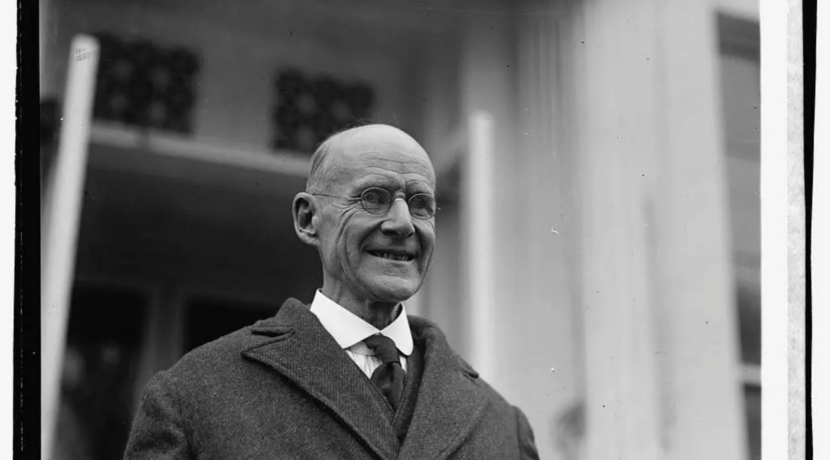
So, what is democratic socialism? It is a political construct primarily advocated by a national organization calling itself the Democratic Socialists of America. The DSA is not a political party per se, although it is largely composed of progressive/liberal Democrats and Independents in the United States. For years after being a significant political party over 100 years ago, the Socialist Party waned and almost disappeared. In 1982, Michael Harrington, an influential public intellectual and activist, founded the democratic socialists of America (DSA). He wrote a noteworthy book titled The Other America, which would inspire President Lyndon Johnson’s administration’s “war on poverty” in the mid-1960s. Harrington died in 1989, having been the heir of the legacy of organized socialism in the US, dating from the early twentieth century popular presidential campaigns of Eugene V. Debs under the banner of the Socialist Party founded in 1901. Debs had won six percent of the national vote in the 1912 presidential election, the peak of the party’s success.
By the early 1930s’ New Deal program of President Franklin D. Roosevelt, socialism seemed to be embedded in a huge overhaul of American federal government primarily as a successful economic agenda. However, by the 1960s, the Socialist Party was basically a party in name only with a minority of disparate elements advocating this or that, including a small minority which had broken away and embraced the communist philosophy. Then all the party could do was cultivate influence in the Democratic Party through union leadership and sympathetic liberal politicians.
A whimper of new socialist energy surprisingly emerged during the first term of the Obama administration in January 2009, but discontent among progressives who were disappointed by the lackluster movement of these years led to frustration and infighting. Although not a DSA member, the newly elected Independent senator from Vermont, Bernie Sanders, captured the attention of progressives throughout the country. Sanders called for democratic socialism as a movement within, not of, the Democratic Party. The democratic socialist organization in 2017 had nearly 30,000 members. And so it continued to grow to the point that, in July 2026, there were over 120,000 members, the largest socialist movement in American history.
The organization’s website sets out the definition and program of the democratic socialist agenda for today. It unequivocally states that “Capitalism is a system designed by the owning class to exploit the rest of us for their own profit. We must replace it with democratic socialism, a system where ordinary people have a real voice in our workplaces, neighborhoods, and society.” Their vision/mission “pushes further than historic social democracy and leaves behind authoritarian visions of socialism in the dustbin of history.” In other words, it has no connection with historic communism.
The social democrats want democracy for sure, but one that creates opportunities for all Americans to flourish, not just survive, plus answering the fundamental questions of people’s lives with the input of all people. They want to control the “key economic drivers that dominate our lives, especially transportation and energy production.” They desire a multiracial working class united in solidarity rather than being divided by fear. They advocate single payer Medicare for All and establishing a Green New Deal based on the philosophy behind FDR’s programs. Basically, the DSA advocates a “democracy powered by everyday people.” In many ways, this is a cultural and political movement together.
Humanism is a philosophy of life that encompasses many of the political, cultural, and social beliefs of democratic socialism if one looks closely at a comparison and contrast of both views. In the 1980s, Dr. Paul Kurtz, then head of the Center for Inquiry/Council for Secular Humanism, published The Affirmations of Humanism: A Statement of Principles. These concepts still resonate over 40 years later. The initial statement is a commitment “to the application of reason and science to the understanding of the universe and to the solving of human problems. The American Humanist Association promotes secular humanism through its website americanhumanist.org and its quarterly magazine The Humanist. Most everything one needs to know about contemporary humanism can be found there.
Turning to the central feature of this article about secular humanism and social democracy, we analyze similarities and differences. Democratic socialism and secular humanism share several core values that can form a basis for mutual support, even though they may have differences in tactics, emphasis, and their political strategy.
First, looking at the commitment to human dignity and rights of each, we see that both traditions put humans at the very center of ethics and governance. Secular humanism affirms morality as grounded in reason, empathy, and non-supernatural ethics without any kind of religious dogma. Democratic socialism specifically holds all human beings have an inherent worth and deserve basic rights to security, healthcare, education, and a decent standard of living.
Second, regarding equality and social justice, there is much in common. Secular humanism promotes equality as a moral imperative, rejecting religious supernatural claims to justify inequality, (e.g., Hebrew scripture and Christian New Testament-related passages). Democratic socialism builds on this by advocating for economic equality, the rights of workers, and the demolishing of exploitative systems. Both traditions reject ideologies that give privilege to a small elite more than to most people.
Third, regarding democratic governance and civic engagement, secular humanism supports democratic systems that protect individual freedoms and encourage public participation and ensure accountability. Democratic socialism also strongly supports democracy but with a special focus on reconfiguring economic and political institutions to serve the common good rather than enabling individual private profit.
Fourth, the use of reason and science in facilitating the progress of human society is most important to each tradition. Secular humanism puts science and critical thinking at the center of decision-making. Democratic socialism often incorporates scientific evidence when making policy design, especially in the fields of health, education, and the maintenance and improvement of environmental sustainability. Again, both traditions reject dogma and advocate for the certainty and critical need of evidence-based solutions.
Fifth, significant are the matters of solidarity and collective responsibility. Integrated humanism and democratic socialism both stress significant social togetherness, which means recognizing true freedom requires material conditions for all people to thrive. This includes a sense of cooperation across communities, responsibility that is intergenerational, and a global awareness of challenges that we all share, like the growing tragedy of the climate change crisis.
Sixth, there is a strong need in this country for a rejection of all religious dogma in public life. In some places this is showing improvement, but in others the Christian Nationalist crowd is still flexing its muscles, although in significantly less strength. Secular humanism explicitly and proudly separates ethics and governance from any religious authority. Democratic socialism, while not specifically anti-religion, often cooperates with secular governance to ensure that policies are based on human needs rather than on religious doctrinal teachings.
What all this comes down to, basically, is a convincing mutuality between the two traditions, with common ground being seen in policies that combine democratic participation along with economic fairness. This can be witnessed in such areas as pushing for universal healthcare, public education, environmental protection, and anti-poverty efforts, while grounding all of these in humanist ethics and scientific reasoning with critical thinking.
The bottom line is, these two traditions make a great partnership. We are allies with both working toward a society where human dignity, equality, and reason guide public life, and where science and democracy serve every human being.