
Orwell: The New Life
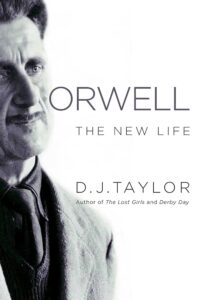
Book by By D.J. Taylor
Pegasus Books (2023)
J.D. Taylor does an excellent job laying out the cycle of Orwell’s life in fascinating intimacy in Orwell: The New Life (2023). Orwell’s voice spans two centuries with a biting commitment to living with a moral compass of humane values without a religious backstop.
There is likely no political novelist who has been invoked more in the last decade than George Orwell. He is a twentieth-century literary titan, coining phrases now embedded in the lexicon: Doublethink. Thought Police. Unperson. Thought crime. Newspeak. Memory hole. In our age, when politicians revoke willynilly their public commitments, deny recorded historical events, obfuscate with intentionally false statements, and capriciously turn on generational allies to make friends with notorious adversaries, Orwell speaks across time. The deceitful pattern is well-known because Orwell drew our attention to it.
As Taylor shows, Orwell’s personality was complex and often marked with contradictions. He was a graduate of Eton, an exclusive English upper-class private school, who passionately believed in workers’ rights. He was a colonial policeman who loathed the British Empire. He was a doting father, apparently so self absorbed that he was oblivious to his wife Eileen’s chronic illness that would lead to her early death. A man whose educated accent gave him away in the coal mines of Northern England, to which he had travelled to write with empathy about the pain of existence of the working poor. A patriot who distrusted nationalism.
One should not expect a one-dimensional heroic figure to emerge from Taylor’s pages. Orwell took decades to forge his worldview, and the political watershed is the Spanish Civil War (1936-1939), which he wrote about in his memoir Homage to Catalonia. A right-wing insurgency led by Francisco Franco prompted an international response from humanist writers and artists who volunteered to fight on the side of the Spanish republicans, including Ernest Hemingway, John Dos Passos, André Malraux, and Pablo Picasso. The war experience annealed Orwell’s commitment to socialism and exposed him to bitter infighting and factionalism that developed his fierce opposition to authoritarianism.
Orwell’s literary watershed is Animal Farm. Ostensibly a children’s book, it is a political allegory about totalitarianism. It is based on Orwell’s distrust of Soviet Russia drawn from his experience during the Spanish Civil War, when the Soviets were as ready to ally themselves with Hitler as their fellow travelers, and use any expediency or lie to prevail. The left-wing militia Orwell had volunteered for was declared illegal even before its first year of existence was over. The author of 1984 was shot in the throat and nearly killed during his time on the front lines. Orwell never forgave the Soviet duplicity.
“Orwell was an unflinching defender of humanist values, a critical fact to appreciate when many lives are now being betrayed in pursuit of nihilistic dominance through systematic deceit.”
To understand Orwell’s brand of humanism, however, we want to follow an aside by Taylor about an essay in which Orwell mounts his most forceful defense of humanism. In Lear, The Fool, and Tolstoy, Orwell analyzes Tolstoy’s repulsion toward Shakespeare, who the great Russian novelist considered a second-rate dramatist, too consumed by poetic style and filling the stage with empty flourishes. Orwell counters that a puritanical vision of art drives Tolstoy’s criticism, or as Orwell puts it, “the quarrel between the religious and the humanist attitudes towards life.” Late in life, Tolstoy turned away from the excess of the grand novel in favor of parables idealizing the moral and spiritual purity he associated with a simple life close to the land. Orwell concludes that Tolstoy’s polemic was driven by malice; as a wouldbe saint, Tolstoy struggled to renounce the world and sought to suppress artistic visions contrary to his own. In Orwell’s view, “All of these [Shakespeare’s] tragedies start out with the humanist assumption that life, although full of sorrow, is worth living, and that Man is a noble animal, a belief which Tolstoy in his old age did not share.”
Orwell would have none of this: “The humanist attitude is that the struggle must continue and that death is the price of life.” Denying this truth is untenable; it contradicts the evidence of common human experience. Compromise is impossible and, as Orwell says, “Often there is a seeming truce between the humanist and the religious believer, but in fact their attitudes cannot be reconciled: one must choose between this world and the next. And the enormous majority of human beings, if they understood the issue, would choose this world. They do make that choice when they continue working, breeding and dying instead of crippling their faculties in the hope of obtaining a new lease of existence elsewhere.”
Some critics fault Taylor for not making any groundbreaking discoveries. This attitude is specious given that Taylor uses newly-available letters from Orwell, deepening rather than upending his legacy. The only flaw I encountered is that a major event, the death of Orwell’s first wife, Eileen, occurs without sufficient context; it feels abrupt. Stranger still, little account of Orwell’s grieving is revealed.
These omissions, however, do not detract from Orwell’s enduring significance to secular social thought—a legacy most clearly articulated in 1984, his grim meditation on the moral consequences of abandoning truth. The novel is set in a dystopian future where a tyrannical, authoritarian regime controls thought and truth through denial and revisionism, and rebellion and empathy are crushed by relentless official deceit. Orwell confronts a political world singular in its obsession with control, willing to revoke truth for dominance: “War is peace. Freedom is slavery. Ignorance is strength.”
However, this journalistic flaw can be laid aside for the treasure of insights J.D. Taylor conveys in Orwell: The New Life. Taylor’s biography is robust and valuable reading. Orwell had his contradictions, difficult to track seamlessly, and in this, the titanic writer proves as human a subject as any other. Orwell was an unflinching defender of humanist values, a critical fact to appreciate when many lives are now being betrayed in pursuit of nihilistic dominance through systematic deceit. Orwell’s observation in 1984 still holds a disarming lesson: “The object of power is power.”
Sadly, this feels truer than ever.