
Richard Wright: The Life and Times
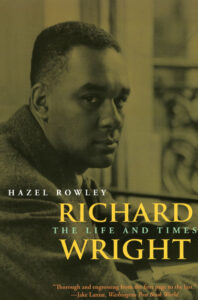
Richard Wright was one of the greatest writers and thinkers in American and global history, most popularly known for his powerful novel Native Son that shook the nation to its core and for being an outspoken critic of racism. He was also the first best-selling Black writer in America.
It is difficult to compress the life of such a luminous figure into a book. But biographer Hazel Rowley makes an exemplary attempt in Richard Wright: The Life and Times. This book chronicles Wright’s life from his in birth 1908 in Mississippi to his death in France in 1960.
Firstly, she aptly shows that Wright’s escape as a teen from his religious fundamentalist family, from the racism and lynchings of the American South, while constantly experiencing poverty-induced hunger and systemic oppression, through dogged determination, courage, self-education, faith in himself, community support, to becoming a bestselling author and world-renown public intellectual and speaker is one of the most heroic feats achieved in human history.
The scope of the book is immense, which makes for a dense read. Rowley starts off with Wright’s childhood in Mississippi. His childhood was a tumultuous one. His father abandoned him and his mother became disabled as a result of suffering a stroke at the age of thirty-five. He was a rebel and misfit who didn’t care about God or religion while under the care of his religiously devout grandmother and other family members who found him frustrating, volatile, and sinful. He developed a love for literature and storytelling as a precocious child, and his austere grandmother made great efforts to extinguish that passion. She thankfully never succeeded.
Much of Rowley’s account of Wright’s childhood and teenage years is drawn mainly from his autobiography Black Boy. However, it becomes obvious while reading this book that the final, published version of Black Boy has much less information about his life than the first draft, which Rowley has access to and references. She also points out and corrects facts and experiences that Wright exaggerated, downplayed, or was mistaken about in his autobiography.
Wright’s struggle with hunger, poverty, a hostile home life, and his growing awareness of the forcefield of racism around him made his life as a young boy unbearable.
From his prepubescence years Wright longed for freedom and spent his whole life moving in the pursuit of freedom and attacking the enemies of freedom wherever he went, whether it was religious fundamentalism, systemic oppression, racism, classism, discrimination, authoritarianism, or censorship. He was perpetually restless, always wanting more than his current circumstances gave him. He wanted better for his life and he knew that his family and the racially-charged environment in Mississippi wouldn’t give it to him. He courageously decided to flee North as a teenager. He made his way to Memphis, then on to Chicago, then New York, and, ultimately, to Paris.
Rowley documents how Wright’s writing and intellectual journey evolved throughout his life. He deeply valued learning and took huge risks to get books that were hard to find due to racist Jim Crow laws limiting the access of books to Black people. He read voraciously and widely across diverse disciplines—including fiction, poetry, psychology, philosophy, and sociology. He was a true international, multidisciplinary scholar. His desire to keep learning made him not only a thoughtful writer but one of the most monumental intellectuals and thinkers of the twentieth century.
He studied intensely and closed the gap that his eight-grade education had created. He wrote obsessively and feverishly through odd jobs, joblessness, poverty, and the puzzlement and disappointment of his family who thought he was wasting his time studying and writing. His autobiography doesn’t even cover the full scale of the struggles he went through to become a great writer. For example, there was a time when he was so angry that there was no food in the house for him and his family after he lost his job during the Great Depression that he threw the only copy of his first novel into the fire before proceeding to go out to beg for food.
While reading the iconoclastic critic H. L. Mencken, Wright realized that he could use words as a weapon, and he did his best to learn how to do so in his literary works. Mencken introduced him to the writers of the literary realism and urban naturalism traditions, including Theodore Dreiser, Frank Norris, Sinclair Lewis, Sherwood Anderson, and Stephen Crane, who shaped his literary vision. He studied his immediate environment—the people and the urban sociology of Chicago.
His participation in the John Reed Club and the Communist Party—which the Club was associated with—in Chicago influenced his political and artistic vision and gave him the writer friends he needed to help him improve his writing. Nine years later, he left the Communist Party due to its authoritarian practices and ideological differences he had with the Party’s leaders.
Wright’s time in Chicago was nothing short of transformative. It is not an exaggeration to say that if Wright hadn’t found his way to Chicago in the time period that he did, he most likely would have not reached the height of his creative powers and would have probably died in obscurity.
In the spirit of the literary naturalism tradition, Wright wanted the White world to see and feel how the atmosphere and cruelty of racial violence and poverty affected the character and behavior of people under its rule. He said in his essay How ‘Bigger’ Was Born that unlike his first published work of fiction, Uncle Tom’s Children, he wanted to write a book that “would be so hard and deep that they would have to face it without the consolation of tears.” This desire led to the birth of Native Son.
People across the racial divide often thought that Wright’s vision of America in his books was too bleak, hopeless, rigid and harsh. However, Wright felt that racial injustice could only be addressed if everyone clearly saw the brutal reality of it without looking away. Doing anything less than speaking truth to power and challenging the status quo was tantamount to intellectual dishonesty and moral cowardice. His primary interest wasn’t in making people feel good or positive. He was once asked by a woman whether his ideas would make people happy. And he replied, “My dear, I do not deal in happiness; I deal in meaning.”
Rowley provides an in-depth look into how each of his novels and other nonfiction work came into existence, the concessions and comprises he made during the editing and publishing process, the battles with censorship, how his works were received by the public, and how he felt about the reception of his books by the general public, his critics, and the literary world.
Notably, Rowley’s description of the editing process of his best-selling book Native Son showed that he accepted changes to the storyline in the book that severely altered how the main protagonist was portrayed and how the story unfolded, which had been suggested by judges of the Book-of-the-Month Club who launched his book. Why Wright gave in to their pressure remains a mystery. One wonders how the book would have been received publicly and sold if he maintained his artistic vision till the end.
She makes connections between the various plot points, experiences, and characters in his novels to his beliefs, inner struggles, and folks that he knew in real life. She also discusses his other less popular books—12 Million Black Voices, The Outsider, Savage Holiday, Black Power, The Color Curtain, Pagan Spain, White Man, Listen! and The Long Dream—and the novels that failed to reach publication during his lifetime, including The Jackal, Rite of Passage, A Father’s Law, Black Hope, Lawd Today!, Eight Men and The Man Who Lived Underground. It becomes apparent that Wright had an odd interest in the psychology of violence, rage, and murder.
Moreover, she gives a tour of Wright’s adventurous journey into film and drama, mainly, the theatre production of Native Son in New York and the film production of the same novel in Argentina decades later. Neither was successful for various reasons.
Rowley’s narrative style is engaging and seamless. She doesn’t just list raw facts, experiences and events, but tells the story of Wright’s life in a compelling way without sacrificing the truth of who he was and the things that he experienced. She consistently adds the relevant socio-cultural, historical, and political context that helps the reader make sense of the events and experiences surrounding Wright’s life.
Likewise, her research and scholarship in the creation of this biography is outstanding. She pored over hundreds of books, articles, newspapers, letters, interviews, records etc. She conducted her own interviews, read all of Wright’s previous biographies, demanded that the State Department release Wright’s case files, hunting for information that Wright’s previous biographers couldn’t access. She treats Wright’s life and work with the respect and diligence they deserve.
Rowley gives us an up-close view of Wright’s personal life. She talks about his health issues, hopes and dreams, inner conflicts, sorrows, joys, guilt, disappointments, failures, embarrassing moments, relationships, friendships, and conflict with other writers. She explores the personal dramas that occurred between him, his friends, wives, lovers, enemies, colleagues and fellow writers. Wright was often arrogant, angry, anxious, guilt-ridden, passionate, calculating, and restless.
The cast of characters in this biography is vast. Wright made friends and enemies wherever he travelled and whenever he wrote. He had a multitude of friends and acquaintances from all walks of life across multiple countries.
The racism violence and injustice in America—the violence, lynchings, diverse forms of discrimination, rejections, dehumanization, the terror and powerlessness African Americans felt—described in the book are appalling and heartbreaking to read. There’s an instance in book where Rowley graphically describes the horrible conditions of the homes that Black Americans were cosigned to live in Chicago, and yet they were charged more twice the rent their White counterparts paid, who lived in far much better conditions.
This was the main impetus that made Wright and many of his peers (like Himes, Baldwin, Harrington, etc.) move to Europe. But racism still followed them there. The American variant of racism was so toxic that some European or Canadian businesses started turning down Black customers when there was an increase of White American tourists patronizing them. While Wright became successful, relatively wealthy, and popular, he was never able to fully escape the sting of racism till his passing.
As a result, Wright would spend his whole life writing and speaking out against racism. This, however, made him a target of the FBI, and from his early thirties he was under government surveillance for the rest of his life.
Wright settled in France in 1956 with his family and remained there for the rest of his life. He has been accused by his critics of losing his artistic spark and losing touch with his American roots that produced his earlier books because of his self-exile in France. However, Rowley counters this belief by showing that Wright’s artistic power didn’t decline but evolved and expanded while living in Paris.
Wright is what we would call a “cosmopolitan humanist.” He figured out that it wasn’t enough to deal with injustice in America—that classism, poverty and sexism had no borders, systemic oppression was a worldwide phenomenon, and that they needed to be fought everywhere. Thinking locally wasn’t sufficient. He needed to think globally. He was no longer just a citizen of America but a citizen of the world. He became interested in liberation movements that were confronting colonial and authoritarian powers in developing countries. He supported the creation of the newspaper Presence Africaine, for French-speaking African writers alongside intellectuals like Alioune Diop, Aimé Césaire and Leopold Senghor. He had a budding interest in women’s rights during this period as well.
This international humanist worldview and his innate restlessness and desire for adventure pushed him to travel. He visited many countries, sometimes at the risk of his physical health, but wrote mainly about Spain, Indonesia, and the Gold Coast—now known as Ghana.
Unfortunately, his travel writing never got the attention that it deserved. It was the same fate of all his later novels, partly because people expected him to write like he did in the past, and also because some of his work, especially his most philosophical novel The Outsider, wasn’t well written, well edited, or accessible. Wright’s popularity and cultural relevance primarily rests on Native Son and Black Boy more than any of his other books.
Wright was an imperfect man and Rowley doesn’t shy away from presenting his flaws. She discusses his life of infidelity, contemptuous ignorance toward differing cultures and belief systems, odd dealings with the US Department of State, prejudices, and hypocrisy, without downplaying any of it. I consider myself a Richard Wright fan. But reading about his flaws and ethical failures was extremely sobering. It was a stern reminder about why it is dangerous to put people on pedestals. For me, his biggest blunder was his lack of presence in his family’s life. He became distant from his wife and two daughters, and was so estranged from his second daughter that she refused to attend his funeral. This doesn’t take away from his greatness and genius, but it does serve as a cautionary tale to artists and activists about the importance of showing love to our families while in the pursuit of creative excellence and social change.
Wright developed amoebic dysentery in 1959 and died 15 months later of a heart attack. According to Rowley, the circumstances surrounding his death look suspicious. She lays out the evidence and course of events without explicitly stating that he died as a result of foul play. Julia Wright, Wright’s first daughter, and Ollie Harrington, the foremost Black cartoonist and Wright’s close friend, strongly believed that Wright didn’t die of natural causes. Wright’s friends were wary of his doctor and the treatment he was getting. Rowley suggests that based on Wright’s apparent symptoms he probably had liver poisoning due to consuming bismuth for a long time at the recommendation of his doctor. An autopsy was never conducted.
Wright had a quiet funeral attended by family and friends. The book ends with a somber, tranquil tone. What I feel is missing at the end of the book is a brief reflection on Wright’s legacy and reputation after his death till the time she wrote the book. Nonetheless, the book is a wonderfully-written biography. It is obviously a passion project and a labor of love.
Rowley leaves us with a picture of a man who was a towering intellectual, a man of dazzling contradictions and faults, a writer of ferocious emotional intensity, a psychologist always excavating the human condition, a global freedom fighter and humanist, a pioneer of colossal artistic and political intelligence, a man who was preternaturally heroic and painfully human. I am grateful to Rowley for preserving his legacy.