Can a Priest Be an Atheist?

Photo by ljupco / 123RF Photo by ljupco / 123RF

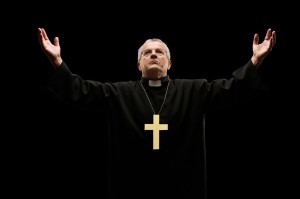
Can one be a priest and an atheist? That’s a question Religion News Service is asking after a survey revealed that two percent of Anglican clergy in England believe that God is a social construct. The survey also found that 16 percent of clergy are unclear about the nature of God.

Despite the growing number of individuals in both the United States and the United Kingdom who identify as non-religious, the survey found that older members of the clergy were more likely to hold unorthodox views about God, rather than their younger counterparts. This finding seems to run contrary to what one might expect. After all, wouldn’t older clergy be more set in their ways than younger ministers? However, Dr. Darren Middleton, professor of religion at Texas Christian University, actually sees this finding as unsurprising: “I suspect that some older clergy are more likely to hold non-traditional beliefs about God because…over the years their ideas have been challenged by arduous situations—ministering to the parents of a child suffering with inoperable cancer, let’s say—where prayer seems problematic and conventional theologies appear outmoded.” Taken from the perspective that older religious leaders have more life experience that may cause them to question traditional church teachings, the survey results seem almost intuitive. Many secular humanists who have turned away from religion should be able to feel some sympathy for questioning clergy who cannot reconcile the church’s beliefs about God with the suffering that they see in daily life.

One individual who does not seem so sympathetic to this struggle is Alison Ruoff, a lay leader of the General Synod, the Church of England’s governing body, who stated in The Independent, “They shouldn’t have been selected…we expect better from [our priests].” Despite these concerns, the Church of England does not sanction clergy who take up nontraditional views or accuse them of heresy. In fact, Middleton suggests that allowing religious leaders to think critically about their beliefs can strengthen the church. “The Church has often benefited from those clergy who are singularly unafraid to doubt,” he said in an email. “I’d like to think, and I certainly hope that people in the pew would appreciate a refreshingly honest priest.”

While the survey results may appear mildly shocking, Middleton does not think that they will shatter the faith of religious adherents. “Two percent does not seem like a number to inspire consternation,” he said. “I’m not surprised by the number, and anyone who has been following ecclesial trends in the UK for the past decade or so should not be surprised either.” While he doesn’t believe that the survey results will significantly affect trust in the church, Middleton does feel that “there is much to commend in ‘religious humanism’” in spite of its controversy within the church. If members of the clergy, in both the UK and the US, felt more comfortable being open about their questions and doubts, their honesty could inspire dialogue between religious humanists and secular humanists, who could find common ground in their shared value of critical thinking.

Tags:
  • Jon Heuman

    I’m an ordained minister and hold a doctorate of divinity in the state of Florida and I am a proud atheist. I think 2% is a Low number and the others are just afraid to admit their beliefs for fear of persecution.

    • Bob

      I have been Unitarian Universalist layperson for nearly fifty years and nearly every UU minister I have ever met is an atheist, agnostic or humanist. That is why I myself am a UU, agnostic, humanist and selective atheist.

    • SecularHumanist199

      I assume that you went into the ministry, at least initially, through a strong belief in the power of god, but why stay in it? Is it because you have a strong desire to try to “minister” to the psychological needs of others and this is a good way to do so?

      I suspect that some number of priests and ministers are doing just that. They are people who are “called” to help others through what ever means, and even though they have determined that god is a man-made myth, working through a religious organization is a good way to do so. There are probably others there that are still in the clergy because it is what they trained for and they don’t feel prepared to move to another career.

      It is a shame that there aren’t more secular roles that people who feel this “calling” can fill to be able to provide the same level of support to people.

    • IslamicScholar

      I find this very interesting. Do you continue to minister at a church? And if so, how do you connect your beliefs to what you are teaching?

  • SecularHumanist199

    I will never understand how anyone can study the bible, or any religious text, and then conclude that it represents some sort of absolute truth and therefore must be followed. Obviously there are lots of people who can, but I have never heard a logical explanation as to how they are able to suspend logic and rationality to do so. Given that clergy are supposed to be the most schooled on their holy book, it would seem logical to expect more of them to conclude that they are fictional, just based on the number of contradictions and outright irrational things that happen in these books.

    • Bob

      50 years ago when I was twenty-two, I read the Bible cover to cover, took extensive notes and determined it was filled with a whole lot of myth, and a little bit of history. Five years later, I read it again to see if I had missed anything. I hadn’t. If, I, of little faith, thought theology was harmless nonsense, I could have stopped thinking about it years ago. The problem is that it is nonsense, but it certainly isn’t harmless.

      • Dr Jon Heuman D.D.

        I have read the bible many times and never took it as literal truth. I have also read many other religious texts. I never took the bible as the word of god it was written by man and humans make many mistakes. I do believe the bible was written with good intentions but we have far to many priests who wish to interpret in the manner it’s benefits themselves and their ignorance. I do not practice anymore because of all the hypocrites’ I won’t even bring up religion unless someone insists. I will perform marriages and funeral ceremonies as long as they understand I will not involve god

  • Jake Stewart

    Not surprising that people who believe in a knock-off religion made up by their government have doubts. When part of your belief system requires you to accept that anyone can just make up their own religion for convenience’s sake, how firmly can you really believe?

    • Bob

      What? Need a little more depth here. I’ve no idea what you’re attempting to say.

      • Jake Stewart

        Google “Church of England” and “angelican church”.
        Jesus –> Catholic church –~1500 yr–> knock-off christian religions.
        In the hierarchy of christianity, knock-off christianity, and government created knock-off christianity how does anyone expect that these folks actually believe in the BS?
        If their faith starts with a 3rd tier belief system… well connect the dots!

        • Joe

          Right on Jake, I’m glad you said it!

  • GotScience

    Anglicans = Catholics light.

  • Ashley

    I think that the number of priests who have left the faith for atheism is also a telling figure, though I can’t find it right now. I know there are many of them- and the fact that they are able to lose that faith and leave it behind has to shake those who stay.

  • Bob

    Maybe they (the priests) have stumbled upon Carl Sagan’s, “Extraordinary claims require extraordinary evidence.” Or perhaps, through experience, they have concluded that if want a better world we will have to leave the pews and build it ourselves.

  • euroyank

    I don’t know….. it’s kind of like the customer service manager not liking the product. Just seems wrong.