
Meet the New AHA Staff Member: Jake Via
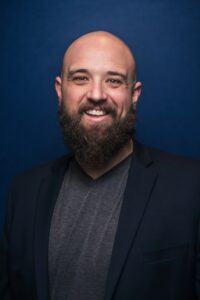
Please welcome the AHA’s new Organizing Director, Jake Via!
What is your educational and work background?
For nearly two decades, my work in nonprofit organizations has centered on youth development, community building, and philanthropy. From Austin to Seattle, Arizona, Colorado, Idaho, and even Guam, play-based programming was always a big focus. It brings people together and fosters deep connection. Time at the YMCA and Playworks reinforced a deep belief that play builds empathy, strengthens relationships, and helps people process both joy and pain.
A nontraditional route later in life led to earning a BS in Business Administration from Thomas Edison State University, achieved entirely through testing out of coursework. No classes, no GPA, just a self-directed, neurodivergent mind hacking the system in a way that worked for my learning style.
Six years ago, a motorcycle accident resulted in a brain injury and the need to relearn how to walk. That recovery journey led to a transition into tech sales, where success came but fulfillment didn’t. The recent political climate made it impossible to ignore the internal pull back toward nonprofit work. I felt a deep desire to be doing something that actually aligns with my personal values and the kind of world worth working toward. When the Organizing Director role at AHA popped up, it was like spotting a lighthouse in a storm. Joining this historic organization, serving the humanist mission and community, and walking in the footsteps of so many incredible humanists? Couldn’t be more humbled and excited!
How did you first learn about humanism?
Like so many who identify as humanists, I grew up in a very conservative Christian environment with a young-earth education. By the time I entered high school, I had entire chapters, even a full book, of the Bible memorized. Homeschooled and immersed in church life, I had already gone on international mission trips, my family worked at a Christian summer camp year-round, and I spent up to six days a week at church as a volunteer, custodian, youth group member and leader, A/V tech—you name it. My whole world existed within this bubble, and I was fully committed. Preaching at homeless shelters and youth groups, leading Bible studies, writing and performing Christian theater productions, and spending summers as a camp staffer all felt like a calling and it was fun too!
And then, my bubble popped. Traveling solo—backpacking through Brazil, teaching outdoor education in the Rockies, lifeguarding in Guam, working in secular roles—I met people from all walks of life. This personal experience led me to question the rigidity of certain doctrines, particularly those that suggested a predetermined fate for those who held different beliefs.
Around this time, I also had a realization: I realized that for me, a faith inherited rather than personally chosen, felt less resonant. So, I stepped away—not to reject it outright, but to see it more clearly and make my own choice. That journey of seeking, combined with the knowledge I had from preparing to be a missionary, having read through the Bible as well as other major religious texts like the Quran, Bhagavad Gita, Tao Te Ching, and more. It led me somewhere unexpected.
Instead of deepening my relationship with a deity, my path led me to explore science and reason as frameworks for understanding the world. In studying various religious texts, I gained an appreciation for how different cultures throughout history have sought to make sense of the cosmos and their place within it, often through rich and meaningful narratives. Searching for a sense of belonging, I came across humanism about fifteen years ago. As soon as I discovered it, everything clicked. Humanism reflected who I already was. I am rational, reasonable, and deeply committed to living an empathetic life. It allowed me to embody the values I was raised with, while finding a personal path free from the specific dogmas and perceived guilt that I had experienced. We share this pale blue dot under the most random and miraculous set of circumstances. Each of us has a responsibility to leave it better than we found it.
Did you grow up in a traditional religious faith? How did it impact you?
I’m always grateful for the community I was raised in and the values it instilled. Kindness, helping those in need, and coming together through volunteering and altruism have all stayed with me. However, like many who navigate their spiritual journeys, I personally struggled with certain tenets that fostered feelings of inadequacy or exclusivity.
Humanism offers an alternative, kinder vision of the world, one where every life deserves dignity, respect, and love, not as something to be earned but as something inherent. There is no need to chase acceptance because we are worthy as we are. Existence itself is extraordinary. The sheer randomness of the universe led to this breath, this moment. For that, I am grateful. Helping others feel whole, loved, and accepted isn’t just important; it is necessary.
What interested you most about working for the American Humanist Association?
We live in a diverse and often complex world. Humanism, and the American Humanist Association, stands as a beacon of hope for anyone who seeks to approach the world with reason and compassion, and wants to be a force for good, empathy, and love. Humanism helped me frame the values I always knew I had in a way that is rational, reasonable, and rooted in science. The work we do leads others toward a more fulfilling existence, and being part of that mission makes me almost irrationally excited.
What book has influenced you the most?
I’ve always been a voracious reader and was even more so as a kid. Thanks to the BOOK IT! program, I ate way too many Pizza Hut personal pan pizzas while devouring books. I loved escaping into Narnia and Middle-earth, but things really got good when I first read The Hitchhiker’s Guide to the Galaxy by Douglas Adams. My love for Mark Twain’s travel books eventually brought me to Letters from Earth and Captain Stormfield’s Visit to Heaven, two of his works that deserve far more attention than they’ve received. Looking back, it’s clear that Twain’s irreverence and Adams’ unique perspective on the universe, along with his interwoven humanism, played a huge role in shaping how I view religion and the world at large.
If you could have dinner with any three people in the world (living or dead), who would they be and why?
No contest or question here: Mark Twain, Douglas Adams, and Stephen Fry.