
Book Review: “If The Train Arrives”
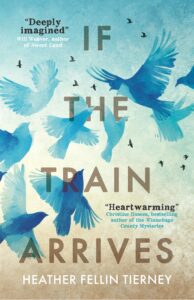
BOOK BY HEATHER FELLIN TIERNY
VINE LEAVES PRESS, 2025
236 PP, $17.99
Traveling by train is not about getting somewhere the quickest way possible; it’s about the process of travel, the landscape and life passing by before we arrive at our destination. “If The Train Arrives” is told from the viewpoints of three people: two travelers, a fifty-year-old woman trying to find her way forward and a teenager returning to family; and one person trying to stand still, a neurodivergent man adjusting to his changing workplace—each of them seeking their place in the world.
Violet is afraid she’s wasted years of her life and is on a mission to restore what she can. Vera is fresh out of high school and traveling to visit the father who abandoned her half her lifetime ago. Lincoln has worked for twenty years in a small-town train station and is concerned about his aging mother and that the trains stay on time.
Their paths cross in the Oconomowoc, Wisconsin train station in November of 1970. Amtrak is taking over U.S. passenger trains, almost no one has heard of “autism” even though the average American knows someone who, a few decades later, would receive that diagnosis, and Second Wave Feminism is pushing women to respect their potential – even if it is still mostly done privately, quietly, and even secretly.
There is a puzzle here about how each character arrives at this life crisis and a mystery about why this train station holds the key to resolving their struggles. The reader falls into their stories, the connections and losses, and what beauty we regret as it passes by. We fall for the wisdom and ferocity and goodness of these people. Tierney gets them—their needs and failures—creating a tender balance between compassion and precision. She vindicates their lives.
It might seem to readers that Lincoln centers the story because he sells and takes tickets at the train station. Critically, he is fortunate to have had a mother who refused to send him into care when he was a child. His mother uses the right words and presents the motivating explanations that make sense to a man easily overwhelmed by emotion or change. She recognizes his specific skills. She calls him: “‘My treasure,’ … ‘I named you Lincoln because it is the name for an old soul.’ She nods at her own statement” (147). She is one of several women who gather and protect the lives of vulnerable people, women who quietly use and abuse power to keep others safe.
Lincoln deliberately models his mother’s compassion. He was born late in his mother’s life, well past the time she expected to bear a child. She is eighty-eight here, and he knows this is old, and what that means. When she is unwell, “Lincoln would knock on the door at noon—the space dark with the drawn curtains—and when her faint voice answered, he would bring her a sandwich with bacon and milk” (23-24).
We let time and people slip away, like rain sinking into garden soil. The water is still there, but we’re not seeing it. “They were fifty-three miles away. But distance is not how far away you are from something. It’s how far away you feel from it” (194). Each of these characters has crossed an unfamiliar distance, a journey terrifying to them. They want family, purpose, and confirmation that their lives have meaning and use. They look back, but as they confront fear and loss, they find a future.
“He thinks about what he knows to be true and what he believes.
“There is something behind it—within it.
“There is, he understands now, a soulfulness to it all.
“It is a sigh, or a song, or maybe it is a sober prayer: a somber beauty.
“His thoughts are not those words, but they are those things.
“This and here and feeling and knowing” (211).
Like me, the author has been a teacher for many years, has worked with neurodivergent people and has more than a passing understanding of how to encourage and support them. If you have someone in your life who loves trains, this novel is about trains. If you have lost someone who still means too much to be left behind, this is a novel about reconnection. If you have someone in your life who has messed up in so many tiny ways that there seems no point anymore to where they’ve gone and why, this is a novel about figuring things out, letting go, and moving on.
Getting from one place to another isn’t about traveling by train, and not always about miles. Sometimes it’s about letting yourself go to where you need to be in your own life and letting others find their way, too. Tierney’s novel suggests that if the train arrives, get on and go.
“Finish each day and be done with it. You have done what you could.”—Ralph Waldo Emerson