
Book Review: “Discriminations: Making Peace in the Culture Wars”
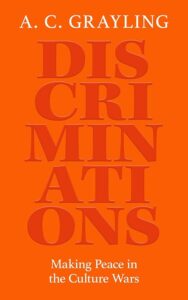
BOOK BY A. C. GRAYLING
ONE WORLD PUBLICATIONS LTD., 2025
It is everywhere: people, places and things are called “woke!”
What? According to several news reports in late summer 2025, even the largely rural Southern state-focused Cracker Barrel Old Country Store restaurants, first established for travelers along interstate and lesser federal highways in 1969, were suddenly accused by traditionalist and n’er-do-well customers of going “woke” because the chain modernized its historic logo. They also wished to modernize their restaurant interiors. “Country hospitality” was under threat! At Cracker Barrel stores, mostly appealing to rural Southern whites, the threat of “wokeness” was rearing its ugly head. But what is “woke” all about?
When I finished reading the last page of the last chapter of A. C. Grayling’s amazing book, what came to mind was the claim—why cannot humans live with each other and behave? The author clearly states this is the only way to create a fair and inclusive society. His answer is so simple, so practical, so understandable and realistic. Why is everything so fraught with kaleidoscopic discord now, especially on social media: people calling each other names or referring to groups with derision and the latest epithet being “woke,” at least among hot-headed conservatives, elected Republican politicians especially?
No wonder Grayling, the world-renowned British humanist/atheist philosopher, wants to understand this “culture war” phenomenon and try to offer suggestions for ending it. Grayling, with a doctorate from Oxford University, was professor of philosophy for twenty years at Birkbeck College at the University of London, and taught at Oxford, plus authored approximately forty books, and lately founded the distinguished New College of the Humanities in London (now a division of Northeastern University London). A philosopher with many years of critical thinking, experience, expertise and training in Greek and Roman philosophy, this distinguished humanist gives a perfect reason to answer the question of how to calm the culture wars ravaging the U.S. and many other countries today. He cogently argues yes, there can be peace in the culture wars.
This intriguing book is divided into eight chapters with a short preface, a ten-page introduction and concluding notes and index. Grayling thoroughly and definitively explains the “culture wars” of the early twenty-first century composed of “wokism” and “cancel culture.” The wars have been on for a long time, the issues at stake are of “universal significance,” only the terms are new. What is at stake for those proponents of cultural battle is basically discrimination, e.g., racism, sexism and “hostility to life choices that do not conform to a putative norm—and the great harm that discrimination does;” hence, the title of this book.
All these issues are what philosophy fundamentally best addresses. To Graying, philosophy is not neutral – there are rights and wrongs in these cultural arguments and “recognition of them is indispensable.” He clearly sets out a mostly middle-of-the-road position, but lying in the woke direction. But he is concerned not only over how some left-wing activist actions are conducted, but also how the anti-woke side have acted about issues such as “mob justice” and “free speech denial” directed at the pro-woke crowd. Graying’s primary desire in this book is to salvage what is good, making the war constructive instead of destructive, having all parties not just accepting a solution but being satisfied.
Dealing with the culture war problem, Grayling writes “it is ideas” that “motivate what happens.” Since the beginning of humanity, “us” and “them” have been a part of this kind of thinking. With such a choice it is usually the propensity of humans to look for leaders, and then to gather under them incorrigible leaders like Trump. Ideas provide the bond for all involved. Grayling’s theme is “to commit without reservation to the major indispensable principle that the concept of human rights is fundamental to solving the problem” of adversarial conflict. This he bases on two sources: (1) the United Nations “Universal Declaration of Human Rights” (1948) and (2) Grayling’s own concept: if a person is denied a decent human life and treated inhumanely, is unable to express their opinion or criticize those is authority, this already denies the universality of human rights.
Clearly expressed definitions of terms and explanations of ethical concepts relating to the culture wars dominate this highly instructive book: the two principal examples are “cancel culture” and “woke.” For Grayling, “cancel culture” (for which he gives several historical individuals as its victims: Oscar Wilde, Michael Servetus, the character Hester Prynne in Hawthorne’s The Scarlet Letter, the character Onan in the Hebrew scriptures and Scott Adams of the infamous comic strip “Dilbert” fame) exactly expresses much of the conflict and backward movement in history. “History is over-full of efforts by one group to ‘cancel’ another in all the ways of othering, excluding, suppressing, silencing, even literally exterminating.” It is heavily fostered in the early autumn of 2025 by the current administration in Washington. Who knows how far this reactionary behavior will go before it is stopped? Those who, for example, campaign for greater social justice garner a reaction from such people on the opposite side desiring to protect a passive attitude serving them very well. For Grayling, all this discussion boils down to what is generally considered “right” or “wrong.” To discern these two, he urges his reader to claim, “a commitment to trying to think things through, to respect evidence, to listen to the other side and try to comprehend it and its motivations—not necessarily, and certainly not always, to forgive but just that: to comprehend.”
“Woke,” for Grayling, is thought to have arisen in the Black community as a rallying cry to wake up people to injustices and stay awake. He says this is everyone’s duty today. We must all fight the forces of reaction and oppression – those forces that violate human rights and the ability to live one’s life without fear and oppression. A long line of additional terms comes forth with an intellectual quality based on historical balance, scope and depth as it has appeared in credible philosophers over the centuries. Also important for Grayling are also the terms “rights” and “interests” and the difference between them. Bottom line: individuals have rights, obligations and interests, groups have interests. The group itself does not have rights, according to Grayling, but it seems to be a complex and complicated matter.
In his concluding chapter called Pax Humana (Human Peace) Grayling offers salient ideas of how to end the culture wars. In general, he cites a need to first and finally end the whole disgrace of racism, adding two new causes which complete the trifecta of discrimination: the climate crisis and gender identity. Overall, and despite some criticism I observed from other reviewers, Grayling’s middle ground is wholly reasonable for solving the culture fights. Essentially, if anyone’s human rights are violated, then any offending practice must end. The ultimate need is to create a fair and inclusive society based on human rights, where everyone’s human rights are respected.
Grayling’s solution is clear evidence of a discerning philosopher advising his readers to exercise critical thinking, to respect all evidence, to carefully listen to the other side of all arguments and try to comprehend another’s opinions and underlying motivations. In today’s fraught situations, like those of the past, human rights are the foremost issue, no matter what interests any person or group has. The distinction between interests and rights continually needs to be made: “Rights are non-negotiable; interests can be rationally adjusted to maximize opportunities for them to coexist.”
Grayling ends with an uplifting theme that speaks directly to the issues before us, especially those in the U.S. Based on solid historic philosophical arguments, Grayling succeeds in providing a clear path for individuals and groups to make peace in the culture wars that are raging today. Read this book to learn the fascinating details of his proposals for calming down the culture wars and diminishing the fights over “woke” and “cancel culture.”
The length of this book and its content is perfect for opening minds and hearts to what we can all achieve by respecting each other and pursuing humanist values. Of the many books in today’s marketplace trying to explain the anxiety-ridden woes of government and society, I feel that this one hit the bull’s eye and with a needed force. Your mind and heart will be opened by this captivating philosopher’s remedy for today’s struggles.