
Meet the New CFE Staff Member: Galina Varchena
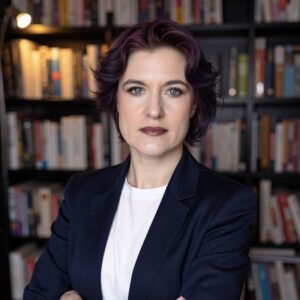
Please welcome the Center for Freethought Equality’s new Policy Manager, Galina Varchena!
What is your educational and work background?
My academic path started at the College of William & Mary, where I studied philosophy and psychology, as well as French and international relations before I moved on to American University for my JD and an MA in International Service.
Being a first generation immigrant, my perspective on American policy was forged during some pretty heavy moments: 9/11, the Patriot Act, and the wave of constitutional amendments across the country designed to prohibit marriage equality, as well as a surge in Christian nationalist, xenophobic rhetoric. Seeing those early attacks on women, immigrants, and, specifically, Muslim communities, really sparked my interest in doing work in the social justice space, though at the time I was not sure how. Throughout my time in College and Law School I had the opportunity to explore the intersections of gender, reproductive, queer, environmental and socioeconomic justice movements through volunteering, internships and externships. I figured out pretty early on that I want to devote my life to working for a more equitable, humane world and against all the forces of intolerance.
I started my career as an immigration attorney and quickly saw how a lack of reproductive healthcare access and religious intolerance could be a death sentence for my clients. Most recently, I’ve been on the ground in Virginia working with the legislature through groups like Repro Rising and Birth in Color on removing barriers to reproductive healthcare and tackling racial and socioeconomic factors around disparate black maternal, fetal and infant mortality and morbidity. My focus there was always making sure the people most impacted by a policy were actually the ones being heard by the lawmakers. Coming to the Center feels like at natural next step in my professional and personal journey.
How did you first learn about humanism?
It started in the classroom with philosophy, but it became much more real to me through popular culture and media. I spent a lot of time listening to and reading people like Dan Savage, Stephen Fry, Christopher Hitchens, and Richard Dawkins. I certainly don’t sign off on every single thing they’ve ever said, but they were my introduction to the idea that humanist thought is a viable, logical alternative to religious dogmatism and the increasing proliferation of Christian Nationalism not just in American but western politics. It took me a bit longer to find my way to the specific policy work being done by the AHA and CFE, but once I did, I knew this would be a place I could pursue my goals.
Did you grow up in a traditional religious faith? How did it impact you?
I was baptized Catholic, but religion wasn’t a big part of our household. The only time I really spent in a pew was during a brief stint at a French immersion Polish Catholic school in Canada before we moved to the States. I have read the Bible, though it was more of an educational project for me than a spiritual one. My family really encouraged me to think for myself and find my own path, which gave me the mental space to be open minded and skeptical. Today I identify as an atheist, and I’m grateful for an upbringing that prioritized my own curiosity over dogma.
What interested you most about working for the American Humanist Association?
The principles here just fit. My own moral and philosophical worldview is rooted in empathy, and I’ve spent my life trying to find ways to make the world a more compassionate place. I want to build a future that is grounded in humanist values for my friends, their kids, and my own nieces and nephews. Working for the CFE is a way to turn those convictions into policy.
What book has influenced you the most?
Bulgakov’s “The Master and Margarita is the big one for me. It was the first book I read that had a real dissident streak, and it opened my eyes to the realities of Soviet life that my family had lived through. That book started a lifelong obsession with protest movements, counterculture, and anti-establishment writers. I think it’s where my own sense of rebellion first started to take root. Also a life-long love for black cats.
If you could have dinner with any three people in the world (living or dead), who would they be and why?
The first would be my grandmother. We lost her during the pandemic shortly after she arrived in the U.S. from Latvia. I’d give anything to have one more long talk with her, share stories about my wedding, introduce her to my husband and hear more about her life. I left Latvia when I was 11, and for many years we talked maybe once a week and on occasion exchanged letters. When she came here, I thought I would have more time with her – and unfortunately, the pandemic cut that time short, like it did for so many other people.
The second would be Terry Pratchett. I discovered his books while I was traveling through England in college and I’ve read nearly everything he ever wrote. His humor and his deep interest in the power of mythology and storytelling would make for a brilliant dinner companion. His advocacy around the dignity in dying was my earliest exposure to that topic – and I would love to have the chance to hear his thoughts around our American and Western relationship with death and dying.
The third would be the Russian poet Alexander Pushkin, another free spirit who spent six years of his brief life in exile by the Russian government. His work has been with me since I was a little girl, when my mother read his poems to me whenever I was sick. I have continued to carry his poetry with me, a link to my culture and past. I find his poetry endlessly rich and fascinating. I’d love to know what else he would have created if his life hadn’t ended so soon, and what he’d think of our world today. If I could squeeze in a fourth chair, it would definitely be Jacques Derrida, just so I could have a go at deconstruction with the originator of deconstruction – especially his thoughts around the “impossible” act of forgiveness.