
The Language of Motion: da Vinci’s “Vitruvian Man”
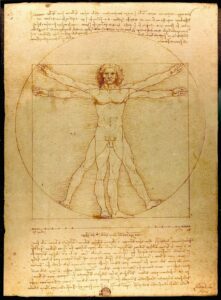 Photograph of Leonardo da Vinci's "Vitruvian Man" on display at theGallerie dell'Accademia in Venice, Italy (photo by Luc Viatour)
 Leonardo da Vinci’s “Vitruvian Man” stands at the center of the page, arms and legs outstretched, poised between the finite and the infinite. It is a celebration of the human form, balanced and elegant, inviting us to marvel at its measured, magnificent beauty, capable of thought and action.
This sense of balance and proportion in the human form has fascinated thinkers for millennia. People have long sought to understand the order underlying our bodies, trying to capture it in lines, shapes and measurements. Geometry became a way to study not just abstract forms, but the harmony present in life itself—a search for patterns that reflect the elegance we see in a single figure poised between stability and motion.
This fascination with proportion and harmony naturally leads to one of humanity’s oldest geometric quests: Can we capture the perfection of the circle in the certainty of a square?
Squaring the circle has haunted mathematicians for centuries. The challenge is deceptively simple: construct a square that has the same area as a given circle. For thousands of years, thinkers tried every method, from clever approximations to complex geometric constructions, only to discover that it was impossible—the circle’s area depends on π, a transcendental number, which cannot be perfectly captured by any finite series of rational steps.
Yet the pursuit itself shaped the development of mathematics. It inspired advances in geometry, algebra and eventually calculus, forcing humanity to wrestle with the tension between the finite and the infinite. Squaring the circle became more than a problem; it became a symbol of human curiosity, persistence and the desire to reconcile the observable, measurable world with ideal forms.
The quest to square the circle is less about its success or failure and more about the human drive to understand the hidden harmony in the world, a pursuit that stretches from ancient geometers to modern mathematicians.
And then along comes Leonardo da Vinci, who doesn’t just wrestle with geometry on paper: He embodies it. Instead of constructing shapes with a compass and straightedge, he traces them in living form, showing us that the human body itself is a canvas for the eternal dialogue between line and curve, the square and circle, thought and action.
But what is happening in “Vitruvian Man”?
If we measure the distance from the top of our heads to our feet, and the distance between our fingertips when our arms are extended, we are inscribed in a square. Next, we raise our arms so that a line can be drawn between our fingertips that passes over our heads and is parallel to the ground. We measure the angle of incline of our arms and extend our legs to the same angle, and find we are inscribed in a circle.
Leonardo shows us that while we cannot square the circle ourselves, God did, when we were created—or so the language of his time would have it. Yet what gives the “Vitruvian Man” its enduring power is not a theological claim, but a human one: that harmony can be seen, measured and understood. The elegance built into our bodies and the natural world is revealed not through divine decree, but through observation, comparison and reason. The balance of line and curve, finite and infinite, becomes legible because the human mind is capable of perceiving it. It is this interplay between the measurable and the dynamic that gives the drawing its lasting fascination—a reminder that profound order is not merely bestowed upon life, but discovered by human curiosity and intellect.
Viewed through a humanist lens, “Vitruvian Man” becomes a celebration of human perception, reason and curiosity rather than divine intervention. The proportions, the symmetry, the interplay of lines and curves reveal a universe structured in ways that we can study, measure and reflect upon. Leonardo invites us to recognize and emulate the elegance inherent in life itself, to marvel at our capacity to understand patterns, to see order, and to bring that understanding into our own work, exploration, and art.
What makes “Vitruvian Man” even more remarkable is how it anticipates motion and the principles that would later become rigid body dynamics. The figure is poised—balanced, symmetrical yet ready to move—a perfect interplay between stability and the potential for motion. Leonardo’s careful placement of limbs hints at forces, torques and energy stored in the posture, as if the body itself is a mechanical system in equilibrium, waiting for the slightest nudge to erupt into motion. The muscles themselves suggest this readiness: Their smoothness and continuity of line imply an effortless transition from relaxation to action. In this sense, the drawing inverts the usual static view of geometry—the human form becomes a living coordinate system in which distances, angles and rotations can be measured, analyzed and translated into the mathematics of motion. It is almost as if Leonardo envisioned the calculus of dynamics centuries before it existed, showing us that understanding balance, rotation and potential energy begins not with abstract symbols but with careful observation of the world in motion. “Vitruvian Man” thus becomes more than a study of proportion—it is an early, intuitive blueprint for understanding the mechanics of living, moving systems.
Leonardo’s “Vitruvian Man” is more than geometry; it is a bridge between the tangible and the aspirational, the seen and the conceivable. On one hand, the square of the body shows proportion, symmetry and balance—the rational, measurable structure of the world. On the other, the circle traced by the angles of the limbs speaks to continuity, rotation and perfection, hinting at mysteries beyond our immediate grasp. While humans cannot literally square the circle, our very bodies carry evidence of a natural harmony that surpasses calculation. This duality mirrors the world of physics: The straight line becomes direction, distance, a measurable quantity, while the circle embodies motion, rotation and the language of dynamics. Together, line and circle form the foundation of understanding—from planetary orbits to the swing of a pendulum. Yet Leonardo reminds us that mathematics, mechanics and measurement are not mere abstractions—they are expressions of beauty, curiosity and human ingenuity. By contemplating the proportions, rotations, and balance of the human form, we glimpse both the principles of the universe and the artistry of life itself, a reminder that the pursuit of knowledge and the experience of wonder can coexist in perfect harmony.
And from this perfect balance between line and curve, between stability and motion, we arrive naturally at polar coordinates. René Descartes, laying down a rectangular coordinate system on paper, set the stage to connect algebra and geometry. Leonardo’s mind, however, was already prepared for something subtler—the polar coordinates of distance and angular rotation: the motion of planets and celestial dynamics. In his mind, the outstretched arm becomes the radius and the turning circle becomes the angle. The human form itself becomes a living map for understanding rotation, direction and the mathematics of movement: The line points, the circle turns, and the stage is set for exploring the world through the language of motion.