
Hope in Exile: Afghan Refugee Children Struggle for Education in Pakistan
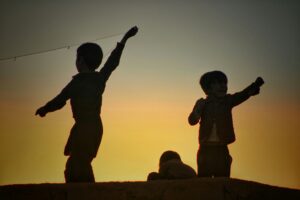 Photo by Farid Ershad on Unsplash
 Exile doesn’t talk, yet even the dreams of Afghan children don’t stay quiet. The noise of factories in Pakistan can supplant the ringing of school bells in refugee settlements. Empty notebooks are sitting around waiting to be used in what is becoming a more distant future. To thousands of Afghan children, education is now a luxury, something they may wish for but won’t have.
In August 2021, my family left Kabul when the Taliban came back to power. We had to leave our home and all that was familiar to us. I was then a high school student, and I wanted to follow my dream of becoming a doctor because I thought education would protect me against the world of confusion. However, the act of going across the border into Pakistan froze this goal. We didn’t find any waiting classes, any teachers, any assurance of the future—only the raw situations of displacement and uncertainty.
This isn’t only my case, but also the case of thousands of Afghan refugee children in Pakistan. The National Commission on the Rights of the Child in Pakistan indicates that only 28% of school aged refugee children have access to public schools or UN Refugee Agency-supported schools. The rest, who would love to study, are pushed out by the law or policies. To access formal schools, certain documentations such as birth certificates, national identification and family registration records from Afghanistan are required. However, most families fled quickly without these documents, or they were lost along the way. Even when they do produce them, they are often turned away, leaving children to spend years waiting at home. For children, this means lost years without education, and for parents, it means watching their children grow up believing that education is for others, not for them. Even when schools are open to refugee children, costs such as fees, uniforms and transportation become barriers for families already struggling to survive. For many, the choice is not between school and no school, but between school and food. Even worse, girls have difficulties even more restricted to homes because of safety issues.
In response, communities and small organizations have stepped in where formal structures are falling short. Across Pakistan, a quiet network of community groups and small organizations is trying to hold together education for Afghan refugee children. These are not large, well-funded systems, but improvised efforts shaped by necessity.
They have created informal schools and classrooms, learning circles and support networks that attempt to bridge the gap between exclusion and opportunity. My TOEFL (Test of English as a Foreign Language) House Learning Circle was formed by two Afghan educators in Rawalpindi, Pakistan. These parents and young adults met every day in a community center, using donated books and online resources to support each other’s learning. Over time, these informal circles not only improved their academic skills but also gave the families a strong sense of support and community.
Another group of Afghan families gather every day in a rented room in Muhammadi Chowk, Pakistan. Without a formal school building, they meet in this small, shared space, sometimes inside a mosque or a community center. Using donated books and free Wi-Fi, these informal gatherings allow children to study, share knowledge and grow together, bridging the gap that the absence of formal schools often leaves behind.
Refugee-led groups, often formed by educated Afghans, play an important role in sustaining access to education and cultural identity. Dawood Hosseini, an educated Afghan, established a refugee-led group that provides informal classes for younger children in rented rooms or community centers. These informal classes focused on core subjects like literacy, math and English, along with Afghan cultural studies to preserve their heritage and identity.
These efforts are not perfect, but they reflect a practical and human response to a crisis that policies alone have not resolved. They show that while the barriers are real, so too are the attempts, often quiet and unnoticed, to overcome them.
Local organizations try to support these spaces with supplies or small stipends, but funding is uncertain and inconsistent. There is also the challenge of recognition. Children who study in these informal settings rarely receive certificates that are accepted by formal education systems, making it difficult for them to transition into further schooling later. Despite these obstacles, these learning spaces offer something vital—a sense of normalcy, dignity and hope. They show that even in displacement, communities are not passive recipients of aid but active creators of opportunity.
Exile education isn’t merely a learning process but a resisting process as well. It states that there will be no borders or political indifference in the pursuit of knowledge. One child, one teacher, one book and one pen can transform the world, as Malala Yousafzai once said. The pen of Afghan refugees is usually broken, but the hand holding it is steady.
There are important lessons in these experiences for those working in humanitarian education. First, community-led efforts should not be seen as temporary or secondary, but as essential foundations that deserve support and investment. These initiatives understand the realities of refugee life better than any external system and are often the first to respond. Second, reducing barriers to formal school enrolment would immediately expand access. Flexible policies around documentation and fees could allow thousands of children to return to classrooms. Third, education programs must be consistent and long-term. Short-term interventions cannot address a crisis that has already lasted for years. Refugee children need continuity, recognition of their learning and pathways into accredited systems. Finally, listening to refugee communities themselves is critical. They are not only beneficiaries but partners with knowledge, resilience and solutions shaped by lived experience.
Behind any statistic there is a true story, such as my own. A boy who lost his classroom, a mother who cried without making a noise, a family that is difficult to survive. Such tales seldom feature in the headlines but one can feel the burden behind the story.
Education shouldn’t be a privilege, but a lifeline. This crisis won’t be complete until all Afghani refugees’ children in Pakistan are able to open a book without fear. While the world is preoccupied with the borders and policies, Afghan refugees are waiting—not to be given charity but to be given a chance, not to be offered sympathy but to be granted justice. During exile, there is still some flickering hope. And even then, all that it needs to sustain itself is one voice saying:
“Don’t worry. You still have a future ahead.”