
I Learned Nothing in the Bornean Jungle
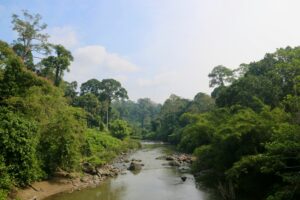 Photo by Polina Koroleva on Unsplash
 I haven’t learned anything since I got here.
Apparently the Bornean pygmy elephant is just the Bornean elephant now. Found that out the hard way. Still, it’s nice to see the little guy get a win after what they did to Pluto. On Tuesday, I mistook a wrinkled hornbill for a wreathed hornbill on a boat full of birders.
“Almost, buddy.”
Jesus. There’s enough feathers, may as well tar me too.
And on Sunday, I faced my name.
For a long time, the Bornean jungle did not know “Garrett.” Even “Gaz” was a stranger to the olive undergrowth. For the most part, I am “Kowan.” I am “Jo.” I am “Bodoh Orang Putih.” Here, the orang bunian, or “forest spirits”, have their own voice. If they learn your name, you must never respond. Today, I answer anyway. Halfway through, I freeze.
There are roughly five million hairs on the human body. Alone, beneath a waning crescent moon, they stand in unison. This is a physiological reaction, to appear larger in tense moments. Yet it is strange; I have never felt so small. Behind me, twigs snap with the sound of breaking fingers. My heartbeat hammers in my temples. The bushes splay open and white light bleeds through verdant, pearly gates.
“Okay! Let’s go.”
Rather than my impending doom, it is a young field assistant who lost me in the night. I am no sweatier than usual, and by the fluorescent light of his headtorch, I would look ghostly regardless. We rejoin the rest of the group at the plantation. It is a warm night. They all are. The air is heavy with humidity. Heavier with trepidation. Rain is coming, and the ice pack melted hours ago.
Time to go home.
Amanda, the project lead of this leopard cat study and an Indigenous Sabahan, settles into the front seat. On a night like this, it’s normal to go through one GPS collar, two blood samples, three spare batteries, four nets, and five hours of your life to get the job done. Still, she remains remarkably talkative, while I am delirious. Each sentence unfolds from the last, revealing this landscape piece by piece as if the sun was rising over it. Without effort, the back seat of this Hilux has become the front row of a lecture hall.
Naturally, I am captivated.
The path is almost archetypal. A nature lover. A childhood colored by wildlife documentaries and walks under forest canopies. Soon, she was volunteering, sunbaked while surveying with the Sarawak Dolphin Project. Then came the Bornean Sun Bear Conservation Centre, and a belief in education as a prerequisite to conservation. Now, as a PhD candidate at the Danau Girang Field Centre, she studies the space use of leopard cats within Sabah’s palm oil plantations, research that speaks to the critical tension between ecological survival and modern development.
She is tethered to this land, her home, and its conservation. Yet, melancholy carries in her voice and ripples in her laugh. They have grown up together, and Sabah has changed alongside her. Like any relationship, time has reshaped them both.
The creation of a thought is a long and arduous process, especially an insightful one. In my most reflective, meditative moments, each segment of my brain croaks into action. I feel them unite and flow into one another like cobwebbed cogs in a great clock. First, two marbles begin rolling around my cavernous cerebellum; on occasion, they collide, igniting like flint and steel. There’s a small bit of string where the cerebral cortex was. If you get lucky, the flame catches. In the frontal lobe, a small mouse has made its den. Assuming the mouse has not bitten through it, the string can catch, and the flame can burn through.
The candle is lit. Light pours from my ears as if the bulb is soon to burst. Enlightened, I inquire:
“Have you noticed any changes in the younger Sabahans? Do their attitudes differ from previous generations?”
“I mourn the loss of a certain set of skills. There is a change of life habits, and a loss of tradition.”
Although Amanda was raised in Sandakan, a coastal haven colloquially coined “The Nature City,” she belongs to the Kadazan, a local Indigenous community often referred to as the “people of the land.” Their homes are adjacent to glassy rice paddies. Their fingers are hardened from handweaving fishing nets. Their obsidian black dresses absorb light, but reflect an extrinsic, continuous animistic tradition.
But these communities exist in a globalized world and a Sabah which is modernizing rapidly. Suddenly, oral traditions compete with formal education systems and a metropolitan lifestyle. As a new world arrives, it becomes incredibly difficult to retain these historic customs.
And yet, it is difficult to find blame in this shift. A mother cannot blame her children for growing. Pursuing opportunity. Making mistakes and learning from them. Is it not the whole point of education? To empower individuals to act on their own?
There are no theatrics, no denouncement of the past. The loss is quiet. A plastic fishing net with glassy lead weights. Hushed names in a jungle where there used to be none.
Nonetheless, the dichotomy is stark. Western epistemology is standardized. Unbiased. Hard cover, white walls, wooden desk, lead pencil, black shoes, red pen, back straight, hand up, yes sir, no ma’am, no more questions. Indigenous systems are practical. Nuanced. Effective. Immediate. It lives in weather patterns and forest medicine, animal tracks and customary festivals: knowledge that is specific to the community and its resources.
Western scholarship is rigid. In many places, its breadth lacks depth. Truths found through spirituality, experiential knowing and collective inheritance are often barred from entry. But when we utilize Indigenous knowledge as a parallel perspective, their joint strength materializes. Modern medicine arrives in paracetamol packets. But when you are on a day’s trek into the jungle, there is only tongkat ali root and a double dose of ground ginger.
A lighter sparks.
Resin, hand-picked from a Hopea tree, smoulders in the corner. The incense curls through the air, climbing like vines towards the crown of my head. It was collected by the field assistant who, much like Amanda, has shown me a world understood through experience, not examinations.
In boats and back seats, beneath canopies and crescent moons, I have been met with custodians eager to share their knowledge. But funnily enough, by Western standards, I haven’t learned anything since I got here.