
BOOK EXCERPT: A Baby Teaches Me the Truth
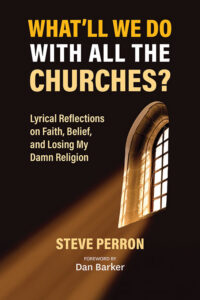
The following excerpt is from the new book, “What’ll We Do With All the Churches?” by Steve Perron. His book is unique among the growing field of memoirs and commentaries on faith and religious deconstruction in that it is built around 13 original songs, all written by the author. Perron is an Emmy Award winning journalist (15 Emmys) and a nationally recognized singer/songwriter (2022 “Golden Pick” winner at the world famous Bluebird Cafe in Nashville). He grew up a devout Catholic, spending seven years in the seminary studying for the priesthood. He now identifies as a secular humanist. The book launched in May, and is available for purchase on Amazon and other outlets. Steve Perron will be appearing as a speaker and performer at the annual NaNoCon gathering in Nashville, July 31st – August 2nd. The following excerpts are from chapters 11 and 14.
I am the father of two beautiful children and the two most perfect grandchildren ever. (No, really, I mean it. There have never been any grandchildren more handsome, more intelligent, more perfect.) Our son came first, arriving during trying times. We weren’t married even a year, living in a big city far from home, with no family anywhere near and almost no friends who were also parents. We were truly on our own.
Plus, I had just been laid off! Still, I managed to find occasions in the midst of all the worry and sleepless nights to marvel at the miracle that was our firstborn. I recall with such clarity one afternoon standing over him as he napped being hit with the sudden realization that this is a human being! We had birthed, created, a human! I almost became wobbly over this. (Yes, I know — I sometimes have weird thoughts, see things in bizarre ways.)
There is another clear memory. I was holding him in my arms, both of us rocking, as he slept. I was marveling at his pure innocence and absolute beauty when, out of nowhere, I started thinking that in spite of his obvious perfection, he was already a sinner in the eyes of the Christian faith. According to my faith, this knee-bucklingly sweet child was far from perfect. He was in fact damaged, broken, and in need of saving to avoid a certain eternity of pain and misery. All through no fault of his own! No, it was because of a sin, the Original Sin committed eons ago by characters in one of the more fanciful Creation stories of all time. (Even as a believer, I never really bought into the whole Adam and Eve thing.) Christianity tells us we are stained by Original Sin from the moment of conception. So my son was a sinner before he was born — even as I watched his balled-up fist punch up and sweep across the inside of my pregnant wife’s stomach. (Yet another awe-inspiring sight I will never forget!)
“There is much of Christian teaching and messaging such as love your neighbor, especially the poor and minorities; avoid violence; do unto others; etc., that I endorse and support, but these notions of sin — no! ”
At this time in my life in my mid-twenties, I was still a believer. But even so, in my mind, I screamed, “No! — my son is not a sinner!” He did not need cleansing or saving! I often look back to this declaration as one of the key moments in my journey of doubt, when I started to seriously question my Christian beliefs. I have since come such a long way, making a twisting and trying journey in matters of faith. But one thing has never changed, and that is my utter revulsion over the uniquely Christian concept of Original Sin. It is an idea that is directly tied to the Christian obsession with guilt, suffering, blood, sacrifice, and death. There is much of Christian teaching and messaging such as love your neighbor, especially the poor and minorities; avoid violence; do unto others; etc., that I endorse and support, but these notions of sin — no! That’s a problem because they are absolutely central to the Christian salvation narrative.
I hear songwriters sing about it all the time. I have been hosting one of the most popular open mics in the St. Louis area for well over a decade. We have a lot of players come in and perform original songs about their Christian faith and their love for Jesus. The songs are good! But so many are about that stuff: sin, misery, pain, tears, and — of course — blood. Washed in the blood! I hear that phrase in songs all the time, and each time I hear it, I flinch. It was after one especially anguished performance at my open mic that I wrote this next song. I consider it the most personal, emotional work in this collection. Believe me, I was feeling it when I wrote this one. So let’s get to it:
Don’t Need to Be Set Free
(Written in early 2024 after hearing a songwriter wail about sin, misery, anguish, tears, and being “washed in the blood of Christ.”)
I see you when I walk
I hear you when I talk
I know that you’re around
Even though you don’t make a sound
So many years I lived in fear
Racked with guilt, drowned in tears
But I got up off my bended knees
I have been released
Got no blood washing over me
No veil of tears, no misery
No miracle to deliver me
No, I don’t need to be set free
Got no chains a-binding me
I don’t need to be set free
I used to hold such pain within
Thought I was born with Adam’s sin
What kind of world believes that’s true
What kind of God does that to you
Got no blood washing over me
No veil of tears, no misery
No miracle to deliver me
No, I don’t need to be set free
Got no chains a-binding me
I don’t need to be set free
So what is God, what is truth
What is evil, what is good
Who is wrong, who is right
Who’s in the dark, who walks in light
Won’t find the answer in a book
It’s all around you — just take a look
It’s right there in you — just take a look
The song “Don’t Need to Be Set Free” is a musical meditation on..the idea of Original Sin. Christians teach that we are all sinners and that the only way our all-powerful God could think of to correct that was with a bloody human sacrifice. This horrifying idea is the foundational principle of the Christian faith. I now strongly reject the Christian fixation on sin, blood, human sacrifice, guilt, penance, confession, etc. When I was younger, I would get angry upon hearing or reading critics of Christianity refer to the faith as a blood cult or a cult of death. But now, I have to admit, I kind of get it. I see where those critics are coming from.
I have a different obsession these days and that is that humans do not need to be washed in the blood of Jesus, or anyone else’s for that matter. There is no need to kneel and bow down, to beat our breasts, to cry out for redemption and cleansing as a result of a sin committed unknown thousands of years ago. No! Today, I instead believe that:
• We are not born damaged and broken.
• We are not born with black holes in our souls.
• We are not born depraved.
• We are not born sinners.
• We are not born in need of heavenly repair or saving.
• We are not any of those things!
We are, each and every one of us, born good and beautiful. The inherent goodness of every baby — for that matter, every human being — is not an illusion, it is real. If this were the prime teaching of the Christian faith, as opposed to its sickening obsession with sin, the world might possibly be a far better place.
So What Am I, Then?
So what the Hell am I? The answer is important to me. It matters. But damn — it’s hard! For a once devout Christian, these are turbulent waters. I knew I could no longer accept the truths of traditional Christianity, which I now consider nothing short of — I don’t know how else to put this — bizarre. But I am just not comfortable declaring myself an atheist, and not because I still hold out some kind of heavenly hope. No, that ship has sailed and I do not want to get back on!
Then, in 2024, I came across a book on the giveaway cart at the local library. That book was “The God Argument: The Case Against Religion and for Humanism” by A. C. Grayling, a British philosopher. In it, he lays out a wonderful argument in favor of secular humanism. As he describes it, humanism is a system of ethics in which each individual is responsible for choosing his or her values in collaboration with other humans, but with no input from or reliance on what is broadly referred to as authority. Authority in this sense refers to any system of beliefs, laws, and such that is followed simply because it has always been in place — most notably those systems believed to be divinely authored. That would include things like the Ten Commandments or the sacred writings or dogma of any given religious or supernatural faith. A secular humanist is one who relies on no God or divine authority or holy scripture as the author or inspiration of the ethics that guide human affairs. Upon reading his book, I realized this is what I am, a secular humanist. A secular humanist may take no position at all on whether God exists but will argue vehemently against citing any reference to or reliance on God or the teachings of a particular faith as the basis for establishing cultural norms or drafting laws or government policies. Yep — that’s me.