
EXCERPT: Searching for Soul: A Brain Surgeon’s Exploration of Near-Death Experience and Afterlife Chapter 3: Doorstep of Death
THE FIRE
Patricia vividly remembered, even after twenty years, the potentially deadly situation she was in. What should have been a terrifying near death experience actually turned out to be, she believed, supernatural and profoundly transformative. The divine being she encountered and what she saw during that experience confirmed her religious beliefs about God. As the cameras rolled, she narrated her incredible and fiery near-death experience, occasionally interrupted by the barking of the lazy dog lying on the sofa and the chirping of the bird in the cage.
Patricia was in her fifties when she and her husband decided to go on a vacation to Florida. They drove in their old but usually reliable motor home from Michigan to Orlando, Florida. They had a very enjoyable vacation. On the way back home, they decided to stop in Tennessee to visit and stay for a couple of days at Patricia’s in-laws. They had to stop at a gas station to fill the gas tank. When Patricia’s husband tried to start the motor home after filling up on gas, the engine wouldn’t start. He spent a few frustrating hours getting the starter working. Eventually they got on the road and decided not to stay in Tennessee and get back home as soon as possible. They stopped briefly at Patricia’s in-laws but didn’t turn the motor home off for fear that it wouldn’t start again. Once they reached Michigan, they decided to stop at Kalamazoo to visit their daughter, who was in school studying to become a physical therapist.
It was a snowy winter day when Patricia and her husband arrived at Kalamazoo. They stopped in a motor home park for the night and were planning on visiting their daughter the next morning. Patricia’s husband decided not to turn the engine off again, for fear of the issue with the starter as well as the cold night. When it was time to sleep, he did warn Patricia not to sleep at the back of the motor home where the bed was because of exhaust fumes. But Patricia refused to listen to her husband’s advice. She didn’t want to sleep on the couch. She needed her space and the comfort of the bed to get a good night’s sleep. Little did she realize that the night was going to be eventful and potentially deadly.
THE POISON
Patricia was woken up from sleep by the smell of something burning. She saw fire and smoke at the back of the motor home. Before she could get up, the motor home was rapidly filled with smoke, and she couldn’t see much. She tried to get off the bed but felt dizzy and unable to move her arms or legs. She momentarily regretted not listening to her husband’s advice about not sleeping at the back of the motor home. She thought it was Lord Jesus warning her through her husband but didn’t heed his advice. The regret turned into fear as she started to feel like her mental faculties were fading. In addition to her body, her mind also was getting weaker. Her head started aching and she felt nauseated; her heart was racing and breathing became harder and suffocating. She was getting disoriented, confused, and she felt like sleeping. For a second she wondered if she was dreaming or if the fire was real. There was a disturbing sense that something catastrophic was going to happen. She fought very hard to stay alert and awake, but the effort was futile. Darkness came over her and she passed out.
Patricia’s husband warned her about the potentially deadly fumes from the exhaust which contain carbon monoxide (CO) gas. The fire, burning in the back of the motor home, heightened the exhaust fumes from the motor running, increasing the amount of CO. We all know what happens with carbon monoxide poisoning from fireplaces in ill-ventilated homes and automobiles running in closed garages. Unless rescued in time, the gas can kill. Carbon monoxide binds with hemoglobin in red blood cells and prevents oxygen from being absorbed from lungs. Important organs of the body, brain, heart, and muscles become deprived of vital oxygen. The confusion, dizziness, and unconsciousness that Patricia experienced were due to lack of oxygen supply to the brain. If there are high levels of CO, and one is exposed for long enough, one can die from the stopping of the heart or brain death. The fact that Patricia survived the motor home and lived to tell the story suggests that the exposure was not severe enough to be deadly—but it was severe enough to push her close to the doorstep of death. In fact, she believed that she had a most amazing and divine near-death-experience.
JESUS, THE SAVIOR
Patricia remembered becoming unconscious, and the next thing she saw was Jesus Christ himself standing in front of her. Instantaneously she and Jesus appeared outside the burning motor home. Patricia was convinced that it was her soul that left the motor home and followed Jesus. When I asked her how she could be sure that it was her soul that was in the presence of Jesus, she said they were not standing on the ground. They were floating three feet above the ground, and she was able to look through the window and see her husband inside the smoke-filled motor home. She wouldn’t have been able to see him if she was standing on the ground. Also, she tried to reach and touch Jesus but couldn’t because the hand was not physical. It was immaterial. She found Jesus to look exactly the way she remembered seeing him in a movie, with stunning blue eyes. She wanted to leave this earthly life and follow him to heaven, but Jesus told her it was not her time. She was told to stay on earth because her husband and daughter needed her. She understood that she was being selfish in wanting to be with Jesus but agreed that she was needed by her family in this life on earth. She asked Jesus if her husband was going to die. He replied in the affirmative and said she would die too. She then begged him to save her husband, and she believed it was Jesus who saved her and her husband from the burning motor home. I was curious to know how she was rescued by Jesus. Could it have been somebody from the motor home camping site? She recalled stumbling out of the motor home along with her husband. I asked if her husband helped her instead of Jesus. She said she and her husband helped each other out, but it was Jesus who made that possible. She was weaker than her husband and fell onto the snow on the ground as soon as they were outside the motor home. Somebody called for an ambulance, and she was taken to the hospital.
She was kept in the hospital for a day. Her heart was checked with an electrocardiogram (ECG). Fortunately, there was no damage to her heart. She was given intravenous fluids, and her blood was checked for any electrolyte abnormalities. They were normal. Her daughter visited her in the hospital and stayed at the bedside. Gradually Patricia regained her strength enough to get on the road. Though partially burnt, the motor home was able to be driven back home in Traverse City, up in North Michigan.
The terrifying ordeal weighed heavily on Patricia’s husband. He felt responsible for the fiery accident that could have potentially killed his wife. It was hard for him to bear that thought. Patricia believed that made her husband depressed. On the other hand, the near-death experience had a totally different and profound effect on Patricia. She never once doubted that her soul left her physical body in the fiery motor home and that she had a conversation with the Lord, Jesus Christ. The experience further deepened her religious faith and her desire to leave the painful life on this earth. She longed to be by the side of Jesus in heaven. When I asked if she believed in heaven, she was emphatic in its existence because she had glimpses of heaven during her near-death ordeal. In her vision of the heavenly realm, she encountered angels also and almost entered the palace of Jesus Christ. The fiery motor home experience was very different from her out-of-body experience during her brain surgery. It is also different from Cheryl’s fear-death experience during her car crash. Carbon monoxide poisoning that pushed Patricia to the doorstep of death resulted in a profound near-death experience (NDE).
Near-death experiences are not uncommon. The recorded accounts of NDEs are sparse in ancient history, but the late nineteenth century appears to be the beginning of the reporting, documentation, and discussion about NDEs.
FALLING FROM THE MOUNTAIN
Albert Heim experienced a strange, brand-new sensation as he was falling down the cliff of the mountain. Heim was an experienced mountaineer and loved the majestic Alps of his country. Born in Zurich, Switzerland, he had interest in the formation of the mountains from a young age, which led him to become a distinguished professor in geology and eventually the director of the Swiss Geological Survey.2 As a geologist studying the mountains and scaling them many times, he was aware of the potential danger of falling down while climbing. He knew a fall could be fatal but didn’t know what would happen if he actually fell down. He did find out when he had an accidental fall from the mountain. Though not fatal, he felt like he was close to death as he was falling. The experience had been something unusual. He felt as though time was slowing down and expanding during the fall. The possibility of expansion of time during the fall was something that never crossed his mind until that fateful near-death experience. He could not comprehend how time would be perceived much different during the fall than usual. Intrigued by the experience, he collected accounts from falling mountaineers that had similar experiences over the next few years. Some of them also felt like time was speeding up, but some felt it was slowing down. A few also claimed that they didn’t experience any significant pain while falling.3 He published the pioneering collection of those experiences in 1892. The paper was considered to be the first to do so regarding experiences during life threatening situations.
Two years prior to that, in France, psychologist Victor Egger and fellow psychologists were having discussions with philosophers about what the climbers experienced while falling down the mountains. Some of them believed they were falling to their death and felt like their lives flashed in front of their eyes, something like a sped-up life review. Egger coined the term experience de mort imminent (experience of imminent death) in 1890.4
Heim’s collection was considered to be the first-ever report of near-death experiences. One could argue that those experiences were more likely to be fear-death experiences rather than true near-death experiences. Many of those experiencers were said to have reported even loss of perception of time altogether. Heim mentioned his experience of and altered perception of time to his students. One of his students was a young man who would become the greatest physicist of his time, Albert Einstein. Interestingly, the story goes that Albert Einstein might have been influenced by Heim’s story of expansion of time in coming up with his theory of general relativity that proposes space and time might be relative rather than constant.
A few decades later, British parapsychologist Celia Green was interested in dreaming as well as in people who experienced a sensation of leaving their physical bodies and looking at themselves from the outside. Fascinated by such experiences, she published a book in 1968 about four hundred such experiences that she collected firsthand.
She called them “Out-of-body experiences,” but they were perceived to be hallucinations.5 John Cunningham Lilly, a neuroscientist, psychoanalyst, and philosopher, conducted research in isolation tanks to understand what happens during sensory deprivation, including when under the influence of psychedelics like LSD. He coined the term “near-death experience” in 1972.6 Just three years later the bestselling compilation of more than a hundred near-death experiences by a psychiatrist in America brought the phenomenon of near-death experience into the mainstream consciousness of the nation and world. It also triggered a serious national and international debate about the nature of these experiences among the general population as well as in the scientific community to understand the phenomenon.
Exorcising Patricia’s satanic and demonic visions by excising the brain tumor and listening to her out-of-body experience during surgery and near-death experience from earlier carbon monoxide poisoning, increased my curiosity to understand these intriguing phenomena. I became inquisitive and wanted to begin with knowing if there were similar experiences in ancient human history, and that such experiences are not just modern occurrences.
THE DEAD RISING
It is not too hard to imagine that throughout human history there might have been many who came close to death but survived. It is likely that some of them had near-death experiences, where they felt their soul or spirit take a heavenly flight and encountered divine or deceased beings. Unfortunately, not many appear to be recorded in ancient history. Also, it is unlikely that the concept of near-death experience even existed. If somebody was unconscious or unresponsive for a while, they were presumed more likely to be dead rather than comatose, and if they recovered, they were considered to have been actually dead and returned to life. There was no concept or criteria for respiratory, cardiac, or brain death. There was no CPR. Even if they were able to observe any of the vital bodily functions—like breath or a heartbeat—they might not have known the difference between a comatose state and irreversible death. So, it is quite possible that, in ancient times, any recalled experiences that would be considered near-death experiences were interpreted as souls of dead returning from journeys into the otherworld. In other words, they believed in the dead rising.
There are three accounts in ancient Greek literature that reflect the dead rising; the fable of Aridaeus of Soli and the vision of Timarchus were from the writings of Plutarch, who was one of the priests in the Temple of Apollo at Delphi, and the more famous account of “Myth of Er” was from Plato’s Republic.7
THE FABLE OF ARIDAEUS OF SOLI
There is a debate if the fable of Aridaeus and the vision of Timarchus were fictional or true accounts as recalled by Aridaeus and Timarchus. Aridaeus of Soli was a hedonistic and passionate man, indifferent to the suffering he caused others in the pursuit of his mortal passions. Having exhausted all his money, he resorted to stealing and deceiving others. One day he fell down from a height and struck his neck. Even though there was no obvious outward injury, he was unconscious and thought to be dead. On the third day as he was being lowered into his grave, he woke up to the astonishment of the onlookers. He transformed into a virtuous man to the surprise of the others, who could not believe the magnitude of his transformation. When asked what caused his change, he recalled and narrated the journey to the otherworlds, of his soul liberated from the body.
Upon his fall from a height, Aridaeus’s soul was flung swiftly as a pilot into a sea. He rose up and saw brilliant light on which he journeyed up among the celestial bodies and watched the stars. He felt as though his soul became a single eye watching the marvelous colorful lights emanating from the stars. It was an ecstatic flight on the light that took him higher and higher. From that vantage point, he saw souls coming up in what appeared to be fiery bubbles, which burst and released the souls that emerged in a human form. As he attempted to communicate with one of the souls he recognized as a relative, the soul addressed Aridaeus with the name Thespesius, meaning “godlike,” and told him that the intelligence of his soul is what was traveling up while the rest of the soul was anchored in the body on earth, and that he did not actually die. The relative also explained that the various colors he saw in the stars were visual evidence of souls being punished and purified. The souls did not cast shadows, and their eyes did not blink. Once the souls reached a single hue, they were deemed purified. Once purified, godlike artisans molded the souls into new forms for rebirth on earth. Thespesius was taken over a long distance to a place where he saw a giant dark hole, which looked like an enormous gaping mouth of a tunnel. Thespesius saw many souls together and in angst in the tunnel. He was taken to another place where souls were being punished. He was taken aback to see his father being punished there for poisoning his guests to get their money. His father might have escaped the punishment on earth but not in the otherworld. In fact, those who escaped punishment on earth got the worst punishment. Thespesius was also taken to a place considered to be “oracle shared by night and moon,” which was the source of fantasies and nocturnal dreams. Thespesius informed his audience that his soul’s journey to reveal that no man would escape the inevitable punishment after death was responsible for his transformation. The fable of Aridaeus has some elements that are common to near-death experiences: bright light, dark tunnel, meeting dead relatives, visions of heaven and hell.
THE VISION OF TIMARCHUS
The vision of Timarchus is an account of what he experienced when he descended into the underground darkness of the “Crypt of Trophonius” for two nights and a day. His relatives presumed him to be dead and were grieving when he came out of the crypt with “radiating countenance.” He described his experience while in the crypt. In the total darkness he was not sure if he was awake or dreaming when he heard a loud noise and was hit on the head. He believed the sutures of the head opened and his soul escaped through that opening in the head. Relieved to be free from the confines of the physical body, the soul expanded joyfully and heard a whirring noise above. Looking down, the soul saw a dark round gaping chasm as if a sphere was cut away. He heard groans and roars of animals, men, and women faintly coming from the dark chasm. He also saw beautiful otherworldly landscapes and marvelous scenery. Suddenly a man, whose identity was not revealed. asked Timarchus what he wanted to know, and Timarchus replied that he wanted to know matters of everything. The man’s voice replied that he would have better knowledge after three months, but it was time for him to depart, at which time Timarchus experienced severe pain in his head and woke up to find that he was at the entrance to the crypt. The vision of Timarchus also has some elements characteristic of near-death-experience from a head injury.
THE MYTH OF ER
Socrates, in his conversation with Glaucon, Plato’s older brother, was discussing the rewards of living a virtuous life and the inevitable consequences of evil life, after death in the otherworld. The “Myth of Er,” as mentioned in the concluding part of Plato’s Republic, detailed the judgment of the souls after death and punishments accorded in the underworld for unjust earthly life, as well as pleasures rewarded in heaven for a just and virtuous life.8
Er, the soldier and son of Armenios, was slain in the battle. Ten days after the battle, when the bodies of the dead soldiers were being collected, the body of Er was the only one, unlike the others, that was not decomposed. Two days later when his body was placed on the funeral pyre, he woke up and told the experience of the journey of his soul to the otherworld.
Er revealed that when the soul rose from his body it traveled with a few companions to a mysterious place. There he saw two holes on earth that were going to the underworld, and two other holes above them toward heaven. He saw souls being judged at that place to allow ascension to heaven for living a virtuous life and thrown into the underworld for living an evil life. He saw souls being thrown into one hole leading to the underworld with symbols of deeds that reaped the punishments tied to their backs and some coming up through the other hole from the underworld—dusty, weary, and horrified. The punishments were for one thousand years. When the unjust tried to ascend to heaven, a loud roar from the mouth of the hole into heaven alerted the guardians who ensured that the unjust souls were thrown back into the underworld. He also saw the souls of the ones that lived a just life sent up through one hole to heaven with their rewards tied to the front. There were some descending through the other hole from heaven, joyful, in white clothes and with bright light around them.
When the souls from the underworld and heaven gathered in what appeared to be a garden, they enquired with one another about what they experienced in the otherworlds. The souls from heaven saw heavenly delights, indescribable beauty, and divine light. The souls from the underworld described horrible punishments. Er was chosen to be the messenger to let others on earth know what awaits in the afterlife and the consequences of rewards or torture depending upon how one lived life on earth.
The story of Er is an example of an incredible afterlife journey of the soul after death into an otherworld and then returned to the physical body on earth. It was not described as a near-death experience. Did his soul ascend to the otherworld after he was truly dead, or was it a near-death experience? Though the great Greek philosophers Socrates and Plato were very inquisitive and thoughtful, there was not enough knowledge or understanding of life and death to decide if Er was truly dead on the battlefield or close to dying but survived. It’s more likely a near-death experience. Since his body did not decompose like the bodies of the other slain soldiers, it is likely that he was comatose and recovered when on the funeral pyre on the twelfth day. That’s a question to be debated another time, but Er’s story probably had a profound influence on Plato’s beliefs in the existence of the divine. It also might have affected his philosophy that was centered on living a virtuous life to achieve soul’s ascension to heaven in the afterlife, which in turn influenced many subsequent philosophers and Christianity itself.
The globally common and universal elements of near-death experiences—irrespective of religion, culture, or ethnicity— are fascinating, especially what experiencers believe to be the disembodiment of their souls and their flight into supernatural realms of heaven along with encounters with gods and angels. Interestingly, the NDEs of humans from ancient history who believed their souls took flights into supernatural realms of heaven and hell have uncanny similarities to the modern-day NDEs. I really wanted to hear more, and in detail, about Patricia’s glimpses of the afterlife. What Patricia saw in heaven during her soul’s flight, her conversation with Jesus, and her glimpses of heaven and angels reminded me of the stories of gods, angels, heaven, and hell from the other major religions, especially the ones from Hinduism that I heard about as a young boy growing up in India.
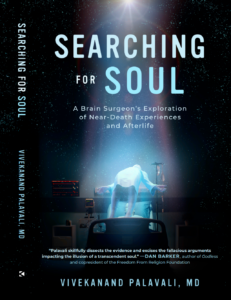
In Searching for Soul, neurosurgeon Dr. Vivekanand Palavali dissects mysticism, religiosity, spirituality, and twenty-first-century neuroscience on the nature of near-death and out-of-body experiences, taking the reader on a journey through history, heaven, and the heart of the human mystery. Through anecdotes, philosophical history, religious research, and modern-day neuroscience, Dr. Palavali aims to ask and answer the age-old question: What is soul?
Dr. Vivekanand Palavali’s book was published on May 26, 2026 by Koehler Books and distributed by Ingram.