
The Green Planet
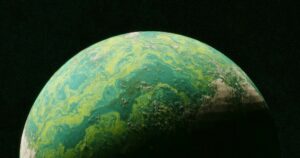
It was a planet whose inhabitants’ desperate distress signals, from within our galaxy, did not seem to be worth the bother of responding to, given that the beings who were sending them were, quite clearly, already too far gone to be saved by the time we could get there, and their planet, which they had turned into an orbiting, rotating abattoir, inundated with organic and inorganic sewage, was also well past the point of salvageability.
Those inhabitants, in explaining the reasons for their distress signals and their desire to escape from the agonies they had brought upon themselves, were extremely forthcoming about the nature of their self-inflicted woes. It is instructive to review what those woes were, so that we may avoid repeating their mistakes on our own planet.
As communicated to us by the inhabitants who asked us to send spaceships with which to evacuate them from the horrors they were experiencing, they were bipedal apes, and they had named their planet “Earth.” They had overpopulated their planet; eliminated almost all of its oxygen-producing forests; overwhelmed its atmosphere with greenhouse gases, which trapped all of Earth’s organisms under a thermal blanket of stifling and progressively greater heat; polluted their oceans with so much phosphorus and nitrogen that algal blooms as large as the planet’s largest continental land masses turned the oceans green, depleted the oxygen levels in the water, and released toxins that caused the extinctions of 99% of the marine life; and further depleted their own oxygen supply by obsessively burning colossal amounts of coal, oil, and natural gas, in the course of which carbon combined with oxygen to form carbon dioxide, and thus removed all that oxygen from the breathable atmosphere.
As the bipedal apes who sent the distress signals explained, when the planet’s oxygen and drinkable water had been depleted to the point where asphyxiation and dehydration had caused the deaths of billions of the weakest members of their species, and of the species of animals they raised to be slaughtered and eaten, rival factions among the surviving bipedal apes used nuclear weapons to fight wars over access to oxygen-generating machines and drinkable water. Those wars wiped out several billion more members of their species and countless other species. Ultimately, multiple simultaneous and sequential viral and bacterial pandemics, which developed greater and greater virulence in the planet’s excessive heat, its oxygen-poor atmosphere, its billions of putrefying corpses, and its omnipresent untreated sewage, caused the extinction of not only the species of bipedal apes, but also all of the planet’s nonmicrobial and nonbotanical land- and marine-based life forms. The oceans, which cover approximately seventy percent of Earth’s surface, were once blue; they are now green, completely covered by a contiguous blanket of microscopic, chlorophyll-containing, free-floating marine algae called phytoplankton.
Earth, like our own planet, was created when dust grains, pebble-sized clumps, and much larger celestial bodies, from the explosion that gave birth to the universe and everything in it, yielded to gravitational forces that condensed the elemental, chemical byproducts of that explosion into an infinitude of planets, some of which, within over two trillion galaxies, orbited around central protostars and contained the ingredients for “life,” which the bipedal apes, like us, defined as the capacity to use energy, develop, reproduce, and react to the environment, with death being the event that ended those four activities.
Earth’s condensed byproducts from the universe’s birth included over ninety elements, five of which – carbon, hydrogen, nitrogen, oxygen, and phosphorus – were contained within the planet’s land masses and oceans, whose liquid was made up of an incalculably large number of molecules consisting of two hydrogen atoms attached to an oxygen atom: the bipedal apes called that liquid “water.”
Under certain conditions, which may have included electrical stimulation from lightning strikes, those five water-borne elements eventually bonded together chemically and yielded, against impossibly long odds, the first forms of life: single-celled, fermentation-produced bacteria, which held the chemical recipes for their reproduction – deoxyribonucleic acid (DNA) – within their nuclei. Their DNA comprised, quite simply, those five aforementioned elements, arranged into four chemical bases, which, in time, under conducive atmospheric conditions, eventually organized themselves into a double-stranded helical structure.
At some point an anaerobic bacterium engulfed an aerobic bacterium. The hostage bacterium adapted to its encasement; its ability to feed on available oxygen got better over time, and in doing that it provided lots of energy to its captor. The bipedal apes called that hostage a mitochondrion: Countless more engulfings led to mitochondria becoming the energy sources within all cells that contained membrane-bound nuclei and other specialized intracellular components. The mitochondria produced energy by converting oxygen and glucose into adenosine triphosphate, the cells’ main fuel. They enabled the proliferation of all of Earth’s ever-evolving multicellular organisms, including, eventually, the bipedal apes that wiped themselves out.
As a result of the bipedal apes’ systematic destruction of Earth’s biosphere, its oceans, ironically, are now covered with the same kind of primordial slime from which the planet’s earliest, most primitive life forms – those fermentation-produced bacteria – had arisen. The bipedal apes’ obvious lack of common sense, which was demonstrated by their single-minded self-destructiveness, stood in stark contrast to the intelligence they demonstrated by being able to explain their biologic origins.
Now that Earth has been emptied of all of those bipedal apes, we shall launch a satellite that will enter its vicinity and monitor the activity across that green planet, to see if its environment can once again give rise to so-called intelligent life.