
The Oatmeal Percolates
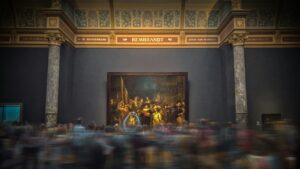 Photo by Václav Pluhař on Unsplash
 Travel. The word, the thought, stirred Harvey. But ‘stir’ is relative. The stirring was not vigorous. It was more like the gentle folding of berries into a batter. It stood like the unadorned oatmeal he had for breakfast each morning when that bowl of morning porridge sat as a testament to the evenness of his life.
His politics were to the center of the center. His comments during office meetings were as measured and inoffensive as the lifeless white of his office’s interior. For over fifteen years he had travelled with his wife. France had come first. The Louvre and the Eiffel Tower. England followed. The Tower of London and Westminster Abbey. In India, the Taj Mahal; in China, the Great Wall. The impetus for travel had come from his wife, offended at overhearing work colleagues describe her as a “museum piece.” With vengeance as fuel, the wife crafted a plan. She and Harvey would travel the world. Upon return she would shape a narrative meant to elicit envy. Then, she died. With no dreams of his own, Harvey carried on with travel, always on packaged tours.
He read the brochures before embarking on these jaunts. Guides offered information as tightly bundled as the tour itself. For Harvey, it sufficed. His camera click…click…clicked – mountains, villages, seashores, buildings. Yet the photo of a mountain was just that – a mountain. Nothing more, nothing less. Once archived, it was forgotten.
The same went for art. From New York to Paris, from Greece to Turkey, only statues or paintings anointed as masterpieces were given attention. What made them iconic? It was a question left unanswered. At work during lunch one day, Harvey had been gloating about a visit to the Louvre when a colleague asked, “Did you see the Mona Lisa?”
“Wouldn’t have missed it for the world.”
“I’m no expert in art,” the colleague said. “What exactly makes it great?”
Harvey went cold. Those at the lunch table waited. He perspired. His mind raced, but it spun like tires on ice. His mental snapshot of Da Vinci’s brushwork began to bleed color upon color. He reached at questions. What made the face so singular? Why had the work been placed so high above others? But traction defied those spinning tires. “Because it’s… stunning…awe-inspiring…one-of-a-kind,” he sputtered. The colleagues resumed their meals.
Harvey stared at his lunch sack. With the spotlight off, his overheated brain settled. The Louvre, in fact, had been a swirl of colors and shapeless shapes. But, back to the Mona Lisa. He scratched his head. There was a mystery.
—
The morning was glorious. Rome! The Eternal City! The trip he and his wife had been planning when death intervened. He showered and dressed and went to join the others gathering in the hotel’s dining room. The guide went over the day’s itinerary. Whoosh…to the Vatican. The current of tourists carrying Harvey discharged at the Apostolic Palace under Michelangelo’s “The Creation of Adam.” The guide intoned in monotone about this Renaissance offspring. “The frescoes above us were painted between 1508 and 1512. The one directly above our heads captures the moment when God is about to give life to Adam, the father of the human race…” Harvey zoned out.
“Well, Chloe,” a man standing behind him said. “There it is. The work you’ve been dying to see since your studies last semester.”
Harvey stepped back and turned so as not to intrude, but an odd impulse drew him to eavesdrop.
“It’s striking, dad.”
“Yes, I see. But what makes you so keen on this work?”
“On the one hand, it’s what stares at you. It took centuries to rediscover and master the anatomy and perspective you see here. Then there’s the heart beating at its center. That’s what’s seldom seen.”
“I’m all ears.”
The young woman kept her eyes on the fresco. “What’s the focal point?”
“The fingers, of course,” the father said.
“And their position is no small thing.”
“Oh?”
She pointed upwards. “Look closely, dad. Check out Adam’s pose. The angles of the arms and legs. The detail given to musculature. The open eyes. Michelangelo has not rendered a lifeless man. Now check out God. He’s straining to touch Adam’s finger. Adam hardly seems to care. And why should he? He’s at ease with his body. The world around him is welcoming.”
“Hmm. I’m intrigued.”
“Take in the marked contrast just to the right. The background goes flat forcing God to the foreground. With God and the angels, we get something surprising. God’s helpers are straining under the weight. There’s one in the shadows – see him? – grimacing. Leads one to wonder why God would need so much support. And what about that angel to God’s right? Male? Female? Hard to tell, but the eyes are square on Adam.”
The father stood in meditation. “Something else. Adam and God seem equal in size.”
“With time, a son’s stature will overtake the father’s.” The young woman paused to gather her thoughts. “This fresco is an essay written with paint and brush. I’d title it ‘The Birth of Humanism.’”
Harvey, head thrown back, was transfixed. Like the flesh of an onion when it’s peeled, thought after thought – heretical, intoxicating – plied him. He could not move. The tour group moved on. He could not move. His fellow travelers, having skimmed over Harvey from the onset, disappeared. Yet all around him life electric stirred.