
Book Excerpt: American Scare: A Cold War in the Sunshine State
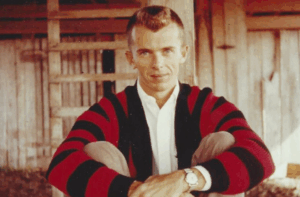 Art Copleston, circa 1959
 The Abduction
January 20, 1959
They came for him in accounting class when he was taking his final exam. When the metal doors flew open and banged, the clatter thundered throughout the tiered seats of Matterly Hall. He didn’t think to look up, at first. The exam was half his grade, and he didn’t have seconds to spare. Maybe a late student, he told himself.
Then came the squeak of boots above the scribble of pencils, the smell of leather and gunmetal over that of paper and erasers. Feet trudged up to University of Florida (UF) Accounting Professor James F. Moore, seated on the lecture hall dais. “Art Copleston,” a voice ordered. “There,” Professor Moore answered softly. It was the resignation in the voice – ordinarily, the booming projection of a proud academic – that provoked the 26-year-old college sophomore to finally, reluctantly, peer up from his desk.
Before his professor, three men in powder blue uniforms stood in matching sheriff’s hats with holstered pistols. Two were already looking in his direction, just as other students in the room were lifting and turning their faces toward him. Copleston looked pleadingly at his professor, but Professor Moore wouldn’t quite meet his eye. Why wasn’t a public educator yelling, “What the hell’s going on?” or even asking for IDs as law enforcement swarmed the room? There was nowhere to run from where he was seated—in the middle of the lecture hall, away from an exit. Perhaps he shouldn’t have come today, he thought, but then he’d have automatically failed the course. Though he had no criminal record, though he was an honorably discharged U.S. Air Force veteran attending UF on the G.I. Bill, Art Copleston was fast becoming a regular target of these humiliations.
 Copleston knew to drop his pencil, rise from his chair and put his hands in the air. Tan and trim with a crewcut, blue-eyed and baby-faced, he must have looked elfishly handsome despite his obvious panic. The officers in blue waved him forward, hands resting on side arms as if Copleston posed a danger to public safety. He recognized none of these men on sight, but uniform insignias suggested Florida state highway patrolmen. “It was pointed out to me that if you took them out of their classroom, there was the benefit of shock,” noted Officer John Tileston, the campus agent who stage-managed these arrests. The class observed passively as an officer clapped a hand on Copleston’s shoulder. They led him past the lecture hall dais and out an exit and shoved him into an idling squad car. This was years before Miranda rights came into being. Though Copleston wasn’t declared to be under arrest, he knew that resisting the officers would have forced a scuffle and made classmates presume his guilt. Besides, resisting could have provoked the officers into making a verbal accusation: one terrible word starting with a Q, a word people ordinarily hissed, a word bullies called him on the playground as a child, a word that would mean he had to transfer to an out-of-state school.
It was a crisp, sunny day in Gainesville that January, with countless students lounging in cardigans on the sprawling mid-Florida campus of green lawns, concrete archways and Spanish moss draped over tall pine trees. “The physical factors of Florida’s geography have hardly changed, if any, since Ponce de Leon discovered the land and gave its mellifluous name ‘Terra Florida’ in 1513,” wrote University of Florida Geography Chairman and famed Florida scholar Sigismond Diettrich, “yet their meaning to man and their effects upon human life have undergone tremendous transformations.” In the front seat of the car, the officers lit up and said little. Smoke drifted biliously into Copleston’s back seat. There was little to do but watch his fellow students out the window. It seemed they were all living in a happy movie.
More than 12,000 strapping youths like himself had enrolled at UF that fall, a new record. Their school also, contentiously, had just accepted its first Black student into the law school in spite of Florida’s policy of “interposition,” attempting to place state segregation powers above the federal Brown v. Board of Education decisions. As a partial result, the Florida campus became a hotbed for stealth activities of state law enforcement. “The ‘Johns Committee’ wanted me to work with them about finding all the queers and Communists on campus,” recalled Officer John Tileston, invoking the theory that “Pink” school integrationists were turncoats in league with “Red” Soviets.
In June 1958, Florida Legislative Investigation Committee (FLIC) Chairman Charley Johns turned his eye towards the university. Charley was a Democratic state senator endowed with extrajudicial powers to root out illegal subversion within state boundaries. He tied his political fortunes so closely to the investigation that it bore the nickname “Johns Committee.” Starting with Communists, Charley Johns recalled a former UF professor named John H. Reynolds, who in 1953 refused to answer questions of the House Committee on Un-American Activities (HUAC) in Washington, D.C. during the so-called federal Red Scare:
Q: “Are you now a member of the Communist Party?”
A: “I refuse to answer that…”
Q: “Have you ever been a member of the Communist Party?”
A: “I refuse to answer that also.”
Federal legislators subpoenaed Professor Reynolds on suspicion of his being part of a “Red cell” of students interested in Communism at Harvard in the 1940s; three former classmates gave cooperative testimony and named Reynolds as a co-conspirator. Within hours of his stand in Washington, D.C., Professor Reynolds was suspended by the UF president and called to appear before a faculty board. Rather than face another kangaroo committee, he resigned from his tenured job.
But Reynolds continued to live and socialize in Gainesville and advocate for “Pink” integration policies among friends, a fact that irked his enemies. Some five years later, legislators and state agents remained determined to catch the proverbial “Commie that got away.” Chairman Charley Johns dispatched Chief Investigator Remus Strickland to Gainesville that summer in hopes of unearthing the elusive Soviet sympathizers infiltrating academia. UF President Reitz, in turn, offered free use of his campus policeman Officer John Tileston – a handsome, married, 23-year-old Korean War veteran – for the undercover operation.
The John Reynolds stakeout bore surprising fruit, revealing associations between the disgraced former professor and friends at the Gainesville Little Theatre, a small troupe of amateur players loosely associated with the University of Florida community. Within that local dramatic circle, investigators were stunned to discover a brimming underworld of homosexuals. Locals like Arthur “Hoyle” Wyman, owner of an off-campus gay party estate called the “Chicken Ranch,” rubbed shoulders and perhaps more with tenured faculty on the university payroll, including one dean and one department head. By his October 1958 progress report, Strickland boasted that he’d uncovered a “considerable homosexual operation” meriting a formal expansion of their campaign. Attempting to reverse-engineer a rationale for why a Communist hunt started turning up queers, Charley Johns challenged his Committee members to establish a causal link between homosexuality and political subversion.
—–
Men in blue drove Art Copleston out of campus towards the Manor Motel, a whites-only motor court on the edge of town popular with tailgater families during whites-only football season. It was mostly empty during winter months, barring the occasional traveling salesman. They rode together for about 20 minutes, during which time Copleston wondered how a college undergrad like himself got caught up in a state spying operation. He strained to recall when he hit the silk of their web. It must have been when Officer John Tileston spotted him laughing with friends that past summer at a near-campus hangout called The Burger House.
The Burger House was a “3.2 bar,” a college tavern permitted only to serve 3.2 percent alcoholic beer, which in theory prevented younger drinkers from becoming disinhibited and engaging in erotic debauchery. In an era when most homosexuals lived euphemistically as “bachelors,” The Burger House was a known “guy bar,” a “bohemian” establishment, a low-lighted locale where Copleston circulated in his element. Closeted gays whispered it to be a “fairyland.” As he lived within what he called easy “boom-boom” distance, in student dorms across the street, Copleston, a wiry weightlifter, was wont to prowl for a tight-waisted trick who might accept an invitation back to his quarters, where they’d mutually review male “physique magazines.” It was only at the last minute, face to face, that Copleston would flash the inevitable codeword – Gay? – to avoid misunderstandings.
Unleashing this illicit twist of a pleasant word from his lips, Copleston knew, made him more naked than naked—every time, placing not only his desire but his future in the coy hands of a stranger. The best-case scenario meant instant consummation. The worst-case scenario meant falling down a social abyss: Being exposed and expelled, then disowned by all relations, then forever unemployable, then suicidal, drunk and homeless.
Copleston chatted up a cute prospect near the bar’s front door, where the line formed for the jukebox, when a classmate approached. “There’s a guy sitting at the bar who’s been watching you a long time,” the fella whispered. “And, by the way,” he continued, “I hear there’s some sort of strange investigation going on…” Copleston turned to his left and became leveled in the fixed glare of a comb-slick man he later learned to be a campus policeman. Officer John Tileston, at The Burger House tailing Hoyle Wyman from the Chicken Ranch, quickly made Art Copleston his new pursuit.
One by one, familiar faces from The Burger House were taken out of classes by men in powder-blue uniforms. Several admitted to their homosexuality and were expelled, Copleston recalled. Tileston later explained that several, during repeated interrogations at the campus police station, gave up the name Art Copleston as a fellow queer. The Q-word always stopped Copleston, a military veteran, short. It was an ugly word, a fighting word, a killing word even—an unconscionable slur even if true, felt Copleston, an attack on his character and his name.
The men in blue marched Art Copleston from the squad car into a cleared-out room of the Manor Motel, its blinds drawn. It was about 10:15 a.m., and Copleston sat at a long table across from a group of middle-aged men in grey suits. None shook his hand. “I’m Mark Hawes,” a man spoke in introduction. Hawes was a “barrel-chested, gravel-voiced ex-Marine,” a 6-foot-1-one-inch Aryan bruiser. “I’m counsel for the Florida Legislative Investigation Committee. This gentleman here is Senator Randolph Hodges, from Cedar Key.” Twenty-six-year-old undergraduate Art Copleston now sat before an elected official.
“How are you?” Senator Hodges asked.
“How are you, Senator?” Copleston responded, attempting politeness. What’s a senator got to do with me? He wondered.
“He’s a member of our Committee. And I think you already know…,” Hawes began to say before Copleston caught the face of his pursuer and interrupted, “How are you, Mr. Tileston?”
The room tensed. Copleston could tell that his saying hello to an undercover state operative embarrassed Hawes and Strickland in front of the senator. How secret could their operation be if a witness identified a mole on sight? Hawes took a beat before continuing, “We’ve asked you to come out here because this committee is conducting, as quietly as we can with as little notoriety as we can, an investigation into the extent of homosexual activity here on this campus.” Leaning into the word investigation when he spoke it, Hawes had made the term sound like “infestation,” which is what Copleston heard. Art Copleston nodded. “Yes, I heard about it,” he answered.
Copleston had spent all his life pretending to be normal, constructing a heterosexual persona, but none of that mattered now. Tileston had sniffed him out at The Burger House just by looking at him. Hardly tripping over a syllable while reciting legalese, Hawes stipulated how the Johns Committee possessed the subpoena power to haul Copleston into questioning at a public hearing about sex crimes with the press in attendance. Or, Hawes qualified, everyone could just cooperate on the record, right here in this room. “Under those conditions,” Hawes asked, “Art Copleston, are you willing to give us a voluntary statement of what you know or might know about this matter?” The lawyer paused. He leaned forward and smiled benignly, as if saying between the lines, “Just help us out a bit, and we can all go home.”
Copleston’s face flushed. The thought of being a cockroach in the spotlight terrified him. Visions of every affair, all his lovers and gay friends, flooded his mind.