
Book Review: “Separation of Church and Hate”
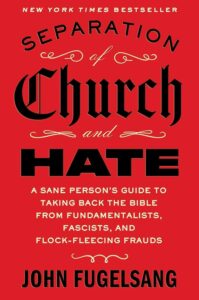
BOOK BY JOHN FUGELSANG
That a book defending Christianity and the Bible against fundamentalists and religious nationalists could be relevant to humanists might seem contradictory. However, the author’s approach—pairing extremists’ stated beliefs with Christ’s actual words—makes for informative and even entertaining reading. It also provides helpful context for humanists when they encounter so-called “Christian” radicals.
John Fugelsang, the son of a former nun and a former priest, is more widely known as a comedian, political commentator, and entertainer. Although he avoids claiming to be “Christian,” he clearly understands and follows Christ’s liberal teachings of compassion, inclusion and love for the poor, the sick and the marginalized.
With the wit and skill of a practiced comedian, Fugelsang takes on more than a dozen misstated and misused interpretations of Christ’s recorded words, addressing topics such as biblical literalism, anti-feminism, homophobia, abortion, sex, immigration, pro-life politics, guns, non-Christian religions, racism and, of course, atheism. He constantly challenges fundamentalists who selectively cherry-pick and misquote Bible verses out of context, urging them to fully read and understand the true relevance of those passages to Christ’s message. Fugelsang especially calls out verses used to justify extreme beliefs about sex and marriage—teachings often attributed to Christ but actually originating with Saint Paul, whose views on women, sex, and marriage he points out were decidedly pathological.
The author clearly knows the Bible more thoroughly than many of those claiming to be Christian, often pointing out numerous errors in their sources, interpretations, and historical contexts. His own deeply held respect for Christ’s message is evident in every chapter, as he contrasts hateful fundamentalism with a more humanistic Christianity—one that avoids the radical dogmas of organized religious extremists and focuses instead on the personal teachings of a great moral leader.
He concludes the book by noting that there are both “Christians” and “Christ followers,” and that the two groups are “not always necessarily the same.” The latter, while often derided by non-believers, are worthy of respect for acting according to the core messages of their ethical leader.