
HUMANISM & THE ARTS | Games as Literature in Motion Stories That Refuse to Let Us Remain Spectators
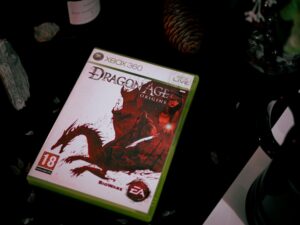 Photo by Maurice Nguyen on Unsplash
 There is a moment, just before you decide, when everything seems to slow down. Not visibly, but unmistakably. As if the world is holding its breath. You know that what you are about to do cannot simply be undone. Not because the options are unclear, but because you sense that none of them are innocent. This hesitation is not a lack of knowledge. It is a confrontation with responsibility. A bodily tension, more than just an intellectual one.
I recognize that moment not only from life, but from videogames. I remember it vividly from “Dragon Age: Origins.” The music fades, the screen lingers, and you reread the text one last time. No one is watching. There is no correct solution, only you and a decision that sets something in motion. You are no longer a spectator. What follows depends on you.
We are accustomed to encountering moral dilemmas through literature or film. We follow characters, understand their motives, empathize with their struggles and then close the book or leave the theatre. We reflect, we discuss, but we remain outside the story. That distance is not a weakness. It allows for interpretation and thought.
But what happens when a story removes that distance? When it does not ask you to judge, but to choose? When understanding is no longer enough, and action is placed directly in your hands?
Watching Is Safe. Choosing Is Not.
In “The Melting” by Lize Spit, choices accumulate quietly before they erupt. What once felt understandable becomes inescapable. Responsibility arrives slowly, without spectacle, only to reveal its weight much later. The novel, and its later film adaptation, show how moral consequences often emerge long after the moment of action has passed.
A similar dynamic is present in “The Misfortunates” by Dimitri Verhulst. The story portrays lives shaped by family, poverty and habit, where choices are rarely free yet never without consequence. Actions unfold within circumstances that precede them, and responsibility appears not as heroism, but as something that lingers uneasily in hindsight.
As readers or viewers, we observe. We may empathize or judge, but we do not carry the story forward ourselves. That is precisely the strength of literature and film. They show without forcing. They make room for reflection, afterwards.
Games do something different. They do not remove that space, but they fill it with action. In a game, understanding is insufficient. You must do something. A choice is no longer a purely reflective exercise; it follows from your own intervention. It puts you in control of actions within a story, actions that have consequences. And that is what gives it a different kind of weight.
When a Game Lingers
Some games are built around situations in which no option is clean. You do not choose between good and evil, but between possibilities that all exact a cost. What follows is not reward or punishment, but a feeling that persists. Not because the game tells you that you were wrong, but because you sense that something has been lost.
That discomfort resembles what we experience in life when we make a valid, rational, defensible decision that still feels wrong. That leaves a bitter aftertaste somehow. You know why you acted as you did, and yet something remains unsettled. Not everything can be repaired. Not everything can be closed.
Games make this palpable because you are the one deciding. They do not allow you to escape consequences by rewinding. The story continues. Just differently.
Media psychologist Christoph Klimmt has shown that interactivity creates a powerful form of identification: players do not merely observe a character, they inhabit a role. Choices cease to be abstract puzzles and become personal acts. This is what gives games their particular moral force.
Moral Choices in Play
In “Dragon Age: Origins,” you are not only a hero but a leader. Power brings responsibility. Your decisions affect not just individuals, but entire communities and belief systems. What begins as pragmatic necessity can later reveal its moral weight. Stability demands sacrifice. Neutrality proves illusory.
The “Divinity: Original Sin” series offers no moral scoreboard. There is no explicit feedback, no verdict. The world responds, sometimes harshly, sometimes unexpectedly. You must interpret your actions and live with their consequences. Decisions emerge from empathy, self-preservation, curiosity or simple necessity. And when a choice feels reasonable, the game reveals its price.
A similar mechanism is strikingly visible in “Detroit: Become Human.” It is a game in which you cannot truly fail, only discover. Set in a near future populated by android labourers and caregivers, it follows characters grappling with obedience, resistance and recognition. Choices are not puzzles to solve, but decisions to make, often under time pressure. The narrative continues regardless. Only afterward do you see which world has emerged from your actions. The game holds up a mirror, not while you choose, but after.
But not all games rely on characters or dialogue. Some tell stories through systems. Games like “Timberborn,” “Age of Empires,” or “Two Point Hospital” force players to think in terms of scarcity and trade-offs. Even sim racing titles such as “Assetto Corsa Competizione” tell stories, not through words, but through attention, repetition and discipline.
In this type of game, meaning emerges through what psychologists describe as flow: a state of deep concentration in which challenge and skill are held in balance. Experienced players perceive, anticipate and process information differently from beginners. Many professional racing drivers rely on simulators like these to preserve this mode of attention and translate it back into real-world performance. The narrative of sim racing is not carried by plot, but by repetition. By discipline. By presence. By focus.
Choosing without a Clean Conscience
Across these examples, moral action is not about finding the right answer, but about bearing consequences. In games that take choice seriously, optimization is impossible. One can only decide, and then live with what that decision reveals about oneself.
Philosopher Miguel Sicart has described videogames as moral artifacts: systems that do not teach morality through rules or rewards, but create situations in which moral tension arises through play itself. Games do not tell players what is right. They confront them with the fact that sometimes no option is clean, and that action cannot be postponed without consequence.
Scholars who have analyzed “Dragon Age: Origins” point out that the game confronts players with what might be called an ethics of knowledge. What unfolds is not merely a narrative choice, but also a psychological experience akin to cognitive dissonance. The game does not only ask what you choose, but confronts you with who you believe yourself to be once the consequences of that choice become visible. The tension between intention and outcome creates an uneasy space that players continue to reflect on long after the controller has been set aside.
In moral philosophy, such tensions are often explored through abstract thought experiments, such as the trolley problem, where no available option is morally satisfying. The concept of moral residue shifts attention away from the dilemma itself toward its aftermath: the lingering discomfort that remains after a decision has been made, even when that decision was rationally defensible or the least harmful option available. Something remains unsettled.
Games that are deliberately designed around this tension make moral residue tangible. Because the player is the one who decides, the aftermath of a choice carries a particular weight, especially when decisions are irreversible and visibly shape the game world. Studies on moral dilemmas in games show that players experience such choices more intensely when they cannot be undone and when their consequences persist in the game world. The game does not accuse or punish; it simply continues, shaped by what was done. What follows is not imposed from the outside, but carried by the player as part of the experience. That discomfort is often unsettling, and precisely for that reason, it lingers. These choices are not solved. They are lived.
But Isn’t It Addictive?
Problematic gaming exists. The World Health Organization recognizes gaming disorder when control is lost and play continues despite clear harm.
Yet intensive play is not inherently pathological. When problems arise, they often coincide with other vulnerabilities: stress, depression, isolation. Gaming then becomes less a cause than a refuge. This dynamic is not unique to games. Work, exercise, substances or even reading can function similarly when they become the sole source of meaning or control.
The fragile boundary lies not between healthy and unhealthy play, but between choosing and being unable to stop choosing.
A recent title, “Clair Obscure: Expedition 33,” exposes this tension with particular clarity. The game does not urge you to do more, but confronts you with why you continue, even when stopping feels like abandonment. Toward its conclusion, this persistence is explicitly tied to the loss of a loved one and culminates in a choice that no longer concerns progress, but how one lives with loss.
Stories that Refuse to Let Us Remain Spectators
Not every game raises moral questions, just as not every book is literature. But the existence of superficial games says little about what the medium can achieve.
In “Claire Obscure: Expedition 33,” everything leads to a final choice between two ways of relating to loss, each with its own cost. What makes this moment so affecting is not that the game declares one option correct, but that you must choose after carrying the entire journey yourself. The ending is not told or interpreted. It is enacted, experienced, by you, as a player, as someone who has agency and control in that moment.
Perhaps the power of games does not lie in spectacle, but in that brief moment of hesitation. The instant you feel that a decision truly matters. When you ask yourself: “Who would I be if the consequences were real?”
Games need no advocate or defense. It is enough to look at the medium as a form of interactive literature. Not because they tell stories, but because they compel us to act within them. Stories that refuse to let you remain just a spectator, but give agency.