
A God in Waiting
Did man fall from grace in his pursuit of knowledge?
Were we created by Gods to live
as their domesticated pets,
to occupy a special place?
According to the Christian view,
in our pursuit of knowledge, we offended our Creator
who preferred us to remain ignorant,
who in a petty act of punishment drove us from paradise,
from the garden,
out into a world of toil and suffering.
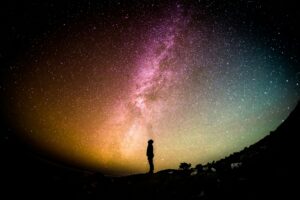
Photo by Greg Rakozy on Unsplash
The myth that man has fallen from some special privileged state remains strong, especially among the religious. Emerson expressed his belief in this idea when he said, “A man is a god in ruins.”1
There is nothing in the natural history of man to support a fall from grace, the creation of man by God, the existence of the Garden of Eden or even the existence of God, all of which are unsubstantiated figments of man’s imagination. All are articles of faith.
Such beliefs make no sense at all, for the evidence shows us that man is stronger, more secure and more privileged today than he has ever been. Ironically, this privileged position has been achieved only through the acquisition of knowledge, the very thing that—from the religious perspective—once condemned man to eternal drudgery.
History has clearly shown: As man’s knowledge and understanding have increased, his position in the world has become more dominant. The danger to humanity comes not from an outraged and jealous God, but from his servants—the medieval fanatics—determined to impose their religious fundamentalism on the world. The only real threat to man’s ascendancy and long-term survival is religion.
While I am biased against religion in its modern context, in all fairness there have been many positive aspects where religious conviction has driven man’s growth, not so much through increased understanding of the natural world as through understanding man’s own nature and motivations. In addition, religious communities have contributed strongly to the development of charity, justice and social cohesiveness.
In the vastness of this universe man is less than a single grain of sand on all the beaches of the world. The universe is indifferent to our presence; it cares not whether we live or die. It cares nothing about our petty lives, our wars, our killing, our intolerance or our deaths.
It cares not whether we are loved or not loved, whether we love our neighbors or torture them to death. It cares not whether we die in our sleep or die screaming with our eyes wide open. From the point of view of the universe we might just as well not exist.
And yet, and here’s the clincher, the universe and its natural laws exist in such a way as to evolve sentient life. If you believe humans to be sentient then we are the proof of that.
As part of the universe and subject to its laws, we are the part that endows the universe with understanding, with appreciation, with the potential to change itself. Through us the universe can appreciate and marvel at its own sublime complexity, at its processes, at its beauty, at its structure.
The universe created life that lies not outside the laws of nature, but within the boundaries of space and time. Through our knowledge and unending search for truth perhaps we have acquired a special function, a special place, a special grace. We are the sentient part of the universe, so rare, but probably not unique.
In an indifferent universe we also brought it something else; something that we always decried the universe for lacking. We brought the universe compassion and caring, we brought it justice, love and fairness, properties that so far as we can tell might be unique to us.
Man did not fall from grace, but acquired it over time, through his curiosity, through his persistence and through his willingness to reject the gods of old. If Man is not a god in ruins, as Emerson once suggested, perhaps man is instead, a god in waiting.
1. Ralph Waldo Emerson (1836). Nature.