
A ‘Peace Plan’ That Rewards Aggression Is a Blueprint for the Next War
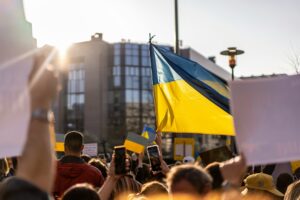 Photo by Anastasiia Krutota on Unsplash
 While somewhere in the world, far beyond Ukraine’s borders, people discuss peace deals and possible negotiations, Kyiv is recovering from yet another massive Russian attack that lasted nearly a full day with only brief pauses. As a result, the Ukrainian capital and surrounding towns suffered casualties and were left without water, heating and electricity — everyday necessities that, once again, became a luxury for Ukrainians in an instant.
It will take several days to fully restore the systems — and we understand perfectly well: This was neither the first nor, sadly, the last such attack. In these circumstances, any peace initiatives sound different — not like abstract diplomacy, but as a matter of the state’s survival and of security: personal security for each of us, as well as the security of the region and the world as a whole.
It is hard for me to accept attempts to present the war against Ukraine as if it were a chess match between major capitals. I remember what the situation in Kyiv and around Kyiv was like less than four years ago: how close Russian troops stood, how hard the Ukrainian army pushed them away from the capital and drove them out of the Kyiv region. I also understand the current situation on the front line and in the occupied territories today. This is a reminder of the real price of the word “security” when an aggressor does not stop on its own and can be pushed back only by force.
Peace can take different forms: It can be a victorious peace, or it can be a peace that rewards aggression. And any aggression that is not punished but rewarded only multiplies evil. If, at the end of the war, the aggressor receives territorial gains, sanctions relief, a return to elite clubs and new economic projects, that is not a compromise. It is a signal to every authoritarian regime: Borders can be rewritten by force, civilians can be terrorized, cities can be destroyed — and if you hold out long enough, you will be called a partner again.
Any agreement in which the victim of aggression receives restrictions, dependency and conditional, fragile guarantees, while the aggressor receives rewards and rehabilitation, is not a peace plan but an instruction manual for the next war. It removes the key deterrent that restrains aggressors: fear of accountability and fear of losses.
Equating aggressor and victim is unacceptable. It is especially dangerous when such initiatives introduce formulas like “full amnesty for all sides.” That may sound like a technical clause, but in reality it is a moral and legal collapse. Amnesty for the victim is legally void. International law (including the Rome Statute of the International Criminal Court, the practice of European courts and the European Court of Human Rights, and UN principles on combating impunity) is grounded in the idea that victims have a right to justice, not to amnesty. Amnesty is an instrument applied to perpetrators, and for grave international crimes it is not permissible at all. States are obliged to investigate and punish war crimes and cannot sign a piece of paper declaring “forgive and forget.” If such a clause appears in any peace plan, it would conflict with the Geneva Conventions, UN principles against impunity, and the case law of the European Court of Human Rights. Amnesty for the victim is pure nonsense: It is impossible to imagine what a people defending itself — after suffering such horrific losses — should be forgiven for. But amnesty for the aggressor for war crimes and other grave international crimes undermines the very idea of international law and the victims’ right to justice.
And here it is essential to clearly state a principled point: Ukraine is conducting a just war of self-defense and has the full right to do so in response to aggression against it. Ukraine does not target civilian objects of the enemy, but it has every right to neutralize military infrastructure that has become a mechanism for the destruction of Ukrainians. This is an international armed conflict caused by Russia’s aggression.
Blurring the distinction between aggression and self-defense is not neutrality; it is an attempt to rewrite reality so that responsibility becomes shared — and therefore disappears. If crimes become safe for aggressors, they are repeated. If they become profitable, they turn into a model of behavior.
Ukraine is not territory to be traded: here a line, there limits on the army, here a ban on security alliances, there some guarantees dependent on the political will of third states. A people lives on this territory — a fact that seems to be forgotten at times in the course of negotiations. Under Ukraine’s Constitution, the Ukrainian people are the sole source of power and the sovereign. No decisions about our future can be legitimate or sustainable without public consent — especially decisions that effectively ask us to accept violent border changes and impunity for mass crimes. Even the very idea of putting potential recognition of new borders and territorial losses to a hypothetical referendum is illegitimate.
There is also a practical dimension: If a country is forced into a peace framework that makes it weaker, limits its right to security and leaves the aggressor without real demilitarization, without regime change and without punishment, that is not stability — it is a pause. It is time the aggressor will use to rebuild forces, accumulate resources, recruit — and strike again. We have seen this pattern many times: aggression, then temporary arrangements, and after a pause — a new attack.
It is also important to note that demands for elections and referendums cannot be appended to an agreement to end the war. Against this backdrop it is especially dangerous when wartime or transitional democratic choice is presented as a quick procedure — as if announcing deadlines and adding fashionable tools is enough, and the celebration of democracy will happen by itself. Democratic participation is not only ballots and dates. It is security, equal access, trust, and the ability of citizens to exercise their right to vote — including millions of displaced people, service members and those forced to flee abroad. It also requires constitutional guarantees, functioning institutions and rules that people trust.
Elections must not become part of an external peace package, because that changes the very nature of the war, substituting the reality of an international armed conflict with a narrative of internal settlement. That is a direct path to political turbulence precisely when society must be maximally resilient. Separately, there is the idea of online voting in a country that Russia attacks with missiles, drones, cyberattacks and networks of influence. This is not a technical issue but a security and political one: Any decision that undermines trust in results becomes a gift to the aggressor.
Another painful and extremely fragile issue is the obligations of third countries toward Ukraine if an agreement is concluded. First, security guarantees that can be withdrawn at any moment cannot be guarantees at all — the word implies an unbreakable commitment. Instead, Ukraine and the civilized world need real mechanisms of collective protection. But guarantees dependent on political circumstances are easily rewritten and easily suspended, especially when the victim is forbidden to actively defend itself or restore control over its own territories. The outcome is a design in which the aggressor retains the right to use force, while the victim receives only conditional promises.
We often say that Ukraine needs a just peace, but it must not mean capitulation disguised as compromise, and it cannot be built on legitimizing occupation, on impunity, or on a permanent restriction of Ukraine’s right to security. A just peace is one in which evil is not rewarded, aggression does not become an investment and borders do not turn into a prize for violence.
Yes, no one will bring back the dead or erase the trauma. But there are things that determine whether this scenario will repeat — in Ukraine or anywhere else in the world. We want accountability; sanctions as a real tool of deterrence; support for the defense capacity of the victim of aggression; respect for the sovereign will of the people; and recognition of the obvious: Aggression has a name, and self-defense does not require amnesty.