
Faith in Freedom: Why Secular Democracy Protects the Sacred and the Human
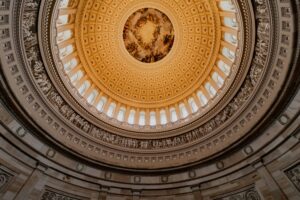 The dome of the US Capitol | Photo by Joshua Tsu on Unsplash
 Across history, every society has faced the same temptation — to surrender the complexity of freedom for the simplicity of certainty. Today, that temptation reemerges in the growing alliance of religious nationalism and political power that calls itself a crusade, a revival or spiritual warfare. Two recent books, Lucas Miles’s “The Pagan Threat” and Katherine Stewart’s “Money, Lies, and God,” describe opposite sides of this movement. Read together, they illuminate the same crossroads: one path leads toward a secular democracy grounded in human dignity and freedom of conscience; the other, toward theocracy — government by those who claim divine mandate and deny moral legitimacy to anyone outside their faith.
In “The Pagan Threat,” Lucas Miles warns of “a rising pagan threat to the church and American way of life.” For Miles, the enemy is not tyranny or corruption, but diversity itself — secularists, humanists, progressives and nonbelievers, all portrayed as infiltrators of “the foundations of faith.” He calls on Christians to “reclaim the public square for God’s glory,” framing pluralism as a kind of moral infection. Humanism, he writes, is “the religion of man’s self-worship,” and secular democracy, born of the Enlightenment, is a “counterfeit revelation.”
Miles’s rhetoric evokes an age-old impulse: to define belonging through belief, to divide the righteous from the fallen, and to sanctify authority as divine rather than human. It is a message that transforms disagreement into sin and diversity into heresy. It imagines salvation not through persuasion but through dominance — a society redeemed not by liberty but by obedience.
Katherine Stewart, in her account of “The Rise of the Spiritual Warriors” within “Money, Lies, and God,” tracks what happens when this theology of control becomes a political movement. She describes a new class of “spiritual warriors” who see politics not as civic engagement but as holy combat — a realm of angels and demons rather than ideas and evidence. These leaders, often pastors turned politicians, claim that God, not the people, ordains power.
When Congressman Mike Johnson declared upon becoming Speaker of the House that “God raises up those in authority,” and later likened his elevation to Moses parting the Red Sea, Stewart recognized a watershed moment: the language of divine appointment had entered the chain of democratic succession. In this worldview, elections are no longer instruments of consent but proofs of divine favor. Dissent becomes sacrilege.
The difference between these two visions of America — one pluralist and humanist, the other theocratic and exclusionary — is not abstract. It determines whether power answers to conscience or compels it.
A secular democracy does not mean a society without faith; it means a society where no one’s faith — or lack of it — grants them power over others. It is the only system that honors both the believer’s right to worship and the skeptic’s right to doubt. It is the architecture of humility: a recognition that no human being, no church, no ideology can speak infallibly for the divine.
When nations abandon that humility, history repeats the same tragedy. Theocracies promise purity but deliver oppression; oligarchies claim order but yield corruption; plutocracies preach merit but practice privilege. What binds these systems together is the concentration of power — whether in priests, billionaires, or autocrats — and the silencing of dissent.
A secular democracy disperses that power back to where it belongs: the individual conscience, the collective voice, the open debate. It affirms that reason and empathy, not revelation or inheritance, are the foundations of justice. It allows every citizen to seek the sacred — or not — without fear of punishment or coercion.
This is not moral relativism; it is moral courage. It is the conviction that meaning and goodness are best discovered through the freedom to think, question, and disagree. A society that honors human agency does not ask its people to worship the same God, but to protect one another’s right to seek truth in their own way.
The “pagan threat” Miles fears is, in truth, the vitality of democracy — the refusal of human beings to be ruled by dogma. And the “spiritual warriors” Stewart documents are not defending faith but replacing it with power. When faith becomes fused with the machinery of government, it ceases to be faith and becomes ideology — enforced, not embraced.
To defend secular democracy is not to deny the sacred, but to defend its authenticity. Faith imposed by law is not faith at all. It is submission. True reverence — whether to God, to reason, or to human dignity — demands freedom.
The founders of the United States understood this when they separated church and state. Their genius was not hostility to religion, but recognition that belief, to be sincere, must be voluntary. They knew that theocracy, like monarchy, breeds tyranny — and that a republic that honors conscience must belong equally to believers and unbelievers alike.
Today, the defense of that vision is the unfinished work of democracy. It calls for courage, not cynicism; conviction, not conformity. It asks us to resist the seduction of certainties that divide the world into saints and sinners, saved and damned, patriots and enemies.
The future of freedom will not be secured by prophets of fear, but by citizens of empathy — those who see dignity in difference and strength in shared humanity.
In the end, the greatest threat to faith is not secularism, but theocracy itself. Because when religion seizes the state, it loses its wellbeing.
And when democracy protects the freedom of conscience, it does not weaken the sacred.
It redeems it.