
How to Be a Good Blasphemer: A Humanist Guide to Courageous Critique
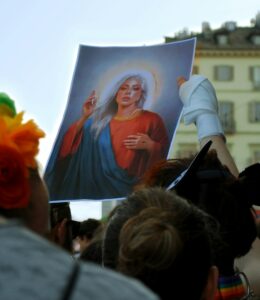 Photo by Chiara Guercio on Unsplash
 In an age when governments prioritize right-wing religious sensitivities over that of fundamental human rights, blasphemy remains a valuable way to undermine such anti-democratic ideologies–often, while having a bit of fun at the same time.
Some see blasphemy only as a blunt weapon used to provoke or demean. Or, a little more charitably, as a tool for clever comedians. But at its best, blasphemy is a scalpel—cutting through dogma to expose hypocrisy, challenge harmful ideologies, and defend the rights of those silenced by religious orthodoxy. A good blasphemer isn’t reckless, but thoughtfully acts to uplift equitable principles.
The Ethics of Offense
Freedom of thought should be absolute. But freedom of expression, especially religious expression, carries social weight. A good blasphemer understands this balance. They recognize that critique can hurt—but that discomfort is sometimes necessary for progress as well. We must not allow threats or violence to dictate the boundaries of speech. Yet we should also avoid amplifying harmful rhetoric that fuels extremism. The goal is not to provoke chaos, but to illuminate truth.
Though often co-opted by conservatives, humanists can reclaim Natural Law, which affirms that people possess inherent rights—autonomous values that no government or religion can override. Among these is the right to question, to critique, and yes, to blaspheme.
De-escalation Without Capitulation
Organizations like the Council for Religious and Life Stance Communities (known as STL) in Norway have shown that it’s possible to de-escalate religious tensions without resorting to censorship or force. The Interfaith Alliance in the United States aims to use the social power of faith to seek more separation of religion and government. And leaders around the world are using the strategies of religious literacy, pluralism, and global engagement to further humanist ideals. The good blasphemer need not undercut these noble efforts to make the world more harmonious.
Dialogue, empathy, and strategic restraint can preserve public order while protecting free expression, but these often well-intended efforts can descend into something far more treacherous.
When government workers charged with providing a service to all are permitted to exclude some based on conflicts with their beliefs; when hate crime laws extend to attempting to curtail “pre-violence;” when people fear to point out injustices wrapped in a cloak of faith, and of course, when harsh penalties are dished out to those who offend faithful sensibilities, then governments must be reigned in. A regular dose of blasphemy can help stop a slide down the slippery slope to theocratic rules.
Blaspheme with Purpose
People can stand up to those who would suppress dissent and endanger humanist ideals by being a good blasphemer. To be most effective, before they blaspheme, they ask:
- Is this critique aimed at harmful behavior or doctrine, not at vulnerable individuals?
- Is it a genuine exercise in humor, satire, or free speech—not a veiled act of bigotry?
- Does it challenge power structures that use religion to justify oppression?
Blasphemy has the most positive impact when it isn’t targeting people’s faith, but instead, interrogates the ideas underlying many faiths that shield injustice or demand unquestioned obedience.
In a 2015 interview, Stephen Fry blasphemously criticized the concept of an all-powerful and supposedly benevolent God, pointing to the horrible and unnecessary suffering in the world. Though a blasphemy investigation was briefly launched, it was dropped due to a lack of public offense. But more importantly, his remarks sparked widespread discussion that may have laid the cultural groundwork for a successful referendum campaign, three years later, to remove blasphemy from Ireland’s constitution.
Blasphemy isn’t just for atheists! The outgoing Christian governor of Jakarta, Basuki Tjahaja Purnama, also known as Aho, was convicted of blasphemy in 2017 for quoting a Quranic verse during a campaign speech. Apparently, his interpretation of the verse was seen as insulting Islam, and he was sentenced to two years in prison as a result. However, his use of religious text skillfully challenged the misuse of scripture for electoral manipulation, and it sparked massive protests and international debate about religious freedom and political speech.
Blasphemy need not have consequences on the world stage to be good. When a child discovers they don’t share their parents’ fundamentalist beliefs and bravely confronts them to explain their positive convictions that don’t stem from religion, that’s an act of blasphemy as well (at least in the eyes of their parents). But their initial view that this is a blasphemous attack on their faith could lead the family to deeper conversations about belief, autonomy, and respect that help everyone involved develop emotional honesty and mutual respect.
These illustrations show how blasphemy, when wielded with purpose, can be a tool for liberation, truth-telling, and cultural evolution.
Final Blasphemous Thought
To be a good blasphemer is to be brave, not cruel. It’s to wield satire and critique in defense of the marginalized, not to deepen their wounds. It’s to challenge the sacred when it shields the unjust—and to do so with clarity, compassion, and conviction.