
The Hollow Man
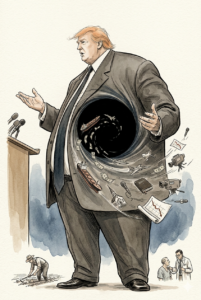 Illustration via Frode Kjærvik
 On the night of April 1, 2026, the President of the United States addressed his nation about the war he had started with Iran. The speech lasted 37 minutes. It referenced goals, achievements and threats. It praised the American military. It promised that things would be resolved shortly, very shortly. Then it ended, and nothing had been said.
This is not a figure of speech. The speech was not evasive, not a case of a leader concealing his true aims behind rhetoric. Evasion implies something being hidden. Dishonesty requires a truth to conceal. What happened on that Wednesday night was more unsettling than either: A man stood before cameras and produced the sounds and cadences of presidential authority, and behind them there was — nothing. No strategy. No goal. No reason. Not a bad reason, not a secret reason. No reason.
Kenneth Roth, writing for The Guardian the following day, documented this emptiness with precision. If the goal was to prevent Iran from acquiring a nuclear weapon, then the war was pointless — Iran had already agreed to forgo one. If the goal was to limit uranium enrichment, then the war was counterproductive — Trump had destroyed the deal that imposed those limits. If the goal was to reopen the Strait of Hormuz, a ceasefire would accomplish that. If the goal was to weaken Iran’s military, the damage was already done. Roth asked the question any reasonable person would ask: why?
But why is the wrong question. It assumes an interior — a place inside the man or the system where reasons are formed and purposes held. Roth’s conclusion — that Trump was “befuddled when it comes to explaining why he is using” his military power — granted the president something he does not possess: an inner life capable of befuddlement.
The speech wasn’t confused. It was hollow. And the hollowness is not a defect. It is the design.
∴∴∴∴∴
In 1971, Luke Rhinehart published “The Dice Man,” a novel that became one of the most provocative thought experiments of its century. A bored psychiatrist decides to surrender his daily choices to the roll of a die. What starts as a game escalates into a systematic dissolution of selfhood. The novel terrified readers — and delighted them — because it exposed how much of what we call identity is habit, and how little stands between a coherent person and chaos.
The power of “The Dice Man” lay in its premise: that a person could choose to abandon coherent selfhood. The die was the mechanism, but the act of placing one’s decisions outside oneself was the transgression. It required something to transgress against. A moral structure. A sense of self. A person who had been, until that moment, someone.
The Hollow Man inverts this completely. There is no self to override. There is no moral architecture to transgress. There is no die to cast, because there is no decision being made. There are only incentives.
The die contained possibility. Any number could come up. The randomness was what made it dangerous, because it meant something unexpected might happen — an act of kindness in a context that demanded cruelty, or cruelty where convention demanded politeness. The die didn’t care. That was its freedom and its horror.
Incentives contain no possibility. They contain only repetition. Poll numbers rise: claim victory. Markets dip: promise stability. Military capacity exists: use it. Applause follows: continue. Stimulus, response. Stimulus, response. The Dice Man rolled and something happened. The Hollow Man responds, and the same thing happens every time. Not because he is predictable in the way a consistent person is predictable — consistency requires a center — but because the incentive structure has no other output.
Rhinehart was writing at the edge of the counterculture, when dissolving the self felt like resistance, like breaking free. Half a century later, the system has absorbed that dissolution and made it productive. The Hollow Man isn’t the counterculture’s nightmare. He is its fulfillment, stripped of every trace of intention.
∴∴∴∴∴
What does it mean that the most powerful office on earth operates without interiority? It is a single phenomenon, refracting through every domain it touches. Begin with the most fundamental: Hollowness is not a failure to achieve substance. It is the discovery that substance was never required. This goes beyond Jean Baudrillard’s simulacra. Baudrillard still assumes an original that has been lost. The Hollow Man demonstrates something more radical: There never needed to be an original. Surface is not a degradation of depth. It is an optimization. The system runs more efficiently without the friction of meaning.
Consider what substance demands. It demands commitment: a position taken and held, which can be tested, challenged, found wanting. It demands consistency: an alignment between what is said and what is done, which creates the possibility of accountability. It demands arrival: the acknowledgement that a goal has been reached, a process completed, a question answered. Every one of these properties is a constraint. The Hollow Man has shed them all, and in shedding them has become frictionless — impossible to hold, impossible to contradict, impossible to pin to any claim that can be falsified.
Obama’s Iran deal was substance. Imperfect substance, as all substance is. It imposed specific enrichment limits, required intrusive international inspections, created verification mechanisms. It could be evaluated, criticized, found insufficient. It could be — and was — called “a disaster.” But a deal is an arrival. It says: this far, and the terms are these. Enough. Hollowness cannot tolerate arrival, because arrival means the process stops. So the deal was shredded — not because a better alternative existed, but because any binding commitment constrains the surface, and the surface must remain free. The single word the hollow system cannot produce is enough.
In the religious traditions that shaped Western civilization, idolatry is not simply the worship of a false god. At its structural core, idolatry is the worship of worship itself — the elevation of the act of devotion above whatever that devotion was supposed to be directed toward. The golden calf did not work because anyone genuinely believed it was divine. It worked because the performance — the gathering, the chanting, the collective spectacle — was self-sustaining. It needed no referent. The calf was a surface, and the surface was enough.
The prosperity gospel is the contemporary expression of this structure. Grace has been removed. Wealth remains as its own justification. The theological content — mercy, justice, humility, sacrifice — has been optimized away, and what survives is the performance: the megachurch, the broadcast, the laying on of hands over a congregation tithing toward a pastor’s private jet. When Trump stood before cameras holding a Bible he has not read, selling Bibles he did not write, this was not hypocrisy. Hypocrisy requires a gap between belief and action, and a gap requires belief. There is no gap because there is no belief. We are not watching a man betray his faith. We are watching a system that has moved beyond the need for faith while retaining — perfectly, frictionlessly — its outward forms. This is post hypocrisy. It cannot be shamed, because shame requires an internal standard that has been violated. The Hollow Man has no internal standard. He has incentives.
And the economic structure completes the picture, because it is the generative engine. When capital detaches from production — when wealth generates wealth through instruments so abstracted that no one can trace them back to a physical thing made or a service rendered — value becomes narrative. The derivative is a bet on a bet. The leveraged buyout strips a company of assets and calls the stripping “value creation.” Trump is the political derivative: power generating power with no underlying asset.
The Iran war is the military expression of the same logic: destroy infrastructure so it must be rebuilt, degrade capacity so new contracts flow, prolong the engagement so the machine keeps running. Iran’s infrastructure is being reduced to rubble. Trump promises, with evident satisfaction, to return the country “back to the stone ages, where they belong.” But the military targets have been hit. The navy is gone, the air force in ruins, the missile capacity degraded. More destruction is needed because destruction is the mode of operation — not because anyone has decided this, but because the incentives point that way and there is nothing inside the system to redirect them.
The hollowness, of course, is frictionless only at the center. For the people on the receiving end it has full material weight. A woman in Tehran does not experience “motion without direction.” She experiences the hospital running without power. A father in Isfahan does not live inside a political derivative. He lives in the rubble of a water treatment plant that will not be rebuilt until a contract makes rebuilding profitable, which requires the rubble to exist, which required the bombing, which required no reason. The purposelessness that registers as mere incoherence in a Washington speech arrives as concrete, specific suffering on people who had no part in the logic that produced it. Every gram of substance the system sheds lands on someone. That is the externalized cost of hollowness — and it is a cost that never enters the Hollow Man’s calculations, not because he has weighed it and found it acceptable, but because the interior where such weighing would take place does not exist. The Hollow Man does not disregard the suffering. Disregard is an act, and acts require a subject. The suffering simply does not register, the way light does not register inside a black hole. It crosses the event horizon traveling the wrong way: outward, toward the periphery, where it accumulates in places the cameras do not reach.
This pattern connects — not as metaphor but as mechanism — to the deepest crisis of our time. The growth economy functions by converting substance into motion and calling the motion progress. Burn the forest, count the lumber. Drain the aquifer, count the irrigation. Extract the oil, count the GDP. The system does not waste resources despite having no direction. It wastes resources because it has no direction. Waste is the direction. The distinction between production and destruction has been optimized away, because both generate motion, and motion is all the system measures.
Three domains — philosophy, religion, economics — and a single discovery at the center of all three: substance is overhead. The system has shed it.
∴∴∴∴∴
But hollowness does not stay contained. It spreads.
Not as doctrine — there is no doctrine to spread. Not as ideology — ideology requires content, and content is friction. Hollowness spreads as permission. The permission to stop meaning anything. The permission to shed the weight of conviction, consistency, and commitment. The relief of it.
Watch it work. A senator enters office with positions — on trade, on foreign policy, on constitutional principle. Positions are substance. They can be tested, challenged, held to account. They create friction with donors, with leadership, with the news cycle. One by one, the positions are softened, then abandoned, then replaced by the only thing that survives in the hollow system: responsiveness to incentives. The senator does not become corrupt in the classical sense. Corruption implies a person who has betrayed a standard they once held. What happens is more thorough than betrayal. The standard dissolves. The senator becomes frictionless — available to any position, committed to none, maximally responsive. Hollow.
And now the senator is a transmission vector. Not because she evangelizes hollowness — there is nothing to evangelize — but because her hollowness grants permission to everyone around her. Staff who once drafted policy based on evidence discover that evidence creates friction and responsiveness does not. Colleagues who once held opposing views find that opposition requires a center, and the center has become optional. The caucus meeting where no one has convictions moves faster than one where people do. Efficiency selects for emptiness.
This is the viral logic: each newly hollowed person reduces the cost of hollowness for the next. When a single official abandons substance, it looks like cowardice. When an entire institution does, it looks like pragmatism. When a whole political culture does, it looks like realism. The vocabulary shifts to accommodate the loss — flexibility replaces conviction, pivoting replaces commitment, messaging replaces meaning — and the loss itself becomes invisible, because there is no longer a vocabulary for what has been lost. We still call it populism, as though there were a populus being served. There is not. It is hollowism: incentive-response dressed as politics.
The media environment accelerates the contagion. A news cycle built on reaction cannot sustain the slow work of substance. The interview that tests a position requires a position to exist. The fact-check that holds a claim accountable requires claims to be intended as claims rather than as stimuli. When the entire information ecosystem runs on engagement — another word for incentive response — it selects for hollow content with the same efficiency that the political system selects for hollow leaders. Not because editors or journalists have failed, but because the substrate itself has changed. You cannot grow roots on a surface. The prosperity gospel fills churches not because congregations have been deceived but because hollowness, once normalized, is easier than faith. Faith demands struggle, doubt, the slow labor of meaning. Hollowness demands only attendance. The performance is self-sustaining, and each person who participates without believing makes it easier for the next person to do the same. The calf does not need to be golden. It only needs to be there.
∴∴∴∴∴
A black hole is not empty. It is emptiness with gravity.
It consumes everything that approaches — light, matter, information — and nothing returns. From the outside, it looks massive. It bends the space around it. It commands attention by the sheer force of its pull. But there is no surface to land on, no structure to engage, no interior to illuminate. The engagement itself is the consumption.
This is the Hollow Man’s power, and it is essential to understand it as power and not as weakness. The liberal commentariat keeps reaching for the language of incompetence — befuddled, confused, incoherent. This misreads the phenomenon completely. A person with substance can be argued with. A coherent position can be tested and found wanting. An honest commitment can be held to account. But the Hollow Man offers no surface to push against. Argument is absorbed. Contradiction is absorbed. Outrage is absorbed. Every serious analysis of his logical failures is the black hole working exactly as designed: a mind fully engaged, producing work that will change nothing, because there is nothing on the other side to receive it.
The Hollow Man is not his own antagonist. He cannot be defeated on his own terms because he has no terms. The system that produced him cannot be reformed from within because there is no within.
But a black hole is also a cosmological endpoint — the final stage of a process, not an eternal condition. And here — without false comfort, without the forced optimism that hollowness itself would produce — it is worth asking what its antagonist looks like.
Not resistance. Resistance is reactive, and the black hole feeds on reaction. Not truth-telling, though truth matters. The hollow system absorbs truth claims without difficulty; it simply produces counter-claims or, more often, produces nothing at all, and the truth falls past the event horizon and vanishes.
The antagonist to hollowness is the capacity to commit. To bind oneself to something specific and stay bound. To say this is enough and mean it. To arrive. The farmer who plants in spring and does not harvest until the crop is ready. The doctor who sees the next patient. The community that feeds itself from its own soil. The negotiator who signs a flawed agreement and then honors it. These are not dramatic acts. They do not generate attention or absorb airtime. They are, by the standards of the hollow system, invisible — which is precisely their strength. Depth does not need to announce itself. Substance does not perform. The Hollow Man’s only real enemy is the person who is not available to be pulled in. Who has weight — not because she is fighting the gravitational pull, but because she is somewhere, committed to something, and has no interest in the spectacle.
The black hole commands the eye. But it is the dense, quiet stars — the ones still fusing, still producing light from their own core — that will outlast it.