
The Sticker Discourse
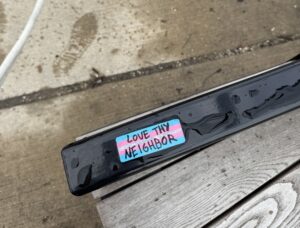
Something I’ve seen emerge – particularly since Trump was elected to a second term – is a form of civic participation I would best describe as sticker discourse. In Chicago, the city I live in, light poles, street signs and any other plasterable surfaces have become a sort of commons for the community – a forum that operates in the analog, refreshing itself every couple of days with new political slogans and diatribes.
I personally have never seen anyone stickering – it’s something I assume happens at night when no one’s watching.
Some of the messages are pre-printed, clearly purchased from an Etsy shop. But much more frequently, they are handwritten, often on post office pads, emphasizing the creativity (and humanity) of the author, as well as the effort (and risk) taken by its author.
Some are quite clever. Many have made me laugh. The crasser ones don’t last long – they get papered over or torn off completely. There is an iterative process to stickering, I’ve learned; they’re often in conversation with each other (more on that later). I’ve found most of these anonymous messages of solidarity comforting to see. At least I live amongst like-minded people.
 I first noticed this phenomenon in full force after October 2023, when messages of solidarity with Palestine (and against Israel) became commonplace, painted on walls, carved into metal, stenciled on the sidewalk. In a country that still conflates anti-Zionism with antisemitism, many of these messages were short-lived. A building owner near me recently tarred a section of concrete next to their building where someone had managed to etch a “Free Palestine” into once-wet cement.
But public infrastructure like light poles and bike racks are fair game in the world of sticker discourse, existing outside the jurisdiction of the propertied class while being completely ignored by an under-resourced city bureaucracy.
Since Trump’s inauguration, most of the stickers I’ve seen have been in opposition to ICE’s presence in Chicago. Many are clearly directed at personnel, trying to bully them out of their heinous line of work. These efforts are meant to make ICE agents feel unwelcome.
Which was the same effect a different political sticker had on me recently. Aside from taking the odd picture, I haven’t been one to engage in sticker discourse – though browsing the latest graffiti is often unavoidable while I’m waiting for a stoplight to turn.
But this morning while walking my dog, I saw a message that actually stopped me and inspired me to become a participant in the discourse for the first time. It was a handwritten note on white adhesive that had an arrow pointing to some anti-ICE message near it. The sticker read: “Angry trannies shoot up schools.”
I felt a rush of panic and immediately took what little fingernail I had and attempted to peel it off. I walk by this corner every morning, so I knew it was a fresh addition. That aspect of self-authorship – the very same quality that entertained me with previous stickers, unnerved me in this one. Someone who lives near me thinks this shit. I’ve never been under any delusions that everyone in my city is a leftist (the vocal opposition to an upzoning proposal in my neighborhood has made that abundantly clear), but I had never been confronted with speech so flagrantly hateful in the four years I’d lived on this block.
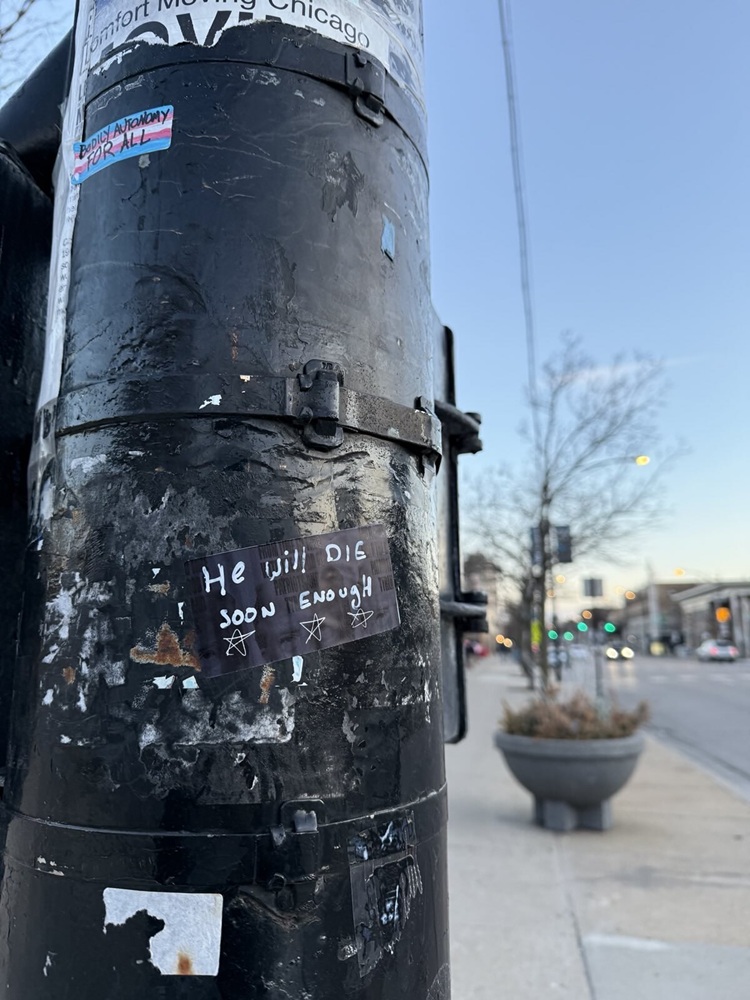 I honestly didn’t stop to think whether tearing off the sticker was appropriate, or whether someone would see me doing what I was doing and perhaps judge (or even misconstrue, thinking I was taking down an anti-ICE message). My first instinct was to make sure nobody else read the odious message. It was cut-and-dry fear mongering, a conspiracy theory dredged up by the far-right after the assassination of Charlie Kirk to put a target on the backs of trans people.
There are no rules to sticker discourse. Many of the usual barriers to political participation are nonexistent in this arena; you don’t need to be registered, have the proper documentation, or live in the right area to bring your politics to the people (or at least, anyone willing to look). There are no gatekeepers, no comment policies to get you booted off the platform.
It’s a clumsy representation of the “marketplace of ideas” that conservatives like Ben Shapiro (and the late Charlie Kirk) like to advocate for: a public arena free of regulation or censorship where the best idea wins out, and hateful, unpopular ones are weeded out.
So that’s what I did. The sticker wasn’t easy to tear, and all I managed to accomplish – before my dog dragged me off to finish his walk – was to peel off chunks of the corners and mostly obscure the message, leaving behind a faint but visible “trannies.” I let out a heavy sigh at this eerie crystallization of the impact of extremism: As hard as we may attempt to expunge hate from our discourse, the trace of a slur uttered still lingers.