
The Universe in a Grain of Sand: How Consciousness Became the Cosmos Looking at Itself
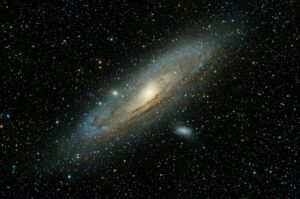 Photo by Guillermo Ferla on Unsplash
 I have often marveled at how small we humans and our planet Earth are in the vast cosmic scale. Imagine holding a 100-gram ball in your hand representing our entire solar system. In this analogy, Earth’s “weight” compared to that ball is almost invisible—just a tiny fraction of a gram. The solar system itself, relative to the Milky Way galaxy, is an even smaller speck in a universe filled with trillions of stars and galaxies. Stretching further, the galaxy we call home is but an almost invisible grain if the entire observable universe were held in our hand as a 100-gram ball.
This repeated pattern of almost infinite scale difference can be hard to grasp. Take the Sun, the huge star at the center of our solar system—it holds 99.8% of our solar system’s mass. Earth, by comparison, is just an incredibly small fraction of that. The Milky Way, containing billions of stars including the Sun, weighs a trillion times more than our solar system. And the observable universe holds billions of such galaxies, making the Milky Way insignificant in the grand total we call the cosmos [1][2][3].
Yet despite this cosmic insignificance, there is a beautiful paradox. It is precisely on this seemingly insignificant Earth that conscious beings arose—beings capable of looking inward and outward, questioning their own existence and the nature of the universe. We are composed of atoms forged in the fires of ancient stars, and our Sun, a medium-sized star, has nurtured the life that evolved into self-aware consciousness [4][5].
From campsites where early humans discovered fire to modern labs unlocking quantum secrets, human curiosity has been relentless. We didn’t just settle for survival; we hunted, farmed, built societies, invented machines and medicines, and reached beyond Earth to explore space. We developed tools to calculate risks and patterns, learned how to harness energy from the Sun through fusion and photosynthesis, and even dream of warping time and space to travel the universe [6][7].
I see this journey as the universe becoming aware of itself—like life emerging and evolving so the cosmos learns about its own origins and destiny. It’s as if the universe started as a tiny, hot condensed ball in the Big Bang and is now on a journey back to itself, its “home,” mirroring the ancient Indian idea of *sat-chit-ananda*—existence, consciousness, and bliss—discovered through deep meditation centuries before modern science [8][9][10].
Life, in this great cosmic story, is a way to push back against the relentless flow of entropy—the universal march from order to disorder. Living systems locally lower entropy by creating order, even as they increase entropy in their surroundings, balancing the laws of thermodynamics [11]. Black holes, mysterious regions of spacetime where gravity distorts time itself, hold large entropy and are part of this cosmic thermodynamic dance [12][13].
Ultimately, humans are “insignificantly significant.” Physically tiny, yet phenomenally powerful because our consciousness weaves stories, meaning, and purpose from the raw materials of the cosmos. We are the universe’s eyes and mind, asking why it exists, contemplating entropy, time, and the edges of spacetime, and seeking peace and understanding in the vast unknown [14][15][16].
When I look at the night sky, I see the footprints of time. Each star’s light, traveling millions of years, does not show me the present but whispers the ancient past—like flipping through a cosmic photo album.
In those still moments, I realize we are not separate from the universe. We are its continuation. We are its memory.
Every scientific breakthrough, every explorer who risked and sometimes lost their life, every thinker who pushed boundaries—all did so driven by a quiet love for humanity, a deep desire not simply to survive but to understand.
From that hot, dense beginning of the Big Bang, matter itself divided and spread, organizing into galaxies, stars, and worlds—until finally it emerged into consciousness, the universe’s own way to look back and wonder at itself.
Yes, entropy pulls us toward dissolution, unraveling order into disorder, yet consciousness stands against this tide. It preserves meaning amid chaos.
In the grand voyage from silence to manifestation and perhaps back to silence again, there is an unfolding story: the universe’s longing to know itself.
And today, through human awareness and curiosity, it does.
Final Reflection
All I see is love.
The ability to perceive oneness in all forms and beings—this is the miracle of Earth, and consciousness is the awareness that reveals it.
The universe—the hot condensed beginning—tried to know itself. Through that process emerged life, awareness, joy, silence, and ultimately, love.
We humans are manifestations of that original fireball—the universe’s highest expression, created to find truth, to rediscover love, and to return back to origin through understanding.
This homecoming is the ultimate journey. And it happens through love—for ourselves, for others, for existence itself.
This, then, is the meaning and purpose.
In loving, perceiving, and understanding, consciousness completes the circle the universe began.
References:
[1] Mass of the Earth and Solar System — Wikipedia
[2] Mass of the Milky Way and Solar System — NASA and Universe Today
[3] Observable Universe Mass Comparisons — Wikipedia, Astronomy Studies
[4] Star Elements in Earth and Life Evolution — Scientific American
[5] Life and Consciousness as Universe’s Self-Reflection — Pachamama Blog
[6] Human Curiosity, Agriculture, Science Progress — Historical and Scientific Reviews
[7] Quantum Mechanics and Energy Advances — Modern Physics Overviews
[8] Sat-Chit-Ananda and Indian Philosophy — Krishnamurti Trust and Philosophical Texts
[9] Universe’s Evolution to Consciousness — Aeon Essays
[10] Anthropocene and Cosmic Return Ideas — Organized Science and Spirituality
[11] Entropy and Life — OpenStax Physics and Scientific Articles
[12] Black Holes and Thermodynamics — NASA and Physics Encyclopedias
[13] Time Dilation near Black Holes — OpenStax and Research Publications
[14] Consciousness and Significance in Cosmos — Anthropic Principle Studies
[15] Human Role in Universe’s Story — Science and Philosophy Discussions
[16] Universe as Observer and Self-Knowing Process — Stephen Wolfram and Philosophical Works
Citations:
[1] Earth mass – Wikipedia https://en.wikipedia.org/wiki/Earth_mass
[2] [Solved] The mass of the Earth is ______. – Testbook https://testbook.com/question-answer/the-mass-of-the-earth-is-________–5ce403a0fdb8bb431fc6fff0
[3] Calculating the Mass of Earth: How Much Does Earth Weigh? https://science.howstuffworks.com/environmental/earth/geophysics/planet-earth-weigh.htm
[4] Earth’s Mass – Universe Today https://www.universetoday.com/articles/earths-mass
[5] How much does Earth weigh? – Live Science https://www.livescience.com/planet-earth/how-much-does-earth-weigh
[6] The mass of the sun? : r/Astronomy – Reddit https://www.reddit.com/r/Astronomy/comments/1cbrudj/the_mass_of_the_sun/
[7] Mass and Weight – Definitions, Differences, and Formulas – Vedantu https://www.vedantu.com/physics/mass-and-weight
[8] The Earth has a mass of 6*10^24 kg. How did scientists figure that … https://www.reddit.com/r/askscience/comments/jmgsdr/the_earth_has_a_mass_of_61024_kg_how_did/
[9] NASA Sun Fact Sheet – the NSSDCA https://nssdc.gsfc.nasa.gov/planetary/factsheet/sunfact.html
[10] Mass versus weight – Wikipedia https://en.wikipedia.org/wiki/Mass_versus_weight
[11] How Do We Weigh Planets? | NASA Space Place https://spaceplace.nasa.gov/planets-weight/
[12] Solar mass https://en.wikipedia.org/wiki/Solar_mass
[13] Mass And Weight – BYJU’S https://byjus.com/physics/mass-and-weight/
[14] Mass of the Earth is kg. – Doubtnut https://www.doubtnut.com/qna/203453903
[15] The Sun https://www.mccc.edu/~dornemam/Planet_Walk/Sun/the_sun.htm
[16] Difference between MASS and WEIGHT – YouTube https://www.youtube.com/watch?v=HG_Z1bKs6ow