
The Weight of Poverty Fell on Small Shoulders Afghan Refugee Children Working Through Their Childhood
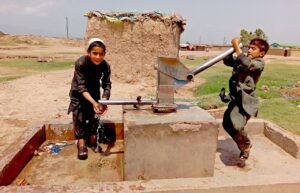 Refugees from Afghanistan in Pakistan (image from Voice of America via Wikimedia Commons)
In the narrow lanes of Rawalpindi’s settlements, the constant hum of factory machines often replaces the sound of classroom bells. Children—some as young as seven or eight—spend their days gluing sandals for less than a dollar a day, trapped in a cycle where poverty pushes them into labor. This is not only a personal tragedy but also a systemic crisis shaped by policy gaps and the persistent pressure of economic hardship.
Before fleeing to Pakistan, I was a high school student in Kabul with aspirations of becoming a pharmacist. I witnessed a relatively stable life—families like mine had access to food, shelter and a sense of everyday normalcy, along with the freedom to move without constant fear. However, everything changed after August 2021, when the Taliban took over. My father lost his job, and the economic stability that supported our household quickly disappeared. In the absence of that stability, our living conditions deteriorated, ultimately forcing us to leave Afghanistan and begin life in Pakistan as refugees.
This experience is not isolated. Across Pakistan, many Afghan refugee families face a similar erosion of basic rights, where displacement and poverty intersect to limit children’s futures. According to UNHCR, the UN Refugee Agency, and the International Organization for Migration (IOM), child labor is not merely a secondary effect of displacement but a direct consequence of economic vulnerability and lack of protection systems. UNHCR’s 2024 reporting documents more than 14,600 cases of Afghan children engaged in labor, while IOM and UNICEF also highlight that in regions such as Balochistan, a significant proportion of school-age children remain out of school and are instead absorbed into informal work. Taken together, these figures show a broader structural crisis rather than isolated incidents.
These figures point to a stark reality: Many families who fled in urgency often arrived without essential documentation, leaving them in a precarious survival economy. Without legal recognition or adequate protection, children are frequently pushed into labor as a means of basic survival. Poverty, once a background condition, becomes the central force shaping daily life—reducing wages, removing safety nets and turning each day without support into uncertainty. In such fragile circumstances, labor is no longer a choice but a necessity imposed by survival.
In response to this crisis, local communities and small organizations have often stepped in where formal systems fall short. Based on field observations and interviews, these grassroots groups have created essential lifelines for displaced families. In areas of Rawalpindi, for instance, community collectives operate informal food distribution points, providing basic staples such as bread, sugar and other essentials. While limited in scale, these support networks function as a critical buffer between extreme deprivation and minimal stability, helping families meet their most immediate survival needs.
Within these informal networks, small but structured support systems have begun to emerge, bridging exclusion and limited opportunity. One example is the Right to Learn organization, founded by an Afghan educator in Rawalpindi. Each day, refugee families gather not only for basic provisions such as bread, flour, beans and milk, but also for practical guidance on survival in a new environment. Alongside material support, the initiative provides informal lessons on livelihood skills and ways to access work, while also fostering a sense of community and shared resilience among displaced families.
Every morning in Raja Bazar, Afghan refugees gather along the roadside, holding worn brushes and paint buckets, their threadbare clothes marking long days of uncertainty. Before dawn, they wait for occasional painting jobs or small commissions that can earn them only a few rupees to sustain their families. In this setting, each brushstroke becomes more than simple labor—it reflects the daily struggle for survival within an informal economy where work is irregular, insecure and uncertain, yet still essential for meeting basic needs.
Local organizations also have attempted to respond by providing essential supplies and small stipends to support these children and their families. However, this assistance remains irregular, dependent on limited and uncertain funding. At the same time, many working children remain outside formal systems altogether—laboring in harsh conditions without recognition, while low literacy and disrupted schooling prevent them from accessing mainstream education or long-term opportunities.
Even with these constraints, such spaces of support still matter. They offer fragments of stability, dignity and routine in otherwise precarious lives, while also showing that displaced communities are not only passive recipients of aid but also active participants in creating informal pathways of survival, learning, and opportunity.
As Grace Abbott once said, “Child labor and poverty are inevitably bound together, and if you continue to use the labor of children as the treatment for the social disease of poverty, you will have both poverty and child labor to the end of time.” And as researchers such as Aysha Akter Adhara also observe, “Child labor is not merely work—it is the silent theft of childhood, where dreams are exchanged for survival and small hands carry burdens far too heavy for their age.” This stark truth is written into the lives of Afghan children laboring in Pakistan today. It shows how these cycles of exploitation are perpetuated by the same forces of political indifference and deprivation that surround them, making every child’s struggle a reflection of this enduring injustice.
There are a few key lessons for humanitarian practitioners. First, responses must go beyond emergency aid and address the structural roots of poverty. Second, support should be steady and predictable so families are not left in constant uncertainty. Third, education and protection services need to be flexible enough to reach working and displaced children. Fourth, affected communities should be directly involved in shaping the programs meant to support them. Finally, every intervention should prioritize dignity, aiming not only to meet basic needs but also to rebuild opportunity and long-term hope.
These experiences of Afghan refugee children in Pakistan demonstrate that child labor is closely linked to economic insecurity, limited access to education and gaps in protection systems. While community-based initiatives and local organizations have provided important support, their reach and sustainability are often constrained by limited resources and uncertain funding.
The situation of Afghan refugee children in Pakistan highlights the need for humanitarian programmers that combine short-term relief with longer-term approaches to livelihoods, education and protection. Without such efforts, many displaced children are likely to remain excluded from learning opportunities and continue to face significant barriers to their future development.
Child labor should never define a child’s future, yet in this context it becomes a daily constraint shaped by poverty and displacement. This crisis will not be resolved until Afghan children in Pakistan are freed from labor and given genuine access to education and protection. While attention often remains on borders and policies, Afghan children continue to wait—not for given charity, but for meaningful justice and opportunity. Even in exile, however, a sense of hope persists—one that endures when someone says:
“Don’t worry. Your future is not over yet.”