
Thomas Paine and the Humanist Soul of the American Revolution Why America’s Forgotten Founder Still Matters
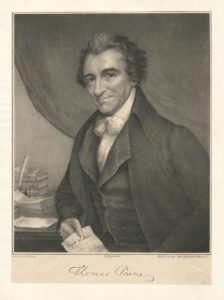 Thomas Paine portrait via New York Public Library
 The Times That Try Men’s Souls
In moments of political strain, societies are not only tested by what they can endure, but by what they are willing to become.
I challenge you to reread the opening lines of “The American Crisis.”
“These are the times that try men’s souls.”
Without context, you could be forgiven for thinking Thomas Paine wrote those words in 2026.
That is not because history repeats itself neatly, nor because our age is uniquely dramatic, but because Paine understood something Americans have repeatedly had to relearn: Political crises are not only contests of power. They are tests of moral courage. They ask not merely what institutions can withstand, but what kind of people we become when the cost of seriousness rises.
Thomas Paine is often remembered as a revolutionary writer. He should be understood as something more demanding: a thinker who grounded political legitimacy not in tradition or authority, but in the dignity of ordinary people. In that sense, Paine is not simply a figure of the past. He belongs to any moment in which public life risks losing its moral seriousness—including our own.
He continued:
“The summer soldier and the sunshine patriot will, in this crisis, shrink from the service of their country…”
The phrase endures because it names a temptation every age produces. To believe in public ideals only while they are easy. To speak of liberty, justice, sacrifice and service only while they flatter us. To love a nation only as mythology, and not as an obligation to one another.
That temptation did not die with the Revolution. If anything, it has become one of the defining civic pathologies of our own time.
Paine’s greatness was not simply that he helped start a revolution. It was that he refused to surrender its moral meaning once the glamour faded and the cost of conviction became real. He understood that a people can survive hardship more easily than they can survive moral exhaustion. Once resignation sets in, collapse does not need to be imposed from outside. It begins from within.
That is why Paine still matters—not because he belongs in the museum of respectable founders, but because he speaks most clearly in moments when public life begins to lose its moral center.
The Man Who Made Independence Thinkable
Paine did not look like the kind of man history usually trusts with founding myths.
He was not a general. Not a planter. Not a polished statesman. He was the English-born son of a corset-maker, a failed businessman, and a man of modest means who arrived in Philadelphia in 1774 with little status and less security. He came with a letter from Benjamin Franklin—and an unusual gift: the ability to make political truth feel plain.
That biography matters.
Paine did not write from above the people. He wrote from within them. He did not speak in the language of elite caution. He spoke in the language of democratic moral seriousness—clear enough for ordinary people, forceful enough to make inherited power look absurd.
And when “Common Sense” appeared in January 1776, that mattered enormously.
By then, colonial discontent was already widespread. But grievance alone does not produce revolution. A people can be angry for a very long time without becoming free. They can resent power without yet rejecting its legitimacy.
That was the threshold Paine crossed.
“Common Sense” did not merely intensify colonial frustration. It changed its character. It stripped monarchy of its mystique and made independence feel not only possible, but morally obvious.
As Paine wrote:
“A long habit of not thinking a thing wrong gives it a superficial appearance of being right.”
Power does not endure only because it is good. It endures because people become accustomed to it. They adapt themselves to what should have provoked refusal. They confuse endurance with legitimacy, tradition with truth and familiarity with justice.
Paine understood that before a people can become politically free, they must first become morally disobedient to the assumptions of their age.
More Than a Revolt Over Taxes
The American Revolution is often remembered as a revolt over taxes. That is true in the narrowest sense—and misleading in the most important one.
Taxes were the spark. Paine supplied the fire.
What he provided was not just anger, but meaning. He transformed scattered resentment into a coherent moral claim.
His argument was not simply that British rule was inconvenient. It was that the entire structure of inherited authority rested on a lie.
Kings possessed no natural right to rule. Tradition did not justify domination. Political institutions could not legitimate themselves by continuity alone. They had to answer to the living.
What Paine advanced was not merely a political break, but a moral reorientation: that human beings possess inherent worth, and that no authority can remain legitimate if it treats them otherwise.
It would be anachronistic to suggest that Paine used the language of modern humanism. He did not. But the moral logic he articulated—grounding legitimacy in the dignity of ordinary people and rejecting authority that could not justify itself in human terms—is unmistakably aligned with what we would now call a humanist framework.
The vocabulary has changed.
The underlying claim has not.
What the Revolution Was—and What It Was Not
The American Revolution did not speak with a single voice. It contained, from the beginning, a tension between two ways of understanding political life.
One was the tradition Paine represented: a moral vision in which legitimacy had to answer continuously to the lived conditions of the people themselves. Political authority was not self-justifying. It remained accountable to whether it produced a reality in which human beings could live with dignity.
The other was more structural. It located legitimacy in design—in representation, in procedure, in the careful arrangement of power. If the mechanisms functioned, if authority was constrained and distributed, then the system was considered sound.
Both were present at the founding.
But they were not the same.
The Revolution was not fought merely against monarchy as a form. It was fought against a condition—one in which the actions of government had become intolerable to those it governed.
That is what tyranny is.
Not simply a king—but a breakdown in accountability between power and lived human reality.
That was the insight.
But the system that followed did not fully encode it.
Rather than building a structure that guaranteed political life would remain accountable to those lived conditions, it built one that prevented the return of monarchy and constrained power through procedure.
This was an extraordinary achievement.
But it left something unresolved.
Because preventing monarchy is not the same as preventing the reemergence of intolerable conditions.
A system can operate as designed—procedurally sound, institutionally stable—and still produce outcomes that drift from the dignity it claims to protect.
That gap has defined the American project ever since.
The Consequences We Live With
The consequences of that distinction are not abstract.
A system designed to function correctly does not necessarily ensure that it produces conditions worthy of the people it governs. When legitimacy becomes tied primarily to process rather than outcome, it becomes possible for a society to remain stable while growing increasingly misaligned with its own ideals.
The crises we face today are often treated as isolated failures—moments of excess, instability or corruption.
But they are better understood as signals.
Not simply that something has gone wrong, but that something essential was never fully resolved.
The Founder We Forgot
And yet Paine sits uneasily in American memory.
He is cited, but not fully embraced. Remembered, but not centered.
That is not an accident.
Paine is difficult to canonize because he remains difficult to domesticate. He was too democratic, too morally serious, too unwilling to grant legitimacy to institutions simply because they existed.
It is easier to remember the Revolution through structure than through a voice that insists structure is never enough.
Paine did not fade because he was irrelevant.
He faded because he remained dangerous.
Reclaiming the Humanist Inheritance
This is why Paine matters now.
Humanism is often treated as something external to the American tradition—a modern posture standing apart from its origins. But this is a mistake.
The moral orientation we now call humanism—grounding legitimacy in human dignity, insisting that authority justify itself in lived terms—was already present at the founding.
It simply was not fully carried forward.
To reclaim humanism is not to replace the American tradition.
It is to complete it.
For many Americans, this moment produces not pride, but discomfort—an uneasy recognition that the country we inhabit does not fully reflect the ideals we were taught to believe in. That instinct is not misplaced.
But it is also incomplete.
Because the American project was never defined solely by what it achieved, but by what it set in motion. Its moral claim was always larger than its immediate reality. Paine reminds us that what was begun was not a finished system, but a standard—a demand that political life remain accountable to the dignity of the people it governs.
That is where pride still lives.
Not in the belief that America has fulfilled its promise, but in the recognition that it articulated one worth taking seriously.
Paine’s words endure because the Revolution he helped give voice to was never simply an event. It was a moral claim—bequeathed, unfinished and still demanding to be carried forward. The question is not whether it succeeded, but whether we have mistaken its beginning for its conclusion.