
Us, We, Them: The Plight and Responsibility of Being a Modern Human
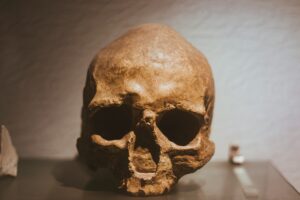 Photo by Ranjit Pradhan on Unsplash
 When I studied anthropology in the 1980s as an undergraduate, the evidence for our species living with other Homo human populations began and ended with the Neanderthals. Back then, based on the fossil dating, Neanderthals were seen as an also-ran cold-adapted lumbering species that lived at the same time as our species in Europe.
However, our more advanced and modern interpretation of 40-plus years of evidence shows how vital and interconnected Neanderthals were to each other and the environments they inhabited. We know that Neanderthals had complex culture, as well as advanced tool making, focal language and a set of spiritual beliefs not unlike our own. While Neanderthals are now extinct, as a point of fact, their DNA lives on in modern human populations due to our species interbreeding with them in both Asia and Europe.
But the evolutionary record does not stand still and, as Darwin rightfully postulated, the tree of life is filled with many branches and offshoots. Many a genus, family and species will continually evolve and adapt to their environments. Others, they will speciate and most will eventually go extinct. Based on both the historical record and evolutionary biology, after 3.5 billion years of organic evolution, we know that only one percent of all the species that have ever existed are alive today.
It may seem like a lot of species are still on the planet, but given the amount of species death that has occurred, it also means that most, and in this case that’s millions of species, have become evolutionary dead-ends for many different and diverse reasons.
Being alive today means that we as individual members of our species have essentially won one of the rarest lotteries ever conceived, the Life Lottery. So it should come as no surprise that while anatomically modern humans are indeed the “last Homo standing,” we also know that until just about 35,000 years ago we shared the planet with a plethora of at least five genetic archaic human cousins who are now sadly gone.
There’s the aforementioned Neanderthals. But we also were roommates with (and in many cases bred amongst) Homo floresiensis (nicknamed the Hobbits), Homo erectus, the Denisovans, Homo naledi, our earliest ancestor, Homo heidelbergensis and a homo species from China named “Dragon Man.”
Wow! Our history is quite littered with archaic Homo sapiens species that just until a few thousand of years ago were sharing the planet and living their best possible lives.
So what led to the longevity and the current evolutionary success of our species that offered a distinctiveness? What features enabled our survival and allowed us to thrive while all these other homo species came to an end? Did our species cause their extinction? Was climate and environmental change a cause?
I think these are important and fundamental questions to ask, but at the same time acknowledge that they cannot necessarily be explained with a magic bullet answer.
Within our genome and expressed traits, we do have evolutionary clues which may give us pause and which have afforded our species selective advantages that these other archaic human species were lacking. And externally, there were many environmental shifts occurring that certainly helped our species succeed as well.
Firstly, our species’ brain has the most advanced frontal lobe of any concurrent or ancient homo species. If you look at a Neanderthal’s skull, you’ll notice a frontal slope reminiscent of earlier, less advanced hominids. While Neanderthals did have larger brains than anatomically modern humans, the morphology indicates that size isn’t as important as the construction of the brain itself. Anatomically modern human frontal areas are larger and rounded, showing a completely different brain shape. A large frontal lobe offers more power for complex thinking, language acquisition, advanced tool making and identity. All hallmarks of our past and current culture.
Perhaps the best examples that map brain complexity and outcomes are the various tool industries. Tool complexity over time showcases how manipulation and detail have gone hand-in-hand with brain development. If you look at what Homo habilis produced versus Homo erectus, or Neanderthals to our species, you can see complex growth in technique and methods.
That’s in addition to growing tool complexity and the mixing of materials and metals to make whole new tool industries. For anatomically modern humans, complex tools coupled with the eventual domestication of plant and animal species allowed us to breed in larger numbers. This entrepreneurship and cultural advantage resulted in social stratification that moved us from band life to eventual city-states. The concurrent hyper-production of goods and services, as well as the development of trade and cultural, linguistic and biological exchange, offered anatomically modern humans selective advantage.
Secondly, to put it in the most pedestrian and non-scientific terms possible, upon leaving Africa, anatomically modern humans bred and spread like rabbits. Given that our species interbred with Neanderthals in Asia and Europe and with every other extinct species of human, it’s clear that we out-competed these other species just in terms of biological reproduction.
We were essentially rewarded by natural selection as the most niche adaptable species and since we grew our numbers quickly and had side-sex with all the other archaic humans, our ancestors were very busy at getting busy. Given that the number of these other small batch humans populations must have had relatively lower birth rates to begin with, it makes sense that modern human populations would outproduce them in the birth-war that was going on generations ago when we weren’t the only humans to exist on the planet.
As our planet warmed from the last Ice Age, the Plio-Pleistocene’s frigid temperatures gradually gave rise to the warmer Holocene epoch. If you were cold-adapted like the Neanderthals, or less fit for abounding environmental changes as impacted the Hobbits, it’s clear that extinction would be a strong possibility for your species. Natural selection works as fast as it can, but it can’t outpace dramatic or rapid environmental change
There have been five major mass extinction events on our planet which have wiped out countless species. While these extinctions have been devastating, they are relatively rare. More common and regular are what anthropologists and biologists call background extinctions. These are ongoing extinction events which sweep species off the planet on a more consistent basis. Since most average species exist between one or two million years before dying out, we might consider our competitor human cousins as background extinction events, leaving our species to be the sole surviving hominid to live out the journey and perhaps answer the biggest question, “What is it that makes us human.”
Given that anatomically modern humans have been here for between 350,000 to 700,000 years as supported by the fossil and genetic evidence, it may mean that we still have between 650,000 to 1.3 million years of gas left in our evolutionary tank. That is, if we allow for natural selection to run its course. That’s quite a good amount of time to get better at being human for our sake as well as for the sake of our planet.
But if events like conventional or nuclear war, human-caused famine or disease, or genetic engineering gone wrong occur, it could lead to sooner extinction, or what is referred to as artificial selection pressure. Essentially we’ll be taking ourselves out of the gene pool rather than nature. Add to it the threat of AI miscalculation, or a host of other technologies going bad, or poor human planning and coordination that causes further environmental degradation, then the same process of artificial selection may cause our extinction at a much faster and dramatic pace than natural typically affords.
This is the burden as well as the responsibility of being the last Homo sapiens group standing. We can embrace our genetic and social history to ensure we live longer as a group, or we can be violent and inhumane to one another and cause our demise at a much faster rate. As a cultural member of one ethnic tribe, Jews often call themselves as “the chosen people.” I think it’s better we understand and also accept a more inclusive view and see us as “the chosen species.” And being chosen is as much an honor as it is a humanistic duty. Empathy rather than war played a significant role in our species’ success and survival. The ongoing goal should be that we use our big brains to ensure we put mutual aid and co-existence to the forefront of our species’ durability and future.