
War, Violence, and the Internalized Male Toxicity Among Trump and His Supporters
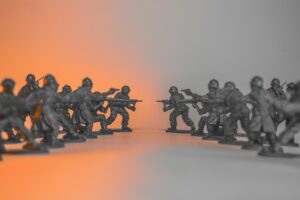 Photo by Saifee Art on Unsplash
 War in the Middle East is upon us again, it seems. Blame the many men in power in all of the countries involved.
The world was taken by surprise when the United States and Israel launched an attack on Tehran, the capital city of Iran. U.S. President Donald Trump and Israeli Prime Minister Benjamin Netanyahu announced the successful assassination of Ali Hosseini Khamenei, Iran’s supreme leader. Iranian government leaders confirmed the death.
Don’t second guess my intentions: Khamenei was a true theocratic dictator who used the peaceful teachings of Shia Islam and the scriptures found in the Quran as a facade to justify authoritarianism, oppression and the total control of daily life over his citizens. He left this plane of existence and the world could be better for it in the long run. But we have to deal with the aftermath of Khamenei’s death and what it signifies to the masses.
Trump is riding high on this accomplishment, but these attacks and Iran’s response by attacking U.S.-allied Gulf states and bombing a major American naval installation are directly related to a normalization and fetishization of violence augmented by toxic masculine selfishness.
In a matter of a few days, the “America First” illusion was shattered for the many tens of millions of President Trump’s followers — especially among young men. He ran for his second term with promises of no new wars. Young men fell for Trump’s illusionary histrionics as they were propagated, advocated and circulated by an army of far-right influencers and MAGA celebrities that paint a rose-colored vision of a just, Trumpified world.
Those influencers comprise the manosphere. During the 2024 campaign, misogynistic “alpha” men justified the reason to vote for Trump through a lens of violence and physical strength as a justification for being a real man.
By that exact logic, those influencers told younger men to vote for masculinity and a type of masculine figure that personifies a right-wing, populist and nationalistic tendency to resort to extreme responses and other cases of asymmetrical interactions, even in calm settings. It is men who are scientifically more likely to initiate a war.
It’s a trope that is so old, but it is men and their fraternities who equate value and worth in society to one’s ability to commit violent acts in an effort to gain utility and more opportunities to find a sexual mate. At least, that is an explanation from evolutionary psychologists as to why it is typically men and more masculine figures in human society who are the ones to commence conflict and war. Historical and cultural evidence backs this assessment. For example, combat sports like the UFC attract predominantly male fan bases, with many who identify as both Republican and highly supportive of the Trump administration. I am aware that not all UFC fans identify that way, but it is no hidden secret that pro-Trump sentiment sweeps the fans and the fighters who name-drop the president in press conferences and official weigh-ins. I do digress.
It’s an excellent example. Trump has projected himself as an immovable strong man on many domestic and foreign policy issues, and it shows. An air of unearned accomplishment and superiority, a deeply ingrained lack of social awareness and an empty feeling of entitlement are characteristics of demagogues — almost always men who adopt an archetype of prejudice and paternalism.
Note that there is a sentiment in political economic theory that suggests the state holds the monopoly on violence. The German sociologist Max Weber made allusion to the state saying that it had the “monopoly of the legitimate use of physical force within a given territory.” And, there, “legitimate” is the operative word. I can rant about Trump and his allies being a toxic masculine breed for an inordinate amount of time. They are, in fact; but that indictment falls short when considering how pervasive the acceptance of violence as an actionable solution to issues of ranging severity.
Trump attacks sovereign countries like Venezuela and Iran without the approval from Congress. He claims to do so as preemptive actions to further American foreign policy interests in those regions of the world. A case can be made that he carried out military strikes as a means to demonstrate that he has the ability to do so. Even though Venezuela and Iran are clear adversaries, the personal nature of these attacks screams through and it follows the sentiment that Trump is blinded by hubris and ego — both characteristics of his toxic masculinity.
Consider what is happening in our country, too. The Trump administration has given carte blanche to the agents of Immigration and Customs Enforcement (ICE) and Customs and Border Protection (CBP) to carry out mass internment and deportations of overwhelmingly non-violent and often legally-residing individuals. A campaign that was fully realized in places like the two Minnesota cities of Minneapolis and Saint Paul, this authority — otherwise, that state monopoly on violence — cost the lives of innocent civilians and the freedom of hundreds more. This stems from the fact that this campaign to ramp up immigration enforcement and to scale an agency like ICE to its largest size ever is also done with a clear demonstration of hubris and ego. But it’s not simply the president’s, but the very organization and internal culture of a workplace like ICE or CBP.
When toxic masculinity is standard throughout the very institutions that enforce our country’s laws and protect us, the audience and workforce these institutions attract are sympathetic to the deeply heteropatriarchy world view espoused by such leaders and entities. This is why people who join ICE this past year have been carefully analyzed to be flagrantly apologetic to the nativist and white supremacist America First doctrines now serving as national policy. And this could explain, according to recent public opinion polling, why Republicans are in strong support of ICE and that many in the party who were surveyed support Trump’s immigration policies.
Toxic masculinity and the dominance of men in society, including in the prosecution of war or violence against their fellow citizens, has been identified in many studies of modern right wing political movements as a factor as to how men are socialized into accepting certain views. And that socialization comes from information sources and centers of powerful influence that cross along the online realm of the manosphere, male grievance with a society they perceive to be feminized, and a messianic obsession with personality cults and idiot talking heads.
Trump did not create this culture, or any variation of it. Like authoritarian dictators he claims to oppose (such as the late Iranian supreme leader), Trump weaponizes this culture. When violence at home or abroad is framed as strength and dominion, men conditioned by such a view will always cheer it on. And the true danger is not just a select class of men who exercise such power, but the millions of men taught to accept brutality and anger as virtues and peace and tolerance as gendered weakness.