
When Death Stops Being Final AI, Memory, and the Illusion of Survival
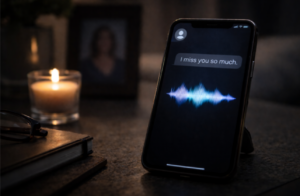
A woman asks an AI system trained on her deceased mother’s emails whether she should quit her job. The answer comes back in her mother’s voice.
Death has traditionally meant the end of a life from the inside. When a person dies, their experiences cease, their plans fall away and their perspective on the world disappears. What remains are memories held by others and traces preserved in documents, recordings and artifacts. These remnants may influence the living, but they do not continue the person who died.
Artificial intelligence is now testing that boundary in a way earlier memorials never could. A box of letters, a saved voicemail or an old video can remind us of someone we loved. But an AI system trained on that person’s emails, posts, writings or voice recordings can answer us. It can respond to questions, offer advice and speak in familiar patterns. For someone who is grieving, that can feel less like remembering the dead and more like hearing from them again.
Simulated Presence
This is not a distant possibility. Services already exist that use emails, text messages, social media posts, voice recordings and personal writings to create chatbots or voice models of the dead. Families are invited to speak with these systems as a way of preserving connection. For someone in grief, the offer can be hard to resist.
The appeal is not theoretical. Writer James Vlahos created a chatbot based on recordings and interviews with his dying father, later known as the “Dadbot.” The project was moving because it began with an ordinary human impulse: A son wanted to preserve his father’s stories, jokes, memories and voice before they disappeared. But that is also what makes the technology unsettling. The more naturally the system answers, the easier it becomes to feel that a person has remained when what has really remained is a carefully arranged record of him.
In other cases, the interaction can become even more direct and emotionally risky. Someone may type, “Mom, what should I do about my job?” or, “I’m sorry I wasn’t a better son. Do you forgive me?” The answer appears under the dead person’s name, in language that sounds familiar. At that point, the mourner is no longer only looking back. He is being invited to speak as if the relationship were still active.
The real question is not whether these systems comfort the grieving. Sometimes they may. The deeper question is whether they preserve anything that could honestly be called the survival of a person. They do not. They do not remember past events as experiences they once lived through. They do not know the person they resemble has died. They do not have a future that matters to them. What they produce is not the continuation of a life. It is a convincing imitation of how a life once expressed itself. At most, the system is a responsive archive, not a surviving individual. The danger begins when resemblance is confused with survival.
How Posthumous AI Systems Are Built
These systems do not bring anyone back. They work by drawing on the material a person left behind: emails, text messages, social media posts, personal documents, voice recordings and sometimes video. A general AI model can be adapted to this archive, or paired with a retrieval system that searches the material for relevant words, topics, and patterns. When someone asks a question, the system builds an answer that sounds consistent with the person’s past speech or writing.
Voice systems add another layer. A neural voice model can learn the pitch, rhythm, accent and cadence of a recorded voice, then apply those features to newly generated sentences. The result may sound intimate, but what is being reproduced is an acoustic pattern, not a living intention.
That distinction matters. The system does not remember events from the inside. It does not know who it is. It does not carry a life forward through time. From an engineering standpoint, posthumous AI is a responsive archive. From a human standpoint, it is resemblance without survival. A person is not merely a collection of outward behaviors or linguistic patterns.
Why Death Still Matters
Someone might object that this is only a new version of an old human practice. People have always left behind letters, photographs, recordings and books. The dead have always continued to influence the living. Artificial intelligence may seem to make remembrance more interactive, but not fundamentally different.
But something important changes when remembrance begins to answer back. Death matters because it ends a life from the inside. It deprives a person of future experiences, choices, relationships and unfinished possibilities. The loss is not merely social. It is the disappearance of a perspective that once existed and now does not. If we start treating simulations as survival, we blur the very fact that makes death morally serious.
The danger is not simply that people will be fooled by machines. It is that we may adopt a thinner idea of death itself. This matters especially in a culture where many people no longer find comfort in traditional religious promises of an afterlife. Artificial intelligence can seem to offer a secular substitute: not heaven, but continuation through data. If death becomes a technical problem of preservation, loss may come to be measured by what information remains rather than by the life that has ended.
None of this diminishes remembrance. Letters, photographs, recordings and even carefully built AI systems may help the living honor those they have lost. But remembrance is not continuation. It keeps faith with a life that has ended. It does not extend that life beyond death. Once that distinction is clear, death can be faced honestly, not as a technical failure to be corrected, but as the boundary that gives human life its urgency and weight.
Living With an Ending
Once we stop treating technology as a way around death, the harder question returns: How should we live if our lives really do end? Artificial intelligence cannot answer that for us. It can predict, organize, imitate and advise, but it cannot decide what a finite human life should be for. That responsibility remains ours.
Human life is shaped by limits. We have only so much time, attention and opportunity. Death makes those limits real. It reminds us that choices matter because they close off other choices. Relationships matter because they cannot always be repaired later. Work matters because a life cannot be spent on everything at once.
To live well is not to look for an escape from death through technology. It is to accept that death belongs to the shape of human life. Death does not create meaning by itself, but it presses the question that every life has to answer: What is worth caring about while we are still here?
A Secular Afterlife
Belief in life after death has long softened the finality of loss. It tells the grieving that the person they loved has not vanished completely, that some form of continuation remains. As traditional religious belief loses authority for many people, artificial intelligence may begin to offer a secular substitute. It promises no heaven, no soul and no divine judgment. Instead, it offers the possibility that something like us might persist through data.
The appeal is understandable. Grief looks for any opening it can find. But there is a cost. If technological simulations are treated as continuations of persons, death is quietly displaced rather than faced. The loss of a life becomes a change in format. Mourning risks becoming confusion about what has actually ended.
A clear view of death requires resisting that temptation. The value of a life does not depend on whether it can be preserved in interactive form. Artificial intelligence may change how we remember the dead, but it does not change what death is. To confuse memory with survival is to buy comfort at the price of clarity.
What AI Cannot Preserve
Artificial intelligence challenges many assumptions about intelligence, creativity and knowledge. But it does not alter the basic condition of human life: We live from the inside, and then we die. No system, however sophisticated, can continue a perspective that has been lost. What dies when a person dies is not a pattern of behavior. It is a subject for whom the world once appeared.
This distinction matters because it preserves the moral seriousness of death. If death were only a problem of insufficient preservation, the loss of a life would become a technical failure. But death is not the disappearance of information. It is the end of a lived point of view, and with it the end of possibilities that mattered to someone.
Recognizing this does not mean rejecting the technology. An AI version of the dead may help some people remember, reflect or preserve family history. But it should remain a tool for the living, not a substitute for the person who has died. Artificial intelligence can serve human life only when it does not ask us to mistake imitation for survival.
Life does not gain its meaning from the promise that it can go on forever. It gains meaning from the fact that it must be lived here, among people and choices that cannot be postponed indefinitely or repeated at will. Death marks the boundary of that responsibility. Accepting that boundary does not diminish life. It clarifies what life asks of us while we are still alive.