
Where Humanists Fit: Notes from a Godless Clergy in a Sacred Parade
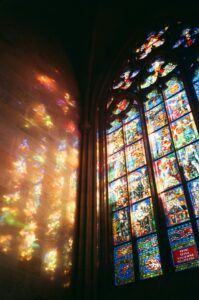 Photo by Jakub Pierożyński on Unsplash
 Marching among priests and imams, a secular celebrant reflects on interfaith inclusion, moral authority, and the sweet irony of swinging a thurible without a theology.
This marble and concrete cavern, with its pillars like interwoven stalactites and stalagmites, pulsed with sacerdotal reverence. As I marched with a procession of faith-based clergy down the center aisle—lined with standing community members and civic leaders—I thought to myself, a humanist celebrant among the robed:
There, but for the grace of God… I am not under the grace of God.
This marked the tenth anniversary of St. Paul’s Episcopal Church’s “Light the Cathedral” service in honor of San Diego Pride. Over the last decade, an increasingly diverse clergy has gathered to proclaim that their traditions affirm the dignity and protection of LGBTQ people.
As someone raised nominally Methodist—attending Christmas Eve services mostly to appease Grandma—my participation as gay, clergy, and nontheist is something I’ve come to cherish. The open arms of San Diego’s most evolved sacral elite give me hope—for them, and for what the future might yet allow.
Where Do Humanists Belong?
But this occasion raises a more complex question—one both reflexive and reflective:
Where do Humanists fit in the world of interfaith engagement?
After two and a half decades in secular humanism, I’ve seen a wide spectrum of responses. For the sake of framing (and knowing that generalizations always flirt with insult), I’d sort them loosely into four overlapping categories:
1. Resistance
2. Tepid Concern
3. Embrace
4. Ambivalence
Resistance
Understandable, even justifiable. Many of us have been wounded by religion’s weaponization. Too many lives have been scarred in the name of a “savior” whose biography, when stripped of nostalgic reverence, reads more like that of a petulant street magician than a moral exemplar. A skim through the Gospel of Matthew without rose-colored glasses reveals Yeshua as a volatile, self-serious, miracle-peddling diva who’d have made P.T. Barnum proud.
So yes, I get the instinct: to share space with the PR team of Yahweh and Company might feel like granting license to those who’ve long harmed in His name.
But as the late Ann Richards of Texas famously put it:
If you’re not at the table, you’re on the menu.
Tepid Concern
Then there’s the raised eyebrow of the tepidly concerned:
We gave up God—why dress up to play pretend?
It’s the knee-jerk recoil of the deeply deconverted. That reflex—like a sneeze at the mention of “God bless you”—has lived in me too. “God?” Did you say God? Strange crop of atheists this year.
For some, this resembles a secular version of Stephen Jay Gould’s non-overlapping magisteria: Let’s just do our thing and let the clergy have their rituals.
Embrace
On the other end, our embracing siblings—Ethical Culture societies, Sunday Assemblies, and spiritual humanists—would likely celebrate a humanist clergy presence. They might even expect it.
To the more hardened among us, this open-hearted inclusion can feel like the soft denial of a battered spouse—craving community in a form that still smells faintly of incense. Is this the hunger for a “god-shaped hole”? The lingering tremble of the believer-in-recovery?
Perhaps. Or perhaps it’s a valid longing for ritual, story, and moral theater—without the metaphysics.
Ambivalence
And finally, a more modern stance: ambivalence.
God is dead. Nietzsche, too. Jesus, meanwhile, has been ghosted—canceled not by the culture wars, but by cultural irrelevance. In the age of curated TikToks and parasocial influencers, the old religious scaffolds have become… quaint.
The chariot of caring no longer seats a congregation; it seats a subscriber base.
Smash the like button. Hit the bell for updates. Amen.
A Fifth Option: Play
As for me, I find myself with petals in each of these camps. And a fifth:
It’s kind of cool to play preacher.
I’ve been invited to give invocations, officiated weddings, and joined more than a few interfaith panels. And each time, I’ve felt—truly—that our portrait of the sacred is incomplete without the humanist worldview.
We belong in the room. Even if we don’t kneel.
Final Blessings (and a Joke)
So where do you land in this ecclesiastical rigamarole?
I don’t think we need a final arbiter. I hunger for plurality. For friction. For thoughtful disagreement. It’s in the mess of our diverse stances that we create something resembling community.
And for what it’s worth: as the Very Rev. Penelope Bridges processed forward, swinging the thurible in full high-church majesty, I got to dust off one of my favorite old jokes:
You ever hear the one about the young gay boy at high mass?
The priest walked by, and he whispered:
“Hey sister—I love your dress, but your purse is on fire.”