
Art at the Intersection of Nature and Civilization: An Interview with Alexis Rockman "I'm an artist because I don't want to be around people."
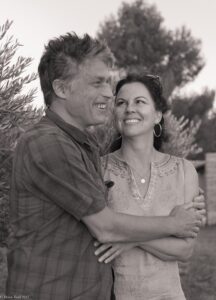 Alexis and Dorothy Rockman (photo courtesy of Alexis Rockman)
 Alexis Rockman is an American contemporary artist known for his vivid, science-informed paintings that explore the intersection of nature and civilization. With a background in natural history, his work raises environmental awareness and has been featured in prominent exhibitions worldwide. Rockman created a striking Earth Day poster highlighting ecological concerns. Rockman discusses his Earth Day 2025 poster and evolving views on art, AI, and ecological themes. Known for dystopian landscapes, Rockman critiques superficiality in AI-generated art and reflects on creative integrity, collaboration challenges, and the personal values driving his decades-long environmental art practice.
Scott Douglas Jacobsen: Today, we are here with Alexis Rockman. He is a New York-based environmental artist renowned for his vivid, dystopian landscapes confronting climate change, biodiversity loss, and human impact on nature. A pioneer in ecological art since the 1980s, Rockman designed the official Earth Day 2025 poster, aligning with the theme “Our Power, Our Planet” to advocate for renewable energy and environmental stewardship. I will start with what may be an unusual question. What painting did you do anyway, but feel somewhat begrudging about?
Alexis Rockman: There are a couple of commissions that, looking back, were purely for the money.
Jacobsen: Six figures?
Rockman: I am not getting into details.
Jacobsen: That’s understandable. I don’t want to drag it out for your next survey show. What environmental piece do you feel has stood the test of time?
Rockman: I do not think of any work as the environmental piece. What is a “scientific” or “environmentalist” piece, anyway? Everything I have done is part of a continuum. I am building on ideas, not chasing trends that become obsolete. Some pieces might be better as art than others, but the message and themes have been consistent.
Jacobsen: Are there particular ones you feel more proud of?
Rockman: No. All of the above. I do not see individual pieces as isolated islands. They are part of a mosaic that represents my body of work. Some I might like more than others, but they are all part of the same evolving conversation.
Jacobsen: We discussed this in another interview, but it is worth touching on again in shorter form. What do you think is AI’s role in art, rather than AI replacing art?
Rockman: AI will replace some things, no doubt. Yesterday, I was using AI for something—it is always tantalizing. You run a prompt and think, “this might work.” However, it never quite does. You go down these rabbit holes and think, “this is great… almost.” Then you look closer, and there is something terrible about it—even though it is shiny and seductive.
Jacobsen: Do you think people are captivated by its superficiality?
Rockman: Yes. There is a slickness to it. It looks credible. It resembles everything you have ever seen before, because it is everything you have ever seen before.
Jacobsen: That is a good line. It is a philosophical zombie. It looks like it is alive, but it is not.
Rockman: Exactly. It is part. What does that mean?
Jacobsen: In philosophy, there is the concept of a p-zombie—a philosophical zombie. It looks like you, acts, and composes like you, but has no inner experience.
Rockman: Absolutely. So, it is part. It will destroy specific careers in the so-called arts—certain types of animation, previsualization in the film industry. Those areas will suffer financially. People working in those spaces will be struck, which is unfortunate. Lucky for me, I make physical objects. So far, 3D printing has not replaced the kinds of paintings I create. But who knows?
Jacobsen: Do you think AI has some strength? It could eliminate the drudgery, like having an assistant.
Rockman: Maybe. However, does it make the art better? I do not know. All these utopian fantasies exist: the Industrial Revolution would free humanity for leisure, right? Moreover, look at what happened. There are always unforeseen consequences in any technological revolution. We are watching it unfold right now. Wait until—what is the singularity?
Jacobsen: But for now, I heard something new out of San Francisco, mentioned by Eric Schmidt, the former CEO of Google. He referred to it as the San Francisco Consensus—that within one to two years, we will have human-level AI (HAI) and, within six years, artificial superintelligence (ASI) with the computational capacity of the entire human race. So… maybe. More people are starting to accept that timeline as plausible.
Rockman: Yes.
Jacobsen: Could AI help artists explore uncharted territory in art?
Rockman: Yes—of course. However, what does that mean? Moreover, does that have value? I am particularly interested in the history of film and every technological revolution. Let’s take the example of when CGI took over the visual effects industry, specifically the one-two punch of Terminator 2 and Jurassic Park in 1992–1993.
There are only a handful of CGI sequences in Jurassic Park, and Dennis Muren and Phil Tippett largely spearheaded them. These guys come from analog effects backgrounds—I know them and am friendly with them. They understood the need for a certain kind of visual and emotional experience.
What I’m getting at is that it depends on the work and the creators. But yes, there’s also a shitload of terrible CGI. It ruined part of the visual effects industry. When I worked on Life of Pi, the film was almost entirely CGI, except for some physical set elements and parts of the water, with the live-action actor playing Pi on a boat.
Four VFX vendors were on that film: the Moving Picture Company in London, Rhythm & Hues in California, a French company called BUF, and another vendor I cannot recall. By the time Life of Pi won the Oscar for Best Visual Effects in early 2013, Rhythm & Hues had already gone out of business.
Because they had to be underbidding from getting the job, in that world, once a studio commits to working with a visual effects house, the studio can demand revision after revision. You have to comply, but you still have to pay your artists and animators. So your profit margins shrink until there’s nothing left. It’s cruel. There’s a fantastic documentary called Life After Pi on YouTube. You should check it out.
Jacobsen: Absolutely. What are other facets of the art world that are similarly precarious?
Rockman: It does not work quite the same in my part of the art world. Some corners have foundries and fabricators, but I do not work with those people. I make all my work, except for the wooden panels I paint on. I do not have assistants. That’s not the way I want to live.
Jacobsen: You mentioned someone who helps occasionally?
Rockman: Yes. There is a wonderful person named Alexander Winch. He’s moving to California in a couple of weeks. He lived in Scranton, Pennsylvania, and would come to New York for a few days, maybe once every two months. He would help me with things I did not know how to do or did not want to do.
Jacobsen: You said that having people around is not the lifestyle you want.
Rockman: I’m not an administrator. I’m kind of misanthropic. I became an artist because I don’t want to be around people.
Jacobsen: That’s the opening quote for this one: “I’m an artist because I don’t want to be around people.”
Rockman: I won’t tell you why.
Jacobsen: Work-wise, that’s right. Do you think there’s a tendency among contemporary artists to be misanthropic?
Rockman: Like everything else, it’s all types. You’d probably laugh if you saw me in public. I’m outgoing, know a gazillion people, and love being in the world. But that’s because I fought to get there. I couldn’t talk myself out of it, so I talked myself into it.
Jacobsen: So, artists are people too?
Rockman: Just like everyone else. If you cut an artist, do they bleed?
Jacobsen: Do they bleed paint or acrylic?
Rockman: Cadmium.
Jacobsen: That’s right. I was interviewing a realist painter. He mentioned that some older generations of artists were exposed to toxic substances—over time, they discovered many of the materials were poisonous. Is that still a risk?
Rockman: Less so. It’s more of a nanny state now. But I still work with cadmiums. Some whites have lead in them. There’s a long tradition of that in painting.
Jacobsen: I will not go down the full rabbit hole of acrylics and paints. But on another note, you’re someone who finishes every piece you start. You follow through. Has that trait served you well in other parts of life?
Rockman: Yes. I follow through. I’m not someone who messes around. I meet my obligations, probably to a fault.
Jacobsen: We do not have to go into what that means.
Rockman: [Laughing] I’m full of mysterious latitudes.
Jacobsen: That’s right—it comes from having been places. So, this time, the Earth Day poster features a solar panel. Why solar panels?
Rockman: What do you mean? Why?
Jacobsen: Renewable energy?
Rockman: Come on. The mandate was to represent renewable energy. I originally had a windmill in a sketch. They came back and said, “Can you do solar panels?”
Jacobsen: So you did not initially want to?
Rockman: Not really. I thought, “Do you want a Dutch montage?” But no—wind, solar, wind power—these things. So I added some whales and stuff. And then they returned and said, “We tend to want a solar panel.” I thought, “Okay… let me figure that out.”
Jacobsen: Why do you think they pushed for solar?
Rockman: You’d have to ask them.
Jacobsen: I kind of want to email them and find out.
Rockman: I work here. [Laughing]
Jacobsen: That’s a phrase you usually say when going into an office with a bunch of coworkers for a corporation that owns you.
Rockman: Exactly. [Laughing]
Jacobsen: Let’s do a few more. That’s funny. So, what did they say about the whale?
Rockman: They were not particularly interested. It was… fine. What I enjoy about projects like this is that I get to do what I want 99% of the time. So it is fun to have these outside challenges once in a while.
Jacobsen: Did you try to throw in a polar bear? That is the quintessential environmental image.
Rockman: Yes. The goal, though, is not to be trite or flat-footed. But yes.
Jacobsen: Or a black bear in the Arctic? [Laughing]
Rockman: From my perspective, the whole project began as cautionary and frightening. But they wanted something much more optimistic, which was challenging for me.
Jacobsen: Who approached whom at the start?
Rockman: I got an email from Elizabeth Broun, the former Smithsonian American Art Museum director. She asked if I would be interested in doing something for Earth Day. The organizers had asked her who she thought they should approach, and she suggested me. I said yes immediately.
Because—listen—I do not care for most Earth Day posters made over the years. They are whatever they are. But I do love that Robert Rauschenberg did the very first one. My wife and I admire Rauschenberg deeply. We own several of his works. She used to work at Leo Castelli Gallery, which represented him. She even knew him before he passed. So, I felt a real connection to that tradition and wanted to be part of it.
Jacobsen: Did your wife have any input on the piece?
Rockman: She talked me off the ledge of walking away from the project. There was a point during all the back-and-forth when I thought, “This is a waste of time if it has to be so optimistic.” She told me to see it as an intellectual exercise—to challenge myself and see if I could make it work.
Jacobsen: That’s fair. We’ll leave it there.
Rockman: Yes.
Jacobsen: Alexis, thank you.
Rockman: Cheers.