
Communities in Action: Sikivu Hutchinson, Black Skeptics LA
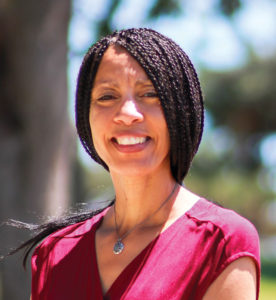 Sikivu Hutchinson
 Sikivu Hutchinson is an accomplished author, creative, and community organizer. She’s the leader of Black Skeptics Los Angeles – a chapter of AHA – but her work doesn’t stop there. Sikivu is heavily involved in local youth education, with a focus on empowering Black queer and gender-expansive youth. She and her colleagues truly exemplify humanist action, putting community, collaboration, and youth empowerment at the forefront of their work.
Please introduce yourself – when did you become involved with your organization, and why?
My name is Sikivu Hutchinson – I actually have two organizations. One is Black Skeptics Los Angeles, which was established in 2010-2011, and serves the needs of African American secular humanists, atheists, skeptics, and freethinkers in the South LA area. Our focus is on educational justice and organizing. We also have the Women’s Leadership Project (WLP), which is a Black feminist mentoring, civic engagement, and advocacy program that is also based in South LA. WLP serves Black girls, girls of color, and queer and gender-expansive youth.
The WLP focuses heavily on gender-based violence prevention education. We have programs in South LA middle schools and high schools. It’s really oriented towards uplifting the advocacy, the voices, and the coalition building of Black girls, femmes, and queer and gender-expansive youth of African descent around issues that are important to them in their school community. For example, we have a missing and murdered march and rally that’s coming up. That’s being initiated by the Standing for Black Girls Coalition, which emerged during the pandemic to really address the degree to which Black girls were experiencing disproportionate rates of sexual and domestic and intimate partner violence that continues unaddressed within LA County and LA City. The youth in that coalition are pushing for a youth center in the Crenshaw Corridor where our organization is based.
We also have the Standing for Black Girls Wellness Initiative, and during the pandemic, we partnered with Open Path Counseling, which is based in Inglewood, California – a predominantly Black and brown community. And this initiative was really propelled by the research and the findings of some of our high school students who were at that time in tenth and eleventh grade. They did a survey that ascertained that the majority of the respondents who were Black girls and girls of color and were also survivors of gender-based violence – specifically sexual violence and sexual harassment – and that they were not able to access mental health care. As a result of their research, we wanted to develop a program that emphasized culturally responsive and humanistic mental health care. A lot of the young people that we work with are questioning, are skeptical, have experienced discrimination and other forms of stigmatization within their communities because they’re queer or gender expansive. Open Paths Counseling provides that humanistic care. It’s run by Black women – it’s very important for us to ensure that our youth are being seen by practitioners who come from their community. Because oftentimes it’s really difficult for, Black girls and Black women to find practitioners who are coming from our lived experience.
Is there a particular moment in time that motivated you to start these programs?
I would say that it was precipitated by a lot of the crises that Black girls were experiencing in the early 2000’s, and the lack of emphasis on the trajectories of Black girls when it came to mental health, gender-based violence, academic outcomes, representation in STEM, and representation in politics. It was a perfect storm of disparities that really hit me when I moved back to LA, and getting back in touch with South LA communities. There were no anti-racist or Black feminist, Black womanist, humanistic programs during that period. And unfortunately, that remains a deficit.
Could you tell me a bit about the leadership structure of your organizations?
We’re very small, and we work collaboratively. It’s a very collectivist-oriented structure with many adult mentors and leaders like myself. Black Skeptics is an umbrella for a lot of different initiatives that primarily focus on youth and educational justice.
Tell me more – what do some of your current programs look like?
One of our key initiatives that’s been going for about thirteen years is the Black Skeptics ‘First in the Family’ Humanist Scholarship Fund. That started in 2013. It was local, and then we transitioned to a national platform. That’s been very successful in providing $5,000 scholarships to BIPOC secular youth who are primarily coming from undocumented backgrounds, unhoused backgrounds, foster care backgrounds, LGBTQ+ backgrounds, justice-involved backgrounds, or have disabilities. We really wanted the scholarship to hit a lot of the youth communities that are most impacted by mass incarceration and policing, criminalization, surveillance, and sex trafficking.
You just produced a film called “Alpha Centauri” – could you tell me a bit about that project?
“Alpha Centauri” focuses on a Black foster care protagonist who is college-bound, a freethinker, and aspires to be an aerospace engineer. We really wanted to amplify the disproportionalities when it comes to commercial sexual exploitation in the United States. Black girls and Black women represent over forty percent of those who are victimized by domestic sex trafficking. “Alpha Centauri” highlights all of these nexus issues in terms of the high rates of foster care victimization, victim-blamimg when it comes to organized religion, and the sexual abuse to prison pipeline. There are a lot of different dynamics there. A lot of the WLP and Black Skeptics community were involved in that film production.
How are your organizations “meeting the moment”?
One way that we’re meeting the moment is really being attuned to the needs of Black queer and gender expansive students. We do professional development that specifically focuses on culturally responsive initiatives and resources. We are currently collaborating with the LAUSD, the Los Angeles Unified School District, which is the second-largest school district in the nation. We’re doing a series of trainings, professional development-oriented, that specifically speak to the challenges that Black queer students are experiencing. That’s really been groundbreaking because it took a year to get these trainings calendared within the district.
It’s not just a small cohort. I’ve done numerous trainings since my child started elementary school back in 2012-2013. They’re about to graduate from high school in June, and it just feels like this tremendous arc – having started with the professional development trainings on gender stereotypes and gender roles, and now having leveled up, scaled to doing it across the district with achievement plan practitioners. Psychiatric social workers, restorative justice counselors, and other practitioners within the district. It’s really been quite momentous and gratifying to see that culmination.
How do you envision the future of your chapter, and what resources will you need in order to get there?
In the near future, we’ll be trying to identify a building that we think would be appropriate for a new Youth Center. The youth are going to create artwork that labels the building as the Tioni Theus Youth Center – named for a young Black girl who was abducted and murdered in South LA back in 2022. Right around the time her body was found, a young white woman was murdered, and there was a lot of press about her death in the effort to find her killer. It just underscores the disparities when it comes to the treatment of Black girls and Black women victims of homicide and abduction.
We’re actively working on that youth center, through advocacy in addition to seeking grant funding. We’ve talked to some potential community partners in the Crenshaw corridor. The LA Black Worker Center, for example, is one organization that’s expressed interest in a partnership. However, we want something that’s public-facing. So sure, we could invest in an office or whatever, but we want a center that’s fully functioning when it comes to programming and resourcing, meaning it has to be visible in the community.
It’s really egregious because there are no youth centers and youth spaces in the particular corridor I’m talking about. And South LA in general is just under siege when it comes to the amount of liquor stores, abandoned buildings, open brownfields… It’s really horrendous. So there are very few culturally responsive spaces that youth can go to after school. With all these buildings, there are a lot of good spaces that could work, but there’s just a lack of elevation.
The youth center is obviously a linchpin of what we’re envisioning for the future. We want to have a full complement of services and resources for gender expansive youth, queer youth, Black girls, and girls of color. We’re also looking to build on the mobilization that we have at this current moment, and really centering the self-determination and the agency of Black girls and Black queer youth. That is our primary charge. There’s very little visibility when it comes to their issues, but we’re gonna continue pushing, resisting, and disrupting that erasure.
Anything else you’d like to share?
We’d really just like to magnify the crises that Black women girls are experiencing in LA County and LA City.
There was a report that came out back in twenty twenty-three by the City Human Relations and Equity Department that concluded that Black women have the highest rate of victimization when it comes to sexual violence, domestic violence, and sex trafficking. I’ve already invoked some of those statistics, but the devastating thing is that we have elected officials from the African American community that don’t give a damn. We’ve been at the LA City Council numerous times agitating about this, trying to ensure that our youth voices are heard and that our policy demands are being taken seriously. And here we are three years after that report was published, and it’s still a Sisyphean battle trying to get Black elected officials to prioritize the lives of Black women, girls, and Black queer communities.
If folks want to support and reinforce this work, go to our websites, womensleadershipla.org or blackskepticsla.org, or find us on Instagram (wlproject__), and check out the work we’re doing.