
Humanists Making a Difference: Humanist Celebrant & Chaplain Frank Chappell
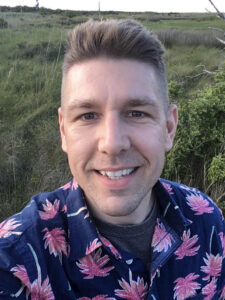
Humanists Making a Difference is our regular series highlighting humanist professionals and the communities they serve. Learn more about the work of celebrants, chaplains, invocators, and lay leaders–and find an endorsed humanist professional near you–at The Humanist Society.
What motivated you to become a celebrant?
I was motivated to become a Chaplain-Celebrant first and foremost because I wanted to provide counseling and care from a secular humanist spiritual orientation. Over 20 percent of the U.S. population identifies as spiritual but not religious and up to 30 percent are in the “none” category. There is a growing need for those who have decided to step out of religions altogether to be seen and served with empathy and care. With a background in Anthropology, I have researched firsthand how essential group rites, rituals and cohesion-building ceremonies can be; they bring us together as human beings with a shared need for meaning, purpose and belonging. By becoming a Chaplain-Celebrant, I wanted to be able to facilitate and celebrate those big human moments of transition and joy that mark our existence. I endeavor to be a conduit for the appreciation of this one life we have to live together and to support those who are searching for the same.
Why did you seek endorsement with The Humanist Society?
As a member of the U.S. military, I work in the Chaplain Corps. I encountered many members who had suffered spiritual injuries or moral injury from their peers, commanders, or even religiously-affiliated chaplains because of their unique spiritual or secular humanist philosophical orientation. I suffered with them as they related how they were shamed and rejected. I could not stand feeling like there was nothing I could do or that anything I tried would be too small an effort to have any result. I am a realist and a pragmatist; I took the advice of Gandhi when he said, “Whatever you do in life will be insignificant, but it is very important that you do it anyway.”
I decided that in order to make a real difference—and to represent my own beliefs and philosophy truthfully—I would work to achieve the endorsement of THS as a Chaplain-Celebrant. I do not feel insignificant when I am being a companion to someone in grief, when I am witnessing a transformation before my eyes or receiving another’s tears with solemnity or joy. It is because of this that I know I have chosen the right journey in seeking my endorsement and living—not simply working—as a Chaplain-Celebrant thanks to THS.
Is there an event you officiated that stands out as rewarding and significant (i.e. unusual wedding ceremony, touching celebration of life, impactful exchange)?
Last year, I officiated a Halloween-themed wedding with a lovely couple. It took place in a large cemetery the couple had chosen; I will never forget the sun setting over the mausoleums as they spoke their vows to each other and acknowledged that one day they will end like all other natural things. It moved me so much to see such acceptance of the inevitability of death amid tears of joy for one day of life.
I officiated a memorial service for a co-worker who passed away this year. Her work family and friends gathered in her name to create a sacred space for their own unique obituaries they had created, poems they wrote, and memories they wished to share. I was brought to tears by the grief, laughter and community gathered because of one beautiful person. That day reminded me of the power of our belonging to the community of humanity and the connections we make to each other that last even beyond the finality of death.
Have there been challenging moments in doing this work?
There have been many challenging moments doing the work of a Chaplain-Celebrant. I was fortunate enough to do my Clinical Pastoral Education at a VA Hospital. Working on the inpatient mental health wards provided a challenge every day. I also worked for the VA’s Center for the Treatment of Addictive Disorders conducting spirituality and bereavement groups. I found my empathy engaged and taxed by the narratives shared in those settings. Our veterans suffer not only in wartimes, but also in resuming their civilian lives and creating a “new norm” for living. Serving those who have given so much of their lives to our nation made the challenges all worthwhile, and while it can be distressing, it is a privilege to have heard their stories, witnessed their tears, and held their hands even as they breathed their last breath.
How does your nonreligious worldview impact your work?
In the civilian world, my nonreligious worldview does not impact my work; my relationships and approach to chaplaincy with patients, counselees or clients comes first for me. I do my best to connect to people seeking me out for services first, then introduce my philosophical orientation. I have found that even when working with religious persons, relationship trumps denomination.
Militarily, I am often met with confusion as to why I am in the Chaplain Corps but am not religious. There is an expectation to be religious or at least theistic/spiritual when one is in uniform and serving with chaplains. However, I usually take such inquisitiveness as a teaching moment wherein I may share my views and spread awareness about humanism generally. Usually, when someone actually meets a humanist, even if they are religious, I have found that they are respectful and even intrigued. As with many religious beliefs, political views, or opinions, when someone actually meets a person espousing what they thought was terrifyingly in opposition to their worldview, they are more apt to humanize lofty concepts as understandable positions held by a person they now respect.
How do people (coworkers/clients) respond (if at all) to you being a humanist? Do you often meet people who don’t even know what humanism is?
I often meet people who have no idea what humanism is and I love to watch their faces when they realize what a benevolent, optimistic philosophical orientation it truly is when someone embodies it with empathy and understanding. More often than not, I have found that humanism is the common ground for me and even religious maximalists who may otherwise be fearful of researching the subject or speaking with a humanist. It gives me great satisfaction knowing that the foundations of humanism can be found in our simple interactions and connections to each other as conscious beings.