
The Trailblazers of Humanism
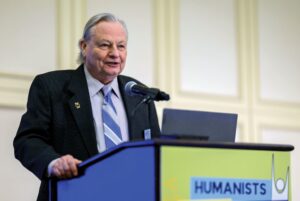
I LIKE TO SAY, when I was at Camp Quest, one of the slogans that I invented was, “cleanliness is next to godliness.” And that was in that video there. But I wanted you to be aware of that because the slogan “cleanliness is next to godliness” doesn’t make any sense. I mean, there’s nothing in the Bible that says God wants us all to be clean. And so if it’s going to be absurd, let’s make it absurd and say, “cleanliness is next to godlessness.”
One of the things that we did was we felt that we, as godless people, had to prove that we could keep our cabins cleaner than the ones at the Christian camps we often rented, like YMCA camps. The Christian groups would be over here and our groups would be over there. We wanted to have cleaner cabins than they did, because we wanted to get the point across: we’re going to have to prove ourselves. We’re going to have to work twice as hard to be thought half as good. And so we need to be clean.
It so happened that that worked because when the camp was trying to rent its facilities to other groups, they would take them on a tour through our kids’ cabins because they were the cleanest cabins around. And so we built up a reputation. We took that absurd slogan and proved it true.
I’m not really here to talk about myself, I think. John is there for talking about me, so I don’t have to. What I want to talk about is all of that tradition that is part of the American Humanist Association, part of the broader humanist movement, of which the AHA is a part. We’ve heard from some excellent speakers and awardees during this conference so far, and we’re going to continue to do so. Our awards program shows how great the things are that our people do. I can’t really hold a candle to the people who have come before me in this conference and received other awards. They’ve done such great things. I’ve just done things within the AHA. They’ve done things in this greater world in ways that astound me. I am so impressed by these folks, and what I want you to take away from all of this is that the people you have been awarding during this conference are part of a long and grand tradition, of which all of us can be proud. As Fish Stark proclaimed at the start of this conference, “We are reclaiming the humanist movement’s heritage as the source of America’s best ideas.” That’s what we’re doing at this conference. And I’d like to pick up that theme that he started on the first day.
Humanists have been at the forefront of social reform, both nationally and globally. So I want to take some time to offer you a somewhat detailed history of modern humanism’s most notable social, political and cultural achievements. This will put together and expand on what you’ve heard so far by various speakers in this conference, because our past offers an inspiring legacy to take us forward as we do new things, and as we honor new people for their humanist action. Our story is a long one, but it’s really only just begun.
American humanism in many ways finds its roots in enlightenment rationalism of the 18th century, which challenged the divine right of kings and gave us developed concepts of government order as reflected in our institutions, both public and private. When we think of the enlightenment, however, it’s easy to remember the men like Voltaire in France, along with our first few deistic U.S. presidents, George Washington, Thomas Jefferson, and James Madison. A deist is someone who believes in god but not traditional religion. And that was also true of Thomas Paine. They believed in nature and nature’s god, and those words found their way into the Declaration of Independence. But there were other germinal thinkers of this era, like Mary Wollstonecraft in England, a deist herself, who specifically included in her concept of human rights the rights of women, children, enslaved Africans, and animals.
Best known for her 1792 feminist work, “A Vindication of the Rights of Woman,” she also promoted the value of breastfeeding and coeducational schools. And because popular charlatans preyed mostly on women, she debunked the scams of popular charlatans. One of the developments that grew out of the enlightenment was 19th-century freethought. Although we today most often remember freethinkers for their opposition to superstition, most of the activity of freethought organizations and prominent individuals like Elizabeth Cady Stanton, the atheist, and Robert G. Ingersoll, the agnostic, was directed toward social change, including advocacy of women’s rights and religious liberty.
Many freethinkers were heavily involved in the labor movement, working as well to end child labor and unsafe living and working conditions and advocating for social reforms like birth control and sexuality education. They also advanced public schools. These people were at the forefront of these novel ideas regarding the anti-slavery movement in the 19th century. Abolitionists weren’t only opposed by the Christian churches in the south, they were ignored by the Christian churches in the north. This caused a high level of anti-clerical rhetoric among abolitionists, like the secular activist Frederick Douglass, as well as among religious ones. As a result, abolitionists back in those days were commonly labeled by the public as atheists. How ironic it is then, that today it is the Christian churches who like to claim credit for the ending of slavery. We need to reclaim our role in abolition.
This focus on relevancy made freethought a powerful force in American social reform. And so it was that that reform became one of the defining characteristics of ethical culture. This movement emerged out of Reform Judaism, free religion and freethought to become a significant force in the northeastern United States, in Saint Louis, and from its founding in 1877 by Felix Adler. It regarded notions of god as irrelevant.
Right from the start, social reform was the focus. Ethical culturists established the first free kindergarten in New York City and San Francisco and created the Visiting Nurse Service, the first of its type that did not do missionary work for organized religion but focused exclusively on physical care. In the 1880s, the Ethical Culture movement established schools for the children of the working class, engaged in relief work, founded the City Club to fight political corruption in New York City, established the first settlement house in the United States to address the social needs of urban slum communities, and founded the Child Study Association to expand knowledge about children. They launched the Legal Aid Society (ever heard of them?), campaigned against child labor and worked for slum clearance and improved public health. Then in the 20th century, the American Ethical Union helped found the National Association for the Advancement of Colored People, the NAACP, and the American Civil Liberties Union.
They aided refugees and developed the Encampment for Citizenship, a progressive summer camp for youth later endorsed by Eleanor Roosevelt. You remember Eleanor Roosevelt, who chaired the drafting committee of the UN International Declaration of Human Rights. She privately declared herself a humanist in the 1950s to our own Lloyd Morain, once a president of the American Humanist Association. So the activities of the American Ethical Union and of other freethinkers took the cause of social reform from the freethought movement and brought it to humanism.
It was in the opening years of the 20th century that an increasing number of liberal religious people, freethinkers and academic philosophers began using the term “humanism,” a term borrowed from the Renaissance, and they used it to describe their human-focused naturalistic worldview. Then, during the time of World War I, two nontheistic Unitarian ministers, John Dietrich and Curtis W. Reese, joined together to promote humanism as a movement within Unitarianism. There it grew as well as in academic circles, until the Humanist Fellowship was founded in 1927, right near here at the University of Chicago. It began publishing a magazine, “The New Humanist,” in 1928, and it was in the pages of that magazine that the first Humanist Manifesto was published in 1933. The manifesto was signed by leading academic philosophers, scientists, Unitarian and Universalist ministers, ethical culturists, journalists, and others.
In 1935, the Humanist Fellowship was supplanted by the Humanist Press Association as publisher of the magazine. Then that association was reorganized into the American Humanist Association in 1941, and John Dietrich and Curtis W. Reese were there to oversee making that happen. So that is the story of our origin as an organization.
On the international scene, following World War II, three prominent humanists became first directors of major divisions of the United Nations. They were Julian Huxley of UNESCO, Brock Chisholm of the World Health Organization, and John Boyd Orr of the Food and Agricultural Organization. In postwar Europe, humanist secular organizations sprang up in a number of countries. In India, M.N. Roy launched the Radical Humanist Movement to reform Indian politics, and Gora, an associate of Gandhi, expanded his atheist center, a humanistic social service institution he had established in 1940. Nehru, the first Prime Minister of India, was an outspoken humanist, and Periyar, another humanist, led a prominent social reform movement in South India.
Then in 1952, at the Municipal University of Amsterdam, Huxley chaired the first international humanist gathering. Over 200 humanist leaders from around the world met and formed the International Humanist and Ethical Union, which began with only five founding organizations, one of which was the American Humanist Association and another of which was the American Ethical Union. It is now renamed Humanists International, and it has become a network of over 170 organizations from more than 80 countries, and represents millions of humanists worldwide. It’s involved in social action projects in a broad range of countries, and is active in the Council of Europe and the United Nations.
However, not all humanist social reformers have done their work through identifiably humanist organizations. A prime example of someone who worked outside the organizations in our movement would be Albert Einstein, who “Time” magazine named person of the 20th century at the beginning of 2000. Although almost everyone knows that Einstein was a great physicist, few know that he was a humanist social activist. Born to freethinking Jewish parents, he co-authored the Manifesto to Europeans in 1915, calling for an end to World War I. He joined the advisory board of the first Humanist Society of New York in 1941, became chair of the Emergency Committee of Atomic Scientists in 1946, and published “Essays in Humanism” in 1950. As his last act, Einstein joined Welsh mathematician and philosopher Bertrand Russell in the Russell-Einstein Manifesto, issued 70 years ago on July 9, 1955.
It warned of the perils that have arisen as a result of the development of weapons of mass destruction, and called for an abolition of nuclear weapons, along with an end to war. The document closed with these unifying words: “There lies before us, if we choose continual progress in happiness, knowledge, and wisdom. Shall we instead choose death, because we cannot forget our quarrels? We appeal as human beings to human beings: Remember your humanity and forget the rest. If you can do so, the way lies open to a new paradise. If you cannot, there lies before you the risk of universal death.” This document was signed additionally by Max Born, Percy W. Bridgman, Leopold Infeld, Frédéric Joliot-Curie, Hermann J. Muller – who was the 1963 Humanist of the Year and a president of the American Humanist Association, Linus Pauling – who was the 1961 Humanist of the Year, Cecil F. Powell, Joseph Rotblat and Hideki Yukawa.
Its issuance directly led to the emergence of the modern antiwar movement, in particular the Pugwash Conferences on Science and World Affairs. These take their name from the location of the first meeting, which was held in 1957 in the village of Pugwash, Nova Scotia, the birthplace of Canadian philanthropist and humanist Cyrus Eaton, who hosted the meeting for the American Humanist Association. Activist involvements emerged almost from the AHA’s launch in 1941. Throughout the 1940s and 50s, humanists were involved in civil liberties, birth control, and environmental protection cases tried in court.
One of the most prominent of these humanist activists was Corliss Lamont, a philosopher who successfully stood up to the House Un-American Activities Committee and Senator Joseph McCarthy, launching effective litigation. He even got the U.S. postmaster to apologize in a personal letter to him for illegally opening his mail. Another was Vashti McCollum. Her 1948 U.S. Supreme Court victory in McCollum v. Board of Education established that U.S. public schools must be religiously neutral. She was later elected president of the AHA and served during the first half of the 1960s.
The 1960s, as we know, were a time of rapid social change. A big part of which was the civil rights movement and the leader of the secular wing of that movement was Asa Philip Randolph. In 1925, he had organized and led the first successful African-American labor union, the Brotherhood of Sleeping Car Porters, eventually becoming the face of the U.S. civil rights movement for a time. He was instrumental in 1941 in inducing President Franklin Roosevelt to ban defense industry discrimination during World War II. In 1948, President Harry Truman was similarly induced to promote fair employment and anti-discrimination policies in federal government hiring and to end racial segregation in the military.
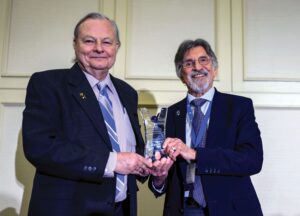 A lot of people don’t know this, but not only were the races segregated in the military during World War II, but they used to separate the blood of Black people and white people for blood transfusions. This put a stop to that. In 1963, it was Randolph who headed the famous March on Washington at which Martin Luther King gave his “I Have a Dream” speech. He was the keynote speaker. He was not the leader. The leader was A. Philip Randolph. And in 1970, Randolph accepted the Humanist of the Year award from the AHA at its national conference in Boston.
Early in the 1960s, the AHA became the first national membership organization to endorse abortion rights, even before Planned Parenthood took on the cause. Furthermore, many of the leading abortion law reform groups that were established during that time were top-heavy with humanists. Also during that decade, the AHA and the American Ethical Union worked together to establish the rights of non-theistic conscientious objectors to the Vietnam War. You’ve always heard there are no atheists in foxholes. Well, I’m sorry, but that’s the only place the atheists could be because they weren’t Quakers. So the atheists were in the foxholes until it was established that they could be conscientious objectors.
In 1974, the National Commission for Beneficent Euthanasia was established in an AHA program, and it issued the groundbreaking statement, “A Plea for Beneficent Euthanasia,” a position paper signed by medical, legal and religious leaders. It called for a more enlightened public opinion to transcend traditional taboos and move in the direction of a compassionate view toward needless suffering in dying. All of this was long before the activism of the Hemlock Society, Jack Kevorkian and the organization Compassion and Choices. And before the current rise in support for improved end-of-life care, including medical aid in dying. We humanists are pathfinders, pathmakers and trailblazers.
In 1977, responding to evangelical Christian efforts to inject creationism into public school science curricula, the American Humanist Association issued a statement affirming evolution as a principle of science. It was signed by 163 scientists, theologians, philosophers and others, and it was mailed to every major school district in the nation. This is where I came in, publicly debating creationists and then launching the “Creation-Evolution Journal” in 1980 to answer creationist arguments in the fields of science, education, and law.
This journal was published by the AHA and also funded scientific research around Glen Rose, TX, to study the fabled dinosaur and human footprints that supposedly existed side by side in Cretaceous limestone along the Paluxy Creek. Creationists claimed that these fossil tracks disproved evolution by showing that humans and dinos had lived at the same time. Our team of scientists in 1982 and 1983, led by Professor Laurie Godfrey, was able to thoroughly demolish that creationist claim to the point that creationists themselves began abandoning it, starting with the Institute for Creation Research in 1986.
 As a result, the four team members were honored at the 1988 conference in Dallas, Texas, with the Humanist Contributions to Science Award. A post-conference field trip to the footprints sites allowed attendees to see the evidence firsthand. Those footprints, if you take a close look, are the same distance apart as the dino tracks that go off to one side, because they’re all dino tracks. They have the stride length of dinosaurs. Not only that, but all you’re seeing on the ones that were regarded as human footprints is the middle toe depression. You’re not seeing very dramatically the side toes, because they put water in the tracks to illuminate them for this photograph. This is a creationist photograph, by the way. So it kind of makes it look like something that it’s not. But at our conference, we let people go and look at these trackways firsthand, and they can see the absurdity of these creationist claims.
One of the things humanists have taken a particular interest in is social action programs that have been used in the past as tools for religious conversion. Thus, in 1990, the AHA advanced Rational Recovery, a substance abuse program that offered a secular alternative to the more traditional religion-based Alcoholics Anonymous. In 1994, a new program spun off from that. It was based on the Rational Emotive Behavior Therapy of humanist psychologist Albert Ellis, and it was called SMART Recovery. AHA chapters and affiliates soon began sponsoring SMART Recovery groups. Because of these efforts, the courts in many communities today now allow those with alcohol and drug dependence issues more choices in the selection of a recovery program. And the number of SMART Recovery groups has now expanded to over 2,500 in 23 countries.
In 1999, as executive director, I lobbied the board of directors to move our national headquarters from its location in a suburb of Buffalo, New York, to the prominence of the nation’s capital. Finances for this effort were soon provided by the Humanist Foundation, and a building was purchased in downtown Washington, D.C., and the move was completed in the early 2000s. Once we were established there, we were able to bring into our new building a new organization, the Secular Coalition for America, which was a coalition of which the AHA was a member. And with that new organization headquartered for a time in the AHA office, the AHA began to participate in direct lobbying of D.C. politicians on issues of humanist concern.
Further along these lines, the AHA launched the Appignani Humanist Legal Center in 2006 with a team of attorneys who, through “friend of the court” briefs, litigation and other legal work, fostered involvement in church-state separation cases and nontheistic equal protection lawsuits. For example, through a successful settlement in 2018, the AHA got the Federal Bureau of Prisons to formally recognize humanism as a belief group, allowing humanist inmates to form study groups and observe humanist holidays like Darwin Day.
That same year, the Center for Freethought Equality helped representatives Jared Huffman and Jamie Raskin create the Congressional Freethought Caucus, which first met in the AHA’s office conference room and today counts 32 members in the U.S. House of Representatives. Its mission is to promote public policy formed on the basis of reason, science and moral values, protect the secular character of our government by adhering to the strict constitutional principle of the separation of church and state and oppose discrimination against atheists, agnostics, humanists, seekers, religious and nonreligious persons. Its mission also includes championing the value of freedom of thought and conscience worldwide and providing a forum for members of Congress to discuss their moral frameworks, ethical values and personal religious journeys. In 2022, the Center for Freethought Equality helped form a similar caucus at the state level, the Minnesota Secular Government Caucus.
Meanwhile, on the world scene, Humanists International now issues an annual Freedom of Thought report. It examines every country in the world for its record on upholding the rights and equality of non-religious people, and covers issues of legal discrimination, persecution and violence. The purposes of this ongoing study are to leverage public criticism against countries that violate human rights, influence international expert debate and opinion, highlight individual stories, provide a tool for activists and civil society and open up public discussion of persecution against the non-religious. This report has become so vast that there is now a separate web page for every country. The report is searchable by region, by the boundary conditions applied to each country, and by arbitrary search terms.
But you should know that this report had its beginning in 2012, when AHA leaders met with the U.S. State Department Office for International Religious Freedom to raise concerns about discrimination and human rights violations directed against people because of their humanism, atheism, or lack of religion. The government office responded by asking the AHA to submit a detailed international report on such discrimination. So that same year the AHA, together with Humanist International and three other allies, developed such a report and presented it to the U.S. Ambassador at Large for International Religious Freedom. Since that time, Humanists International has taken over and expanded the project.
Also in this connection, in 2020, the AHA led a diverse coalition of nearly 70 national organizations in support of a congressional resolution that would call for an end to blasphemy, heresy, and apostasy laws around the world. In response, both houses of the U.S. Congress adopted strongly bipartisan resolutions that did just this, calling upon the president and the State Department to prioritize the repeal of blasphemy laws in their relationships with countries that have them, and to release prisoners who have been accused or convicted of blasphemy offenses. Such laws exist in more than 80 countries, with the death penalty often applied and are used to restrict the rights of not just the non-religious, but also minorities of all faiths and philosophies, women, LGBTQ+ people and political dissidents.
Everything I’ve spoken of is just a sampling of the social reform, innovation and activism that has become a hallmark of the humanist movement throughout our organization’s history and prehistory. This conference doesn’t run long enough for us to cover it all. But I can’t end this brief summary without tying it to an important humanist philosophical point. To some people who don’t know us very well, all of this social action by non-theists makes no sense. They assume that a godless secular humanism ought naturally to lead to nihilism, that if we live in an uncaring universe, a universe that provides no cosmically guaranteed values, then we ought to have lives every bit as value-free and valueless, every bit as uncaring as we believe the universe to represent.
But in reality, the opposite is the case, as humanists see it. If the external universe doesn’t care, then all caring is left up to us. If the universe provides no a priori ideals of right and wrong, then we must find them within our collective human nature and experience. If we are to enjoy a better world than the one we were born into, we have no choice but to roll up our sleeves and make it so. If there are no supernatural inducements, no “beyond the grave” carrots and sticks to inspire good behavior, then we must apply practical, down-to-earth motivations ourselves.
In other words, it is precisely because humanists are without God-given guarantees, without resources for tapping into some supernatural millennial escape hatch, that they are driven to take matters into their own hands. Now, I want you to look at that picture. The reason it looks the way it is is because it was taken from the far side of Saturn, looking toward the Earth, and the Earth is right there. That little dot you see near that outer ring, do you see that little dot there? All right, that’s us. Lonely in this uncaring solar system. It’s us, and it’s up to us.
So if there is ever to be a heaven, human beings will need to make it themselves. Life is a “do it yourself” job. Thus, in practice, humanism isn’t just a set of ideas or critiques of the ideas of others. It represents a commitment to the social action principle that if it is to be, it is up to me.