
FIRST PERSON | Journeys to Humanism: My Rabbi Led Me to Jewish Humanism
 Photo by Aleks Megen on Unsplash
 Journeys to Humanism, theHumanist.com’s regular series, features real stories from humanists in our community. From heartwarming narratives of growth, to more difficult journeys, our readers open up about their experiences coming to humanism.
Eric Gordon
Los Angeles, CA
My path to humanism was smooth. It was my rabbi, Robert E. Goldburg of Congregation Mishkan Israel in New Haven, Connecticut, who inspired me with his interpretation of prophetic Judaism in the classical Reform tradition. In our temple we wore no yarmulkes or prayer shawls, and even after modern Israeli Hebrew started dominating American Jewish life our temple held fast to the old Ashkenazi pronunciation.
The week he received tenure, he sermonized powerfully about the impoverished vision of the local Jewish Federation. He regularly invited controversy, dialogue, confrontation with ideas and shibboleths.
Bob kept an apartment in New York, a short train ride away, for his off days, and often he’d return with a sermon based on the latest Broadway play or musical. The stage was as much a religion for him as the Torah. When he was jailed in Alabama during the civil rights years, he entertained fellow prisoners with memorized passages from Shakespeare. The many guest speakers he invited to address our congregation on a Friday night included the likes of Dr. Martin Luther King, Stokely Carmichael, Daniel Ellsberg, and Arthur Miller (Bob even converted Marilyn Monroe to Judaism before she married him).
Rabbi Goldburg could dine out on his stories—many about himself. He liked to recall the obligatory beit din, the three-man rabbinical court at his Hebrew Union College ordination in 1948. As he approached the senior rabbis, he announced, “Before we begin, I just want to say I have some doubts.” Not caring to hear any more, the senior rabbi told him, “Rabbi Goldburg, one thing you have to learn is, Don’t answer questions that haven’t been asked.”
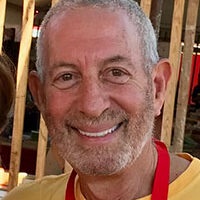
Eric Gordon
Another story was set at the temple’s annual Women’s Auxiliary luncheon held in the lovely garden of one member’s home. Just as the food started coming out, a sudden bank of dark clouds rolled in. “Rabbi, do something!” the hostess pleaded. “Mrs. Rosen,” he replied, “You don’t understand. I’m not management, I’m only in sales.”
As a questioning teenager, I once cornered him, saying, “Rabbi, I don’t believe in God, and I don’t think you do either. So why do we go through all the motions and prayers, holiday after holiday, year after year?” He answered, “The Jewish tradition is old and deep, very rich, and full of important values—justice, truth, compassion—that we’ve committed to passing on to the next generation. What you see is only the vessel in which we carry it.” That satisfied me—and for a brief time I actually thought of becoming a rabbi myself.
Bob introduced me to Erich Fromm’s lucid “You Shall Be As Gods,” a humanistic interpretation of Hebrew Scripture. It influenced me perhaps more than any book I’d ever read. From it I learned, among many other topics, his psychological explanation for circumcision, and I’ve become a vocal opponent of it ever since. (Sometimes I like to joke, “My circumcision was very traumatic: I couldn’t walk or talk for a year!”)
He also introduced me to Jewish Currents magazine, a secular then-monthly out of the Jewish left that is still around, one of the early places I started publishing my reviews and articles.
At college, where I majored in Latin American Studies, I began an extracurricular Hillel course in Yiddish, smatterings of which I heard at home. Later on, my attachment to Yiddish would flourish grandly, but already I sensed that it was the language of the diaspora, of struggle, literature and socialism, as opposed to the Hebrew of the modern Zionist state.
After a brief academic career, I did freelance writing, mostly about culture and art, and then devoted ten years to researching the first biography of a true Jewish humanist composer, Marc Blitzstein (“The Cradle Will Rock”), then collaborated with composer Earl Robinson (“Joe Hill, “Black and White,” “Ballad for Americans”) on his autobiography. Later in life I translated the entire fictional work of Álvaro Cunhal (pen name Manuel Tiago), a Portuguese leftwing, anti-clerical, anti-fascist political leader.
Living in Los Angeles since 1990, I eventually learned that the position was open for Southern California Director of the Workers Circle/Arbeter Ring, a Jewish group (once socialist) oriented toward Yiddish culture. I got the job and resumed my Yiddish language study. For 15 years I was their leader. Being a self-defined secular and “non-Zionist” group, I was happy not to be expected to defend Israel at every turn. In an internally organized “secular yeshiva,” a three-year course led by Hershl Hartman of the Sholem Community, I became a “vegvayzer,” a secular Jewish leader authorized, like ordained clergy, to conduct life cycle ceremonies. I also became a humanist celebrant.
Bob Goldburg had shown me the way toward humanism, and I am forever grateful for his guidance.
We all have our own stories of how we came to be humanists, and we want to hear yours! Fill out the form here to be featured in this series. You can also share your journey and chat with others on the Journeys to Humanism channel on the AHA’s Discord Server.