
Why a Humanist Confirmation?
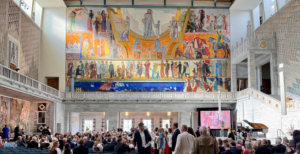
On a recent trip to Norway, I had the unique opportunity to attend a humanist confirmation ceremony at Oslo’s beautiful City Hall. What ceremony, you ask? And why would nonbelievers need to be “confirmed?”
For over 10,000 Norwegians and their families every year, it’s the culmination of a 14 or 15-year-old’s experience in a fairly intensive course that provides knowledge of the philosophy and lifestance of humanism, and dives deeply into key humanist concepts, including critical thinking, ethics, identity and human rights. The course helps participants reflect on their own experiences, choices, values and actions and–through such reflection–strengthen their ability to think independently and act ethically.
While some humanists in the United States engage in similar coming-of-age events–such as those found in Ethical Culture, Unitarian Universalism, and led by some Humanist Celebrants–there is certainly nothing on this scale in terms of quantity or grandeur. Both these qualities were on display the moment I walked into the hall, alongside leaders from Humanists International and our generous hosts at Human-Etisk Forbund (the Norwegian Humanist Association), the same space where the Nobel Peace Prize is awarded annually.
As you can see in the photo of those getting ready to receive their certificates, many choose to wear the traditional Norwegian “bunad,” a centuries-old design featuring elaborately embroidered, hand-sewn fabric and intricate jewelry that adds an element of class, making the event all the more meaningful.
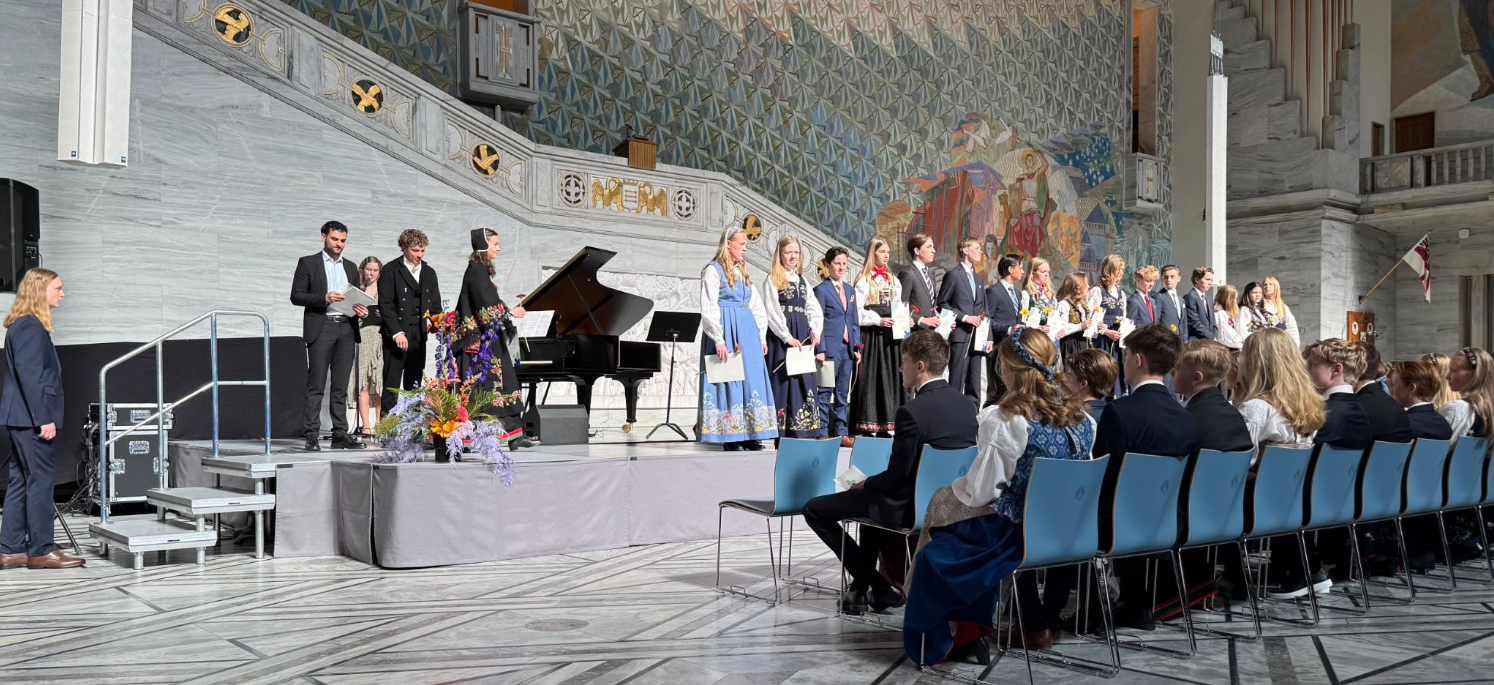
The experience, interspersed with concert-quality music, began with those getting confirmed walking in and taking their place. Then, Pia Sødal Bratterud, who works with Human-Etisk Forbund, welcomed everyone, pointed out that this is the 75th anniversary of this ceremony, and shared that in the first such ceremony in 1951, the following was told to the young people in attendance: “We are happy for you. We think highly of you. You mean something today, you will mean even more in the years to come, and you will eventually mean everything. We have confidence in you. We believe that you will build a better world.”
The main speaker, Marius Loken, explained that confirmation is about entering the ranks of adults, but assured them that even adults are not as adult as you might think. He added, “Dear confirmation candidates, do not set limits for yourself, because you have greater capacity and abilities than you may think. We humans can endure the most incredible things, and if you work hard enough, then results may be achieved.”
The experience was uplifting for all involved and was a delight to see. As Ceremony Advisor Siri Sandberg explains, “Choosing to do a humanist confirmation is often the first conscious and considered decision that teenagers have taken for themselves in this aspect of life.” Carefully considering one’s beliefs and exploring one’s worldview should be an important part of becoming an adult, regardless of one’s beliefs and background. I’d bet that if it were more universal, many more would naturally gravitate toward humanism.
Humanist confirmation is a major cultural milestone in Norway, with more than 20% of all Norwegians choosing the humanist path over the traditional church every year. We’ve got a long way to go to make this opportunity more accessible in the United States, and we should make the effort.
Coming of age is a time of opportunity for those hoping our next generation will be more empathetic, more altruistic and more humanistic than the last, so it behooves us to support the expansion of this kind of education and the appropriate demarcation of a major life transition. Learning reason-based principles and understanding what matters most to us as individuals and as a community can help folks on this path, grounding and centering them in how to leave their unique imprint on the world and what they most need to thrive.