
When Christian Nationalism Becomes Public Policy
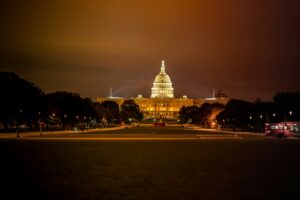 Photo by Heidi Kaden on Unsplash
 One year into President Trump’s second term, a new nationwide survey from the Public Religion Research Institute (PRRI) offers an eye-opening snapshot into the ideological forces shaping American public life. According to the survey, roughly one-third of Americans qualify as either adherents or sympathizers of Christian nationalism, which is the belief that the United States is divinely decreed as a Christian nation and should privilege Christianity in its laws and institutions. Among Republicans, that number rises to a majority: 56%.
While Christian nationalism has long existed on the political margins, PRRI’s data shows how deeply embedded it has become within mainstream governance. Support is strongly correlated with Republican control of state legislatures, favorable views of Donald Trump, authoritarian attitudes, hostility toward immigrants, and, notably, tolerance for political violence. Christian nationalism adherents are more than twice as likely as skeptics to agree that “true American patriots may have to resort to violence.”
This is not simply a matter of private belief. It is a worldview with concrete consequences.
Christian nationalism differs from personal religiosity. Many Americans are devout without endorsing the idea that the government should enforce a particular religious identity. PRRI’s research draws that distinction clearly: while Americans overall reject Christian nationalism by a two-to-one margin, it remains dominant among white evangelical Protestants and increasingly influential within conservative political infrastructure.
What makes this moment particularly dangerous is the way Christian nationalist rhetoric has migrated from campaign slogans into public institutions, including schools, courts, and legislatures.
Across the country, debates over education have become one of the clearest battlegrounds. From curriculum restrictions to book bans to efforts to frame academic accountability as “religious discrimination,” Christian nationalist arguments increasingly position secular standards as hostile acts. In this framework, neutrality is rebranded as oppression, and pluralism is cast as moral decay.
PRRI’s findings help explain why these conflicts feel so relentless. States with the highest levels of Christian nationalist support, including Arkansas, Mississippi, West Virginia, Oklahoma, and Wyoming, are also states where lawmakers have pursued aggressive policies targeting gender identity, racial education, and church-state separation. The alignment is not coincidental. As PRRI CEO Melissa Deckman notes, Christian nationalist ideology is strongly associated with legislative environments primed to pass policies endorsed by its leaders.
Education is particularly vulnerable because it represents a shared civic space. Public schools and universities are tasked with serving students of all beliefs, religious and nonreligious alike, using evidence-based curricula. Christian nationalism challenges this premise directly, insisting that Christianity deserves special authority within public life.
The result is a growing tension between belief and governance.
Recent controversies in higher education show this. In multiple cases, students and political organizations have framed enforcement of academic standards as ideological hostility, particularly when coursework engages topics like gender, race, or sexuality. These disputes are rarely about silencing belief; they are about resisting secular frameworks that do not privilege one religious worldview over others.
This strategy mirrors a broader pattern identified in PRRI’s research: Christian nationalism adherents are significantly more likely to hold authoritarian views, distrust democratic institutions, and support extreme measures, from mass deportations without due process to criminalizing mandatory childhood vaccinations. These positions reflect a desire for moral certainty enforced by state power, rather than negotiated through democratic pluralism.
Humanism offers a fundamentally different vision.
Humanism affirms that ethical societies are built through reason, empathy, and shared responsibility, not religious dominance. It insists that government neutrality toward religion is not anti-faith, but pro-freedom. When no single belief system controls public institutions, individuals are free to practice, question, or reject religion without coercion.
PRRI’s data underscores why this distinction matters. While white Christians who attend religious services frequently are more likely to support Christian nationalism, religious Americans of color and the religiously unaffiliated overwhelmingly reject it. Christian nationalism is not synonymous with faith; it is a political project rooted in power, identity, and exclusion.
That project poses a direct challenge to pluralistic democracy.
When Christian nationalism frames itself as patriotism, dissent becomes disloyalty. When it frames itself as religious freedom, accountability becomes persecution. And when it frames itself as a moral order, democracy becomes conditional.
The danger is not that Americans are religious. It is that religion is being weaponized to justify inequality and erode democratic norms.
PRRI’s findings should serve as a warning and a call to action. If one-third of Americans are willing to accept a vision of the nation that privileges one faith, condones authoritarian leadership, and tolerates political violence, then the defense of secular democracy cannot be passive. It must be explicit, principled, and grounded in shared human values.
Public institutions, especially schools, must remain spaces where evidence matters, where diversity is not a threat, and where no belief system is entitled to special treatment. That commitment is not hostile to religion. It is the foundation of freedom in a society where belief is truly voluntary.
Christian nationalism asks who belongs. Humanism answers: everyone, and equally.