
Is Anybody Out There? Does Anybody Care?
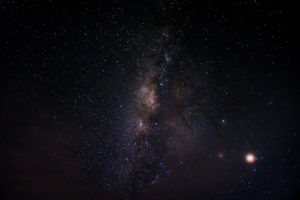
Perhaps I’m over-thinking this (you might argue under-thinking?), but in terms of first contact, why would any interstellar species be that interested in Earth or any of us?
Sure, we like our planet a lot, so much so that we’re destroying the environment and each other through countless historic and present-day wars, mini and micro aggressions. Though our flowers do smell pretty and the California coast is stunningly beautiful. And don’t get me started on the pastrami at Katz’s Deli in Manhattan.
But what’s so special about this ball of rock we call home? It exists in a sleepy backwater area of the cosmos without any truly discernable value. And with no cosmic neighbors that would make our solar system look appealing, this part of the galaxy is just a dead end. Perhaps visiting would be rather senseless and even a waste of time?
Certainly, the figures are impressive – there are 200 billion stars in our galaxy, of which our sun is just one. Now consider that, of these, our scientists have found just 3,200 stars with planets – not because we’re done looking, but because the distance of our galaxy is so vast we’ve only scratched the surface of what might be out there.
It’s like going to the beach with a Dixie cup, putting the cup in the water and then looking at the full contents while declaring, “We’ve not found ANY beluga whales in our sample.”
Personally, I think any well-developed alien that could manipulate space-time and ride through the multi-verse in ships we cannot even conceive would be really bored by our world.
I mean, for us the Earth is special, but for the aliens, I think it would be like visiting Kentucky.
Sure, I know Louisville is very nice, but even we humans aren’t really visiting the state in huge numbers during our vacations. Plus, Kentucky has the onerous distinction of being the state home of The Creation Museum.
Perhaps Earth is the Kentucky of the galaxy, or even the cosmos? Small, indistinguishable, boring and filled with a semi-conscious species of ape who terrorizes their neighbor?
In the wonderful 1991 Albert Brooks film, “Defending Your Life,” deceased humans go to a place called Judgement City, where they need to defend their lives on earth before “moving on.”
One character comically notes that humans only use about 3-5% of their brains, and that once you use more than that, there’s lots more interesting places to explore other than Earth.
So, if you have an alien species that uses their brain in ways we cannot comprehend, has moved past the self-harm stage of their social evolution (something we have not), and travels in machines that we could not understand, then coming to Earth I think would be very disappointing and depressing. Really, not on anyone’s “to-do” list.
What could we teach these aliens? Very little, I assume, given the complexity of knowledge and technology that they would have would dwarf our own understanding.
If a higher-order ET came here to observe us, and not help us usher in a new age, then we’re probably viewed by them the same way we view Neanderthals or possibly australopithecines. With amazement but feelings of, “thank goodness I’m here now and don’t live amongst these barely comprehensible monkeys.” Or in an ego-crushing scenario, they may see us as having the brain power of beetles or starfish.
I don’t think any alien species would come here to deliberately destroy humans. It would be too easy, and we simply couldn’t put up much of a fight. Plus, they wouldn’t get much in return given our planet’s resources aren’t that special nor on any level remarkable.
More likely, if we were visited, they’d kill us off with interstellar viruses. The way the Pilgrims killed off the native populations. An unanticipated holocaust caused by the mere fact that native people had no immunity to the diseases carried over by the Europeans when they arrived to plunder The New World.
Finally, I’m not sure what benefit an altruistic alien species would gain by helping modern humans. Even in the best case, it would be like training great apes to use sign language. Yes, we’d be able to somewhat communicate, but at best it would be how a toddler speaks to and understands an adult.
All the training and energy is laid at the feet of the grown up, and the baby would need to be focused to absorb the knowledge for themselves to grow into a functioning adult.
Maybe some of us humans are ready, but the rest of us, (just look at our politics), are pretty gleeful to remain in the 3-5% brain use zone. Of course, all this speculation on my part, given my anthropological vigor in researching first-contact outcomes, are biased and not fully formed. Clearly, even as I edit this, I must admit that I may be missing some objectivity.
After all, Carl Sagan, Stephen Hawking and Gene Roddenberry, each great science authors and science-fiction thinkers, had divergent views about first contact. Their views saw either ensuing calamities or optimistic positivity that would come from such a historical moment in our human history. But even their speculation is more opinion and theoretical than actually based on any data.
However, given our physical place in the vastness of the cosmos, we may be looking at the ultimate Venn diagram of cosmic loneliness, combining unobjective ignorance, inflated self-importance and critical self-deception. Therefore, we may be safe from ever being fully able to answer the question of, “is there life out there?”
If there are species flying by, they may be skipping our Kentucky-fried Earth and heading to more interesting and greener pastures in Alpha Centauri. To planets more worthy of their time and attention.
Of course, I could be wrong and in that case places like the frequently speculated and conspiracy-rich Area 51 might tell us things some of us may not be ready to comprehend or wish to know about.
But if alien species are out there and hear our plea to communication and connect, it looks like we’re being ghosted. Whether it’s SETI or METI, or some other group or organization that makes first contact, I’d really like to know what these interstellar beings think of us and if they conclude our species is worth the time or has potential to be better.