
The Last Chapter Isn’t Over: The Value of Storytelling in Caring for Our Elders
“People need a function, he believes. And he has always been functional, no one can take that away from him.”
— Fredrik Backman, A Man Called Ove
Fredrik Backman’s “A Man Called Ove” follows a protagonist who has lost his wife and has hardened into a bitter and solitary figure, a curmudgeonly presence in his neighborhood. His character is reminiscent of Scrooge in Charles Dickens’s “A Christmas Carol,” described as “hard as flint.” Yet Backman’s novel slowly reveals that Ove was not always this way. Moving between past and present, the story offers glimpses of the man he once was, the version of Ove who seems to have disappeared alongside his wife. In remembering Sonja, we learn that after her cancer diagnosis she “found it easier to forgive than Ove did. Forgive God and the universe for everything.” Ove, by contrast, felt that “someone needed to remain angry on her behalf.”
As we read, we come to realize that his seemingly petty frustrations, his arguments with council representatives and “the men in white shirts,” even his gripes about modern-day computers and espresso machines, are only the anger and bitterness that stem from a deeper well of grief, which in turn stems from love: “everything that was evil seemed to assail the only person he’d ever met who didn’t deserve it.”
“A Man Called Ove” isn’t the only widely-loved novel in the English-speaking world that, over the last few years, has placed an elderly character at its center. These stories are not filtered through wise mentors dispensing epigrams from armchairs, nor are their characters depicted as the stereotypical softened grandparents who exist mainly to bless or guide the young. Instead, these are protagonists who can be just as complicated, difficult, and stubborn as any other. They grieve, they complain, they contemplate to what extent life is even worth the bother of living and go on character-developing journeys.
Annie Lyons’s “The Brilliant Life of Eudora Honeysett” follows a woman who has decided that she is ready to embrace death. Clare Pooley’s “How to Age Disgracefully,” Anna Johnston’s “The Borrowed Life of Frederick Fife,” and Peter de Smet’s “The Secret Diary of Hendrik Groen” all tell stories of an elder who, in some way or another, has slipped through the cracks of a culture that has stopped looking their way, even though they have a lot of burning brightly left to do.
These novels spotlight the loneliness that emerges as a result of the gradual, culturally normalized rejection of our elders. The knots of their lives cannot be undone by any medical intervention that seeks to return them to society as “functional” as before. Rather, their character development is sparked interpersonally through the relationships they form with other people.
However, many of our elders in the real world feel invisible, and the body seems to know when it is no longer being reached for. We now know that pain increases, mental and physical decline intensifies, and risk of heart-related illness rises with loneliness. The way we erase our elders is a collective illness, and the cure is not a prescription but living, breathing, equally complicated, often inconveniently persistent people who keep taking an interest, showing up, and showing their love.
These novels are selling in the millions, and perhaps it’s because they’re striking a nerve that Western culture has been trying not to touch. Their popularity speaks to a cultural absence that even the young can sense, one that emerges when growing old becomes something to look away from rather than embrace. The characters they introduce us to are not easy to love at first, but as we let them in, they are hard to shake. Their stories are stories for which we have, collectively, been yearning.
In the Corridor
There is a particular quality of light in long-term care facilities that anyone who has spent time in them will recognize. It is fluorescent and flat, and it illuminates without warming, flooding a room in a way that makes that room feel hard to enter, let alone inhabit. The corridors are wide enough for two wheelchairs to pass, and the televisions play to rooms of people with blank expressions, who haven’t chosen the channel. The architecture is efficient, clean, and functional, a built environment that communicates to the people within it that their primary relationship is no longer with the world but with the management of their own decline.
Not all care homes are this way. Often, there is a team of carers who take their title seriously enough to remain playful, contending with the cold light with their own warm presence. And some care homes are more welcoming and inventive, run by people whose imaginations extend far beyond the clinical. Still, enough care homes have such a particular cold and sterile quality that they have become a kind of cultural shorthand for what we would rather not think about. They typify the way we treat the people we have decided are no longer functional or useful enough to maintain a capitalistic idea of societal progress.
The kind of loneliness to which we commit our elders is that of a slow dissolution of personhood, delivered through the steady drip of indifference. Down these long corridors, there are people who are still willing to tell their stories. We just need to tune in and listen, to recognize the value of hearing these stories to both the storytellers and to ourselves.
Dr. Noelle: I often tell my medical students, “If you can’t tell me the patient’s story, don’t tell me anything else.” The differential could be brilliant, but the starting point is the person.
I care for about nine hundred and fifty patients now, and more than three hundred and fifty of them over sixty-five. Many family physicians are running seven-minute appointments, and I understand the immense systemic pressure. That system, however, doesn’t make space for the reality that you cannot know a person in seven minutes, nor hear about their long-lived life, nor acknowledge the reasons why they want to continue to live.
I am drawn to elder care, and I stay there, because the work is complex and the stories are wonderful.
What We Stand to Lose
Caring well for our oldest members is not charity. To view it as such is to construct a misaligned ethic of care that relies on their dehumanization. If we think of our elders as people we have to manage in the same way we think of running errands or doing chores, we are also underestimating the extent to which care is an interpersonal, human exchange.
Caring for our elders can be difficult, that much is true. It is tiresome, often unglamorous work, and it puts us in the position of having to contend with our own aging and mortality, which, in Western culture at least, we are accustomed to veering away from in fear. Yet caring for our elders is fulfilling and meaningful too, in its own right. It is essential to our collective wellbeing, yet we have cut through it with corridors instead of nourishing it in our communities. It is also a way to treat our fears of aging with care, which is, by extension, a way to care for ourselves too.
Isolation and ageism erode individual dignity, just as they erode social cohesion. When elders are sidelined, we lose their company, their wisdom, their famous recipes for pineapple pudding, their accounts of historical events filtered through the eyes of a teenager who loved basketball. We lose their slow-gathered wisdom, their insights about love and forgiveness and regret that took seventy or eighty years to acquire. Elders hold intergenerational memory and keep us together just as the roots of old trees hold soil.
We live in a culture that rushes past older people, that doesn’t bother to look them in the eye. As a result, we risk leaving them feeling unseen and burdensome in the very communities they’ve helped to build. Yet, when we slow down enough to hear their stories, when we let ourselves sit in the company of someone whose pace is different from our own, we are reminded that aging is not a problem to solve but a stage of life to accompany, and that the accompaniment can become a core part of our own wellbeing, our own stories, too.
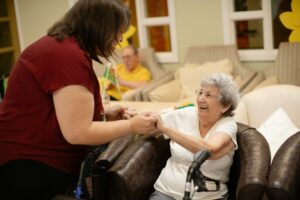
Lesley: My own path to elder care did not begin there. I am a high school English teacher and a chaplain, and both jobs are, at bottom, the same work: listening carefully to how people make sense of their lives. During my Clinical Pastoral Education rotations, I was placed in senior care homes, and those placements rearranged me. I remember standing in one of those corridors for the first time, the light flat and fluorescent, and feeling the call to continue this work. This is the impulse that I believe many of us feel, to care for our elders, even if it is an impulse we culturally try to get away from.
What I have learned since is that care in these spaces is built through gestures so small but so necessary that they can hold a person’s world together. Playing a veteran’s favourite song while he closes his eyes and finds himself, for the length of a verse, back in another decade entirely, for instance, or wiping food from someone’s chin the way you would help touch up your friend’s lipstick over lunch. Sometimes, care is in answering the same question for the fourth time in ten minutes for a person living with dementia, with the same warmth you brought to the first, knowing that, for them, it is the first time they’ve asked it. There is an unusual magic to be found in hearing stories that don’t follow a linear path, in letting them unspool as they will, and making time for all their nuances. Equally, there is joy to be found in the slowing down demanded by pushing a wheelchair down a forest path while someone tilts their head back and breathes in the particular sweetness of pine they’ve known since childhood.
When I’m not caring but teaching, in my classroom, I screen Edie, a film about an eighty-year-old woman who undertakes a climbing expedition in the Scottish Highlands after a lifetime of being told she cannot, and I watch my students’ assumptions about aging come undone. For a time, I brought students to a local care home each week, to make art alongside residents, mostly using watercolours. With paper strewn everywhere, paint on the tables, and occasionally someone’s elbow in someone else’s water cup, that program grew into a monthly gathering where teenagers and seniors now crowd around Rummikub tiles and share stories.
One of my students began visiting a particular resident each week after the program ended. The man had lost both his wife and his child. My student came just to play poker or to talk. That was all. My student just wanted to be there.
That exchange, to me, captures the spiritual and communal ache so many of us must feel to return ourselves to our elders, and to bring them back to us. This is the empathy that fuels the spirit, the way to find the widened perspective that, when we’re young, can help keep us tethered to the joy of our own lives.
Closing the Gaps
The gaps in elder healthcare reveal what our medical system believes about the value of an older life. Long wait times for specialist referrals mean that a patient whose condition is worsening must sit with that worsening, sometimes for months, suspended from the world rather than being welcomed back into it. Ageism in medical systems tends to manifest in this de-prioritization, the unspoken assumption that more urgent medical attention belongs exclusively to the young, whose lives are, as the implication goes, more “worth living.” Rushed appointments strip patients of the time they need to formulate their concerns, to find the right words, to ask the questions they’ve been saving up since the last visit.
These are administrative inconveniences, yes, but more than that, they are failures of imagination, rooted in an untrained ability to see the person sitting in the chair as someone with eighty years of context that a chart could never capture. These gaps can leave a person feeling that they are being processed rather than accompanied in their old age. While restructuring an entire healthcare system may not be possible overnight, we take one step toward a new way of being in relation to our elders with every moment that clinicians slow down, every time a carer decides to stay and listen, and every decision friends and family make to drive the long way home to pay a visit.
Dr. Noelle: I teach my students principles that aren’t emphasized enough in our teaching, principles like being conscious of how you might accidentally dismiss an older patient, making sure they can hear you clearly before you begin, and speaking directly to them, not exclusively to the family member in the chair beside them. Learn who they are, even when they have a hard time telling you, even if it means asking again or by just observing the way they carry themselves and the way they interact. Give them the time to talk, even when the clinic is running behind, so that you can get to know who they are beyond the patient in the chair or bed. Even the curmudgeons, and I say that with real affection, are usually lonely underneath the bluster. Spend enough time, show enough patience, and the crankiness pulls back. What’s underneath, nearly every time, is a person who, just like you or me, only wants to be seen, heard, and known.
Lesley: Years ago, I spent a summer at the Yiddish Book Center in Massachusetts, one of thirteen teachers selected to study texts translated from Yiddish under the guidance of Aaron Lansky, a man who has dedicated his life to rescuing Yiddish books from basements, dumpsters, and the edge of oblivion. Lansky understood that when a language disappears, it takes with it an entire way of seeing the world, a treasury of jokes and prayers and lullabies and arguments that cannot be reconstructed once the last person who held them is gone.
The gaps in our systems of care are also failures of preservation. Everyone contains an archive of stories, and that archive is extensive come old age. Stories are what linger after our elders are gone, but only if we listen while we still can.
Dr. Noelle: The moments that stay with me after I’ve closed the chart aren’t registered clinically, but they register humanly and stay with me: when a patient’s partner gives me a gift to remember them by, or when a patient anticipating his 100th birthday knows exactly what cake he wants for the occasion. I know that for the rest of my life, the dates marked on my calendar, their important dates, will be the days I think of them.
The standard I hold myself to is simple enough: I care for my patients the way I hope another doctor will care for my own parents, as the people I know them to be. The medicine we prescribe must follow from the relationship, not the other way round.
The Last Chapter
In the epilogue of “A Man Called Ove,” Ove has been re-oriented toward the world, somewhat grudgingly and against his will, by the neighbours who refuse to stop needing him. He fixes their joists, teaches their children, and all the while, grumbles about their incompetence. Yet, they learn to love him anyway, and, as he stands beside Sonja’s grave, he admits that “Sometimes it can be quite nice having something to get on with in the daytime.”
In its own stubborn, understated way, this is Ove’s declaration of a return to life because he has found that, to many people, he still matters. For his funeral, although he has asked for no ceremony, no fuss, three hundred people show up, holding candles. They come not because Ove was easy to love but because he was lovable nonetheless, because he has been present in their lives, and they in his, and that mutual presence had impacted them all.
Elder care is not simply a way of managing illness, extending life, or even prolonging death. Rather, it is a way to stay with people through the final chapters of their story, in community and with curiosity and care. The gaps in our healthcare systems stem from a culture that has forgotten the value of stories, how they bind us to one another and encourage us to live more widely and vulnerably. When we fail to hear these stories, not only do we let our elders down, but we also impoverish ourselves, cutting away at the intergenerational memory and communal wisdom that will become our stories too, in the end.
This is an invitation to think of who we are beyond our individuality and toward our communities. The way forward asks us to slow down, to sit with people whose pace is different from our own, to choose patience over efficiency. Clinicians must begin to see patients before diagnoses, and communities must see neighbors before burdens.
The elders in our care homes, our clinics, are staring blankly at the TV screens and feeling lonely. Yet, they are poised to teach us so much about the value of sitting down, staying a while, and asking the question that every human being deserves to be asked for as long as they live:
What’s your story?